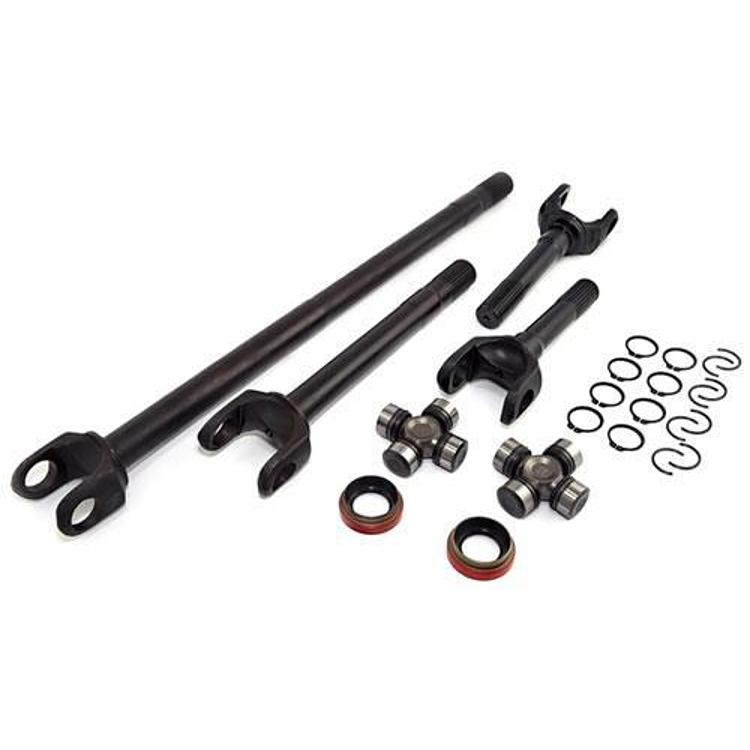
Chromoly vs stock Dana 44 shafts comes down to load: stock shafts last with open differentials and moderate tires, while a locker or 37-inch tires justify 4340 chromoly. Yukon Gear & Axle 4340 chromoly is rated about 39 percent stronger in twist than 1040 steel, and it helps most at the front U-joint ears.
Key takeaways
- Steel: Yukon 4340 chromoly shafts are rated about 39 percent stronger than 1040 steel, and 1541H about 20 to 25 percent, though a well-made 1541H shaft can come close to 4340 in twist. All three carry roughly 0.40 percent carbon, so alloying and heat treatment make the difference.
- Front or rear: 4340 belongs on front shafts first. They carry torque with little bending, and through-hardening reaches the U-joint ears. A semi-float rear shaft also bends, which favors induction-hardened 1541H.
- Splines: shaft diameter sets strength, and spline count must match the carrier. Going from a 1.31-inch 30-spline shaft to a 1.50-inch 35-spline shaft adds about 50 percent twist capacity.
- Locker effect: a locker lets one shaft carry the whole axle load when the other tire unloads. That is the point where stock shafts start to break.
- The fuse moves: a stronger shaft sends the next overload to the U-joint, the carrier, the ring gear or the tube.
What is the difference between chromoly and stock axle shafts?
Stock axle shafts are usually plain medium-carbon steel with a hardened outer layer, while chromoly shafts use an alloy steel heat treated all the way through. Both have about the same carbon, so the extra twist strength comes from the alloying elements and the heat treatment, not from more carbon.
The steel numbers tell the story. In the SAE steel numbering system, the last two digits give the carbon content in hundredths of a percent, so 1040, 1541 and 4340 all hold about 0.40 percent carbon. The first two digits name the alloy family: 10xx is plain carbon, 15xx is carbon steel with extra manganese, 41xx is chromium-molybdenum and 43xx is nickel-chromium-molybdenum.
“Chromoly” is the trade name, and it is loose. True chrome-moly is 4140. AISI 4340 adds 1.65 to 2.00 percent nickel to 0.70 to 0.90 percent chromium and 0.20 to 0.30 percent molybdenum, and that alloy content lets it harden deeply and evenly. G2 Axle & Gear sells the same family under the name “chromalloy”: its G2 Dana 30/44 chromalloy outer axle shaft 97-2031-001 is one example.
| Steel | Type | Usual heat treatment | Strength vs 1040 | Where it fits |
|---|---|---|---|---|
| 1039 / 1040 | Plain carbon | Induction hardened | Baseline | Factory shafts with press-on bearings |
| 1050 | Plain carbon, more carbon | Induction hardened | About 18% more | C-clip and factory-replacement rear shafts |
| 1541H | Carbon with 1.35 to 1.65% manganese | Deep induction hardening | About 20 to 25% more | Semi-float rear shafts, heavy-duty replacements |
| 4140 | Chromium-molybdenum | Through-hardened | About 27% more | High-twist shafts with limited bending |
| 4340 | Nickel-chromium-molybdenum | Through-hardened | About 39% more | Front inner and outer shafts, full-float shafts |
Those percentages are Yukon Gear & Axle’s ratings for twist strength, and the steel grade alone does not settle the question. Dutchman Motorsports induction-hardened 1541-H shafts are rated 25 to 30 percent stronger than stock 1039 at the same length and spline count, and a properly made 1541-H shaft can nearly match through-hardened 4340 in torsion. Most factory shafts are 1039 with press-on bearings or 1050 with C-clips, and factory Dana 60 shafts are generally induction-hardened 1541H.
One thing chromoly never changes is stiffness. Nearly all steels share the same shear modulus, so a 4340 shaft twists the same amount per foot-pound as a 1040 shaft of the same size. The alloy raises the torque at which that twist stops springing back and becomes permanent, and it raises fatigue life.
How do induction hardening and through-hardening change a shaft?
Induction hardening gives a shaft a very hard skin over a softer, ductile core. Through-hardening gives the whole cross section the same moderate hardness. The first resists wear and bending fatigue well, the second carries more twist and treats the whole part, ears included.
- Induction hardening: an electric coil heats the outer layer, which is then quenched. Most factory 1039 shafts have a case depth of 0.125 to 0.150 inch at 50 to 54 on the Rockwell C hardness scale (HRC). Dutchman’s 1541-H shafts reach about 0.300 inch and 56 to 59 HRC.
- Through-hardening: the whole bar is heated in a furnace, quenched and tempered. A through-hardened shaft typically measures 46 to 48 HRC. That is softer on the surface than an induction-hardened shaft but stronger at the center.
- The case depth matters: twisting stress rises from zero at the center to a maximum at the surface, so the hard case sits where the stress is highest. Fatigue cracks tend to start at the boundary between case and core, and a deeper case moves that boundary inward to lower stress.
This is why front shafts lean toward chromoly. U-joint ears need heat treatment for strength, induction hardening them is not practical, and through-hardening treats the ears as thoroughly as the shaft. Replacement shafts in induction-hardened steel are still common and proper for stock-level use: the Alloy USA front 27-spline outer axle shaft 10104 is heat treated and induction hardened in 1541H or 4140 steel, depending on application.
Do more splines make a stronger Dana 44 axle shaft?
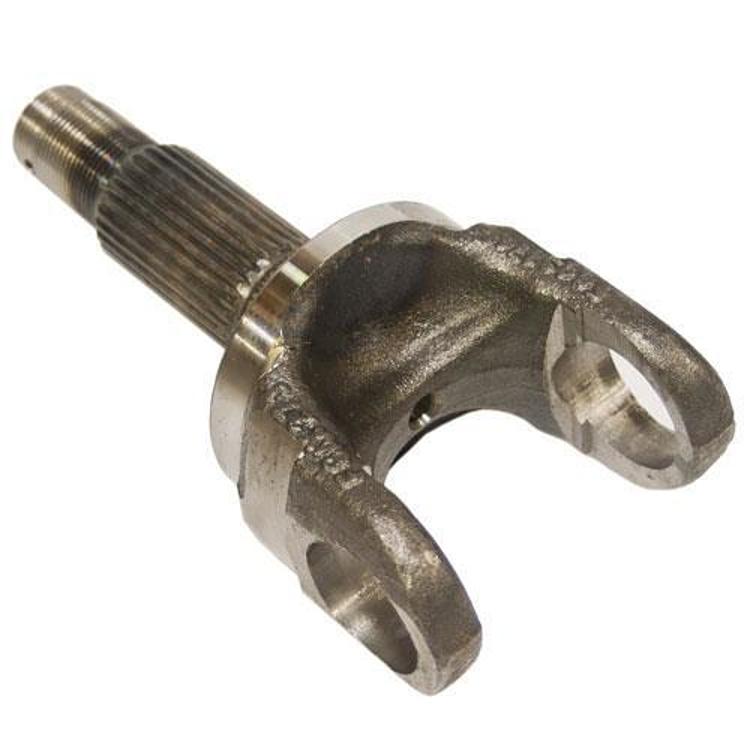
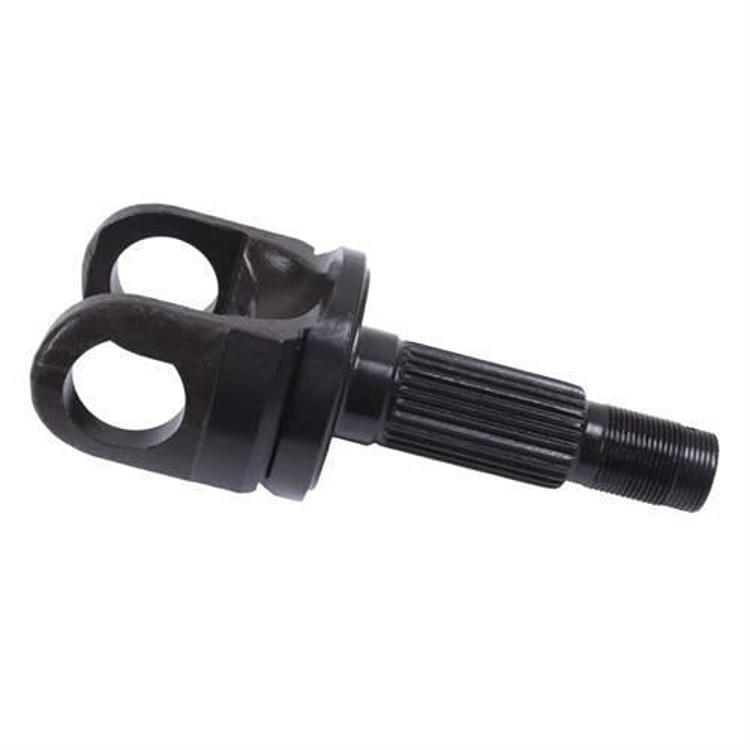
Only when more splines come with a larger diameter or a shallower tooth. A shaft’s twist capacity rises with the cube of its smallest diameter, so diameter drives strength and spline count mainly sets how much steel remains under the teeth. Spline count must also match the carrier.
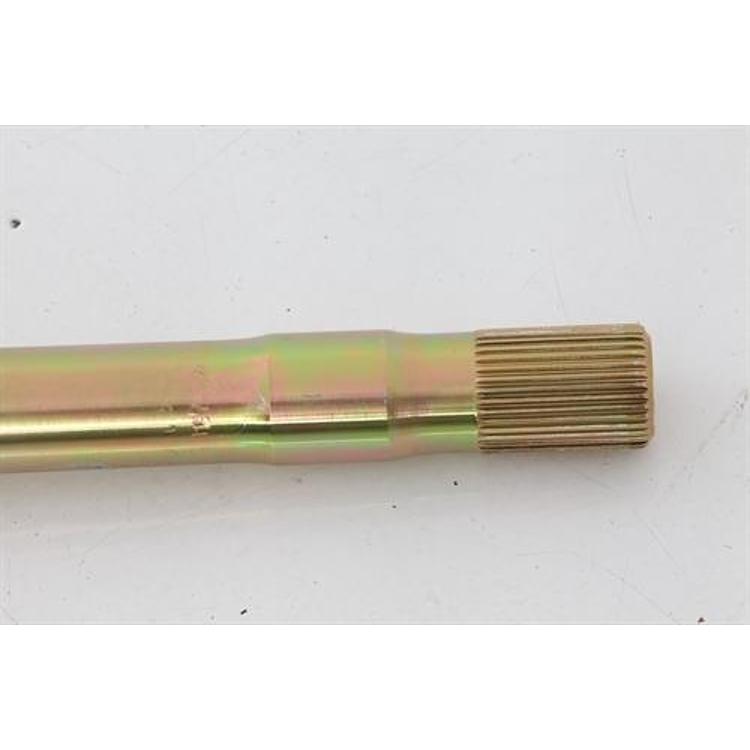
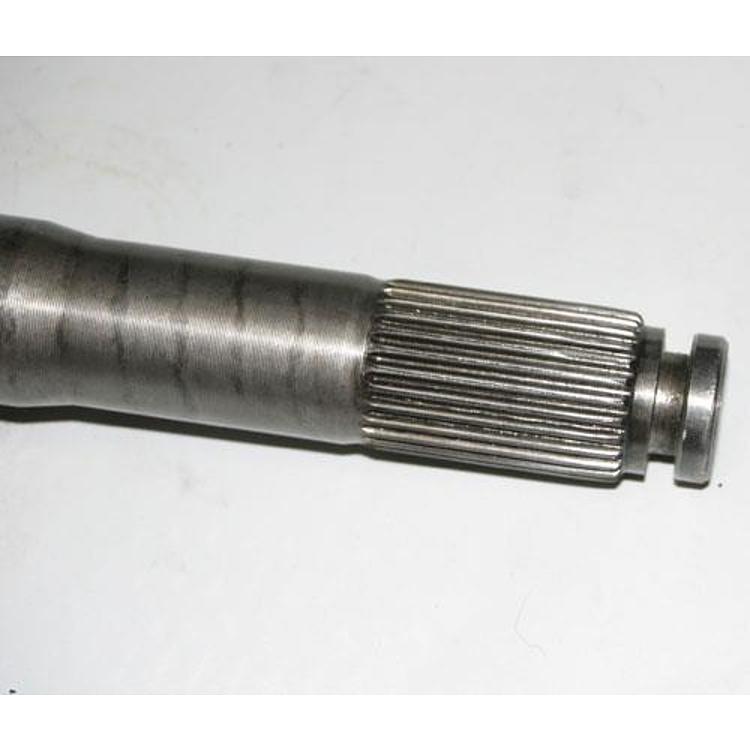
A spline is a machined tooth that locks the shaft to the differential carrier or the hub. The smallest diameter of the shaft is usually at the bottom of those teeth, called the root. Fine teeth cut shallower than coarse teeth, which leaves a thicker root on the same outside diameter.
| Splines | Where you find it | Outside diameter | Twist capacity vs 30-spline |
|---|---|---|---|
| 19 | Older Dana 44 front outer shafts; older Dana 44 rear shafts | 1.175 in front outer; 1.30 in rear | About 0.7x for the front outer; under 1.0x for the rear, with coarse teeth |
| 27 | Dana 30 inners and outers, later Dana 30/44 outer shafts, Dana 35 rear | About 1.18 in | About 0.75x |
| 30 | Dana 44 front inner and rear | 1.31 in | 1.0x (reference) |
| 32 | JK Rubicon Dana 44 8.9-inch rear | 1.41 in | About 1.25x |
| 35 | Dana 60; aftermarket Dana 44 | 1.50 in | About 1.5x |
The right column applies the diameter-cubed rule to the outside diameter, so treat it as a guide to relative twist capacity and not a rating. A 27-spline shaft such as the Dana Spicer Dana 35 rear axle shaft 73624-1X measures 1.18 inches. The full Dana 44 and Dana 60 specifications list the other sizes.
Ratings for the whole axle follow the same order. Dana’s maximum momentary output torque is 3,460 ft-lbs for a low-pinion 30-spline Dana 44, 4,170 ft-lbs for a high-pinion 30-spline Dana 44 and 5,340 ft-lbs for the low-pinion 8.9-inch 32-spline rear. Those are axle ratings, not shaft ratings.
- 19-spline outers: the 1971-1991 Wagoneer and Grand Wagoneer take the Alloy USA Dana 44 outer axle shaft 10127 at 19 splines and 9.94 inches. The G2 Dana 44 chromalloy outer axle shaft 97-2033-002 is another 19-spline stub, at 9.92 inches.
- 27-spline outers: the G2 Dana 30/44 chromalloy outer axle shaft 97-2032-001 runs 8.72 inches for standard Dana 30 and Dana 44 fronts. The 6-inch style, such as the Dana Spicer 43205 outer shaft, fits later Dana 30 and Dana 44 fronts.
- 33- and 35-spline rears: the G2 Dana 44 YJ/XJ/TJ 33-spline rear axle kit and the Alloy USA Dana 44 35-spline chromoly rear axle kit 12137 need a matching 33- or 35-spline aftermarket differential.
Inner shaft, outer shaft or U-joint: what fails first?
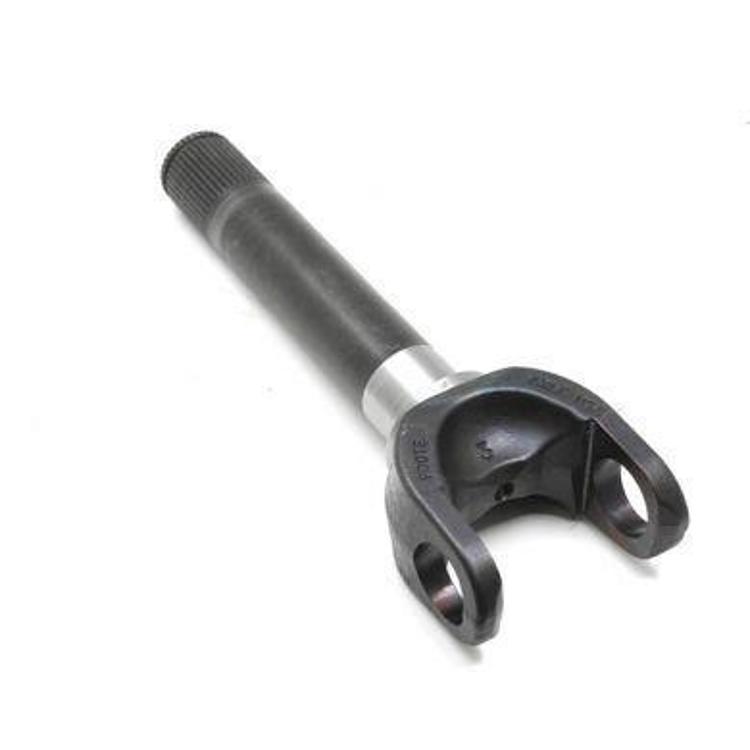
On a front Dana 30 or Dana 44 the U-joint and the outer shaft ears usually fail before the long inner shaft. The joint runs at a steep angle in tight turns, and the ears can spread under load. Inner shafts break less often, usually at the splines where they enter the carrier.
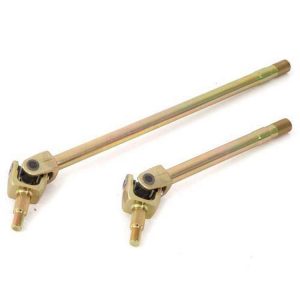
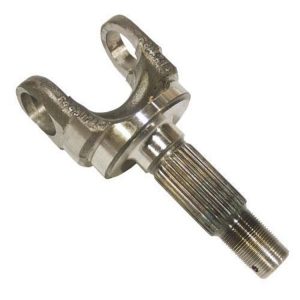
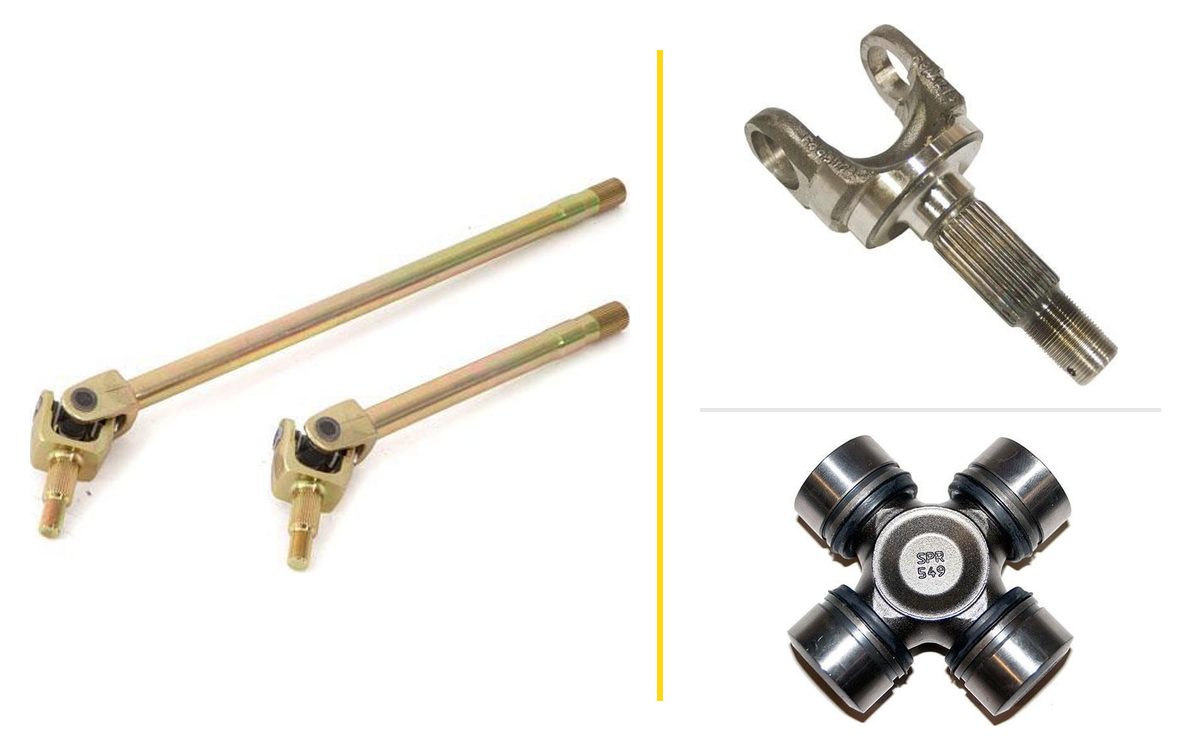
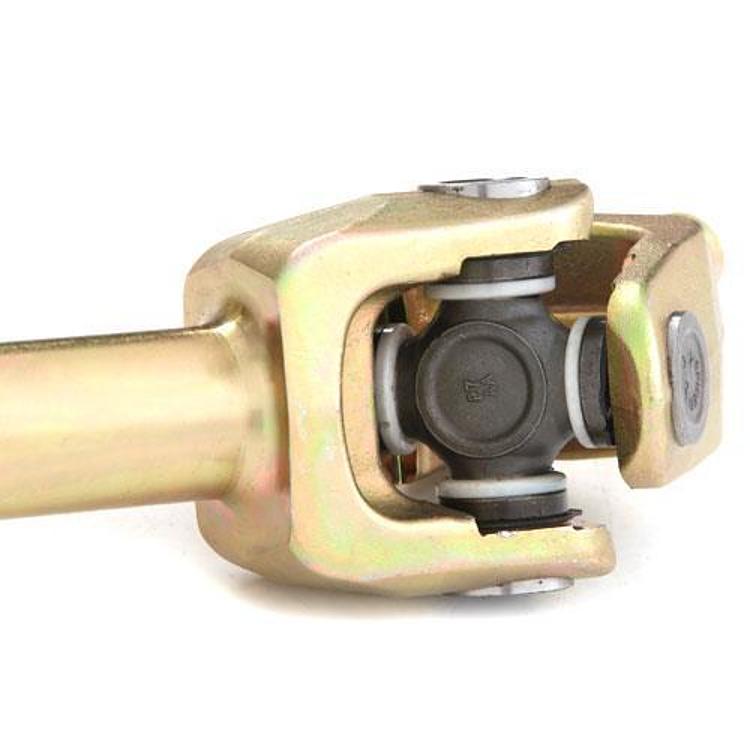
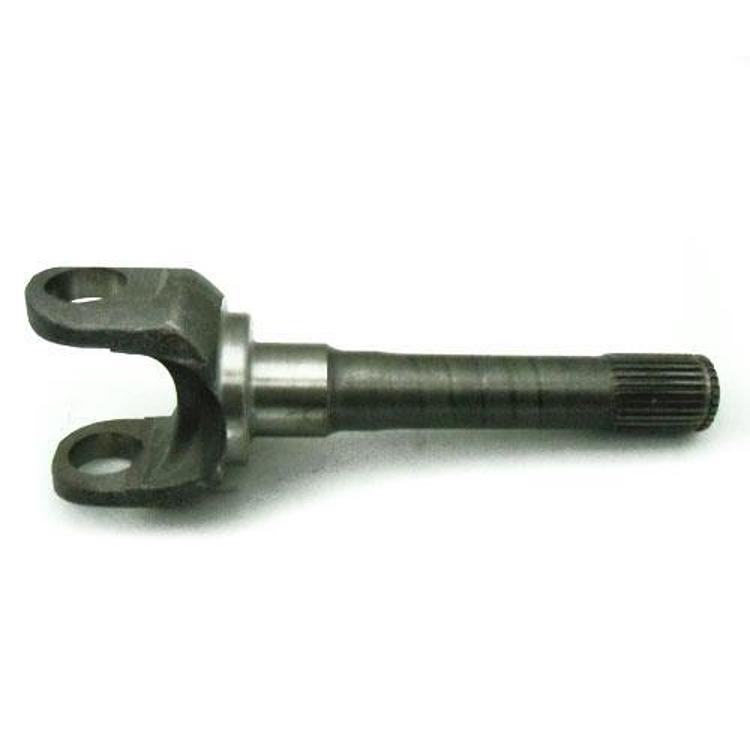
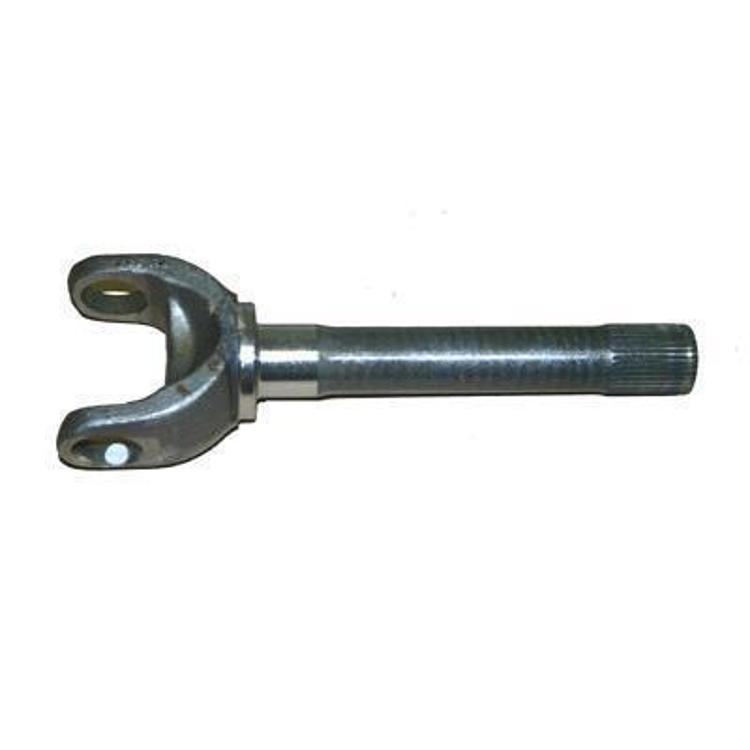
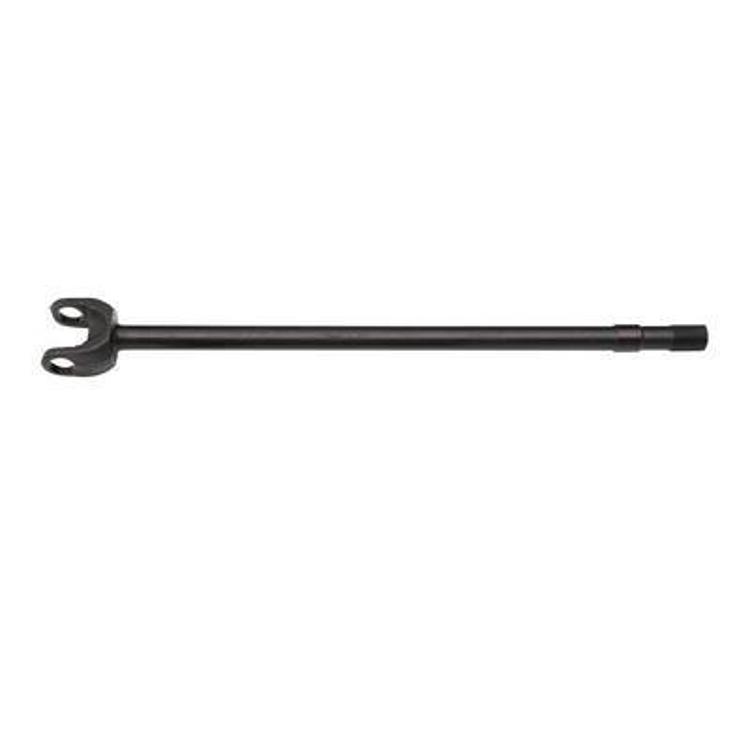
A solid front axle shaft has two pieces joined by a universal joint, or U-joint, so the wheel can steer. The inner shaft runs from the differential to the knuckle. The outer shaft, or stub, runs from the U-joint through the wheel bearing to the hub. Its forked end is the yoke, and the two arms of the fork are the ears.
| Failure point | What you see | Usual cause | What to change |
|---|---|---|---|
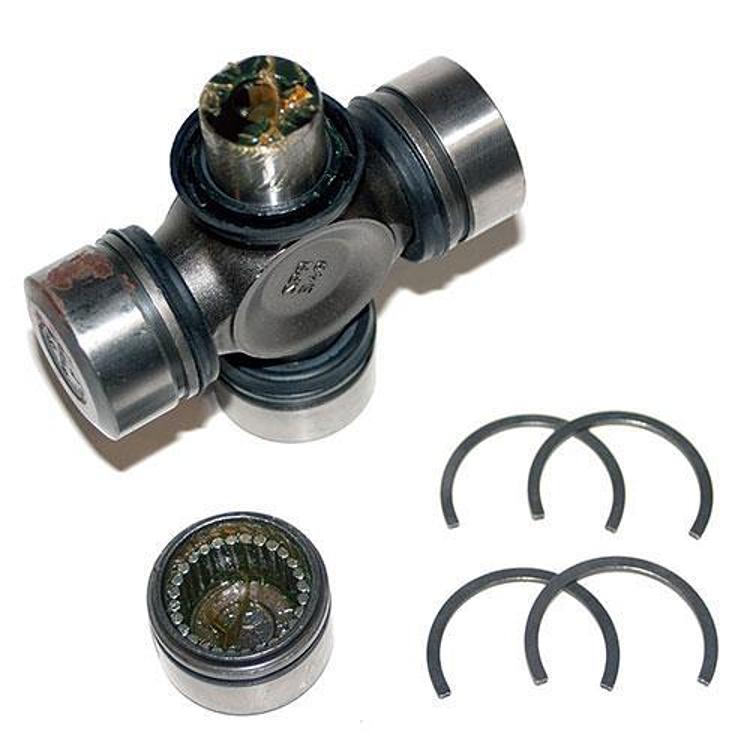
| U-joint | Snapped cross, scattered needles, cap out of the ear | Throttle at full lock, worn joint, shock load | New joint; full-circle clips and a stronger joint on hard use |
| Outer shaft ears | Oval cap bores, spread or cracked ears | Joint load beyond what the ears can hold | 4340 outer shafts |
| Outer splines or thread | Twisted splines at the hub, stripped axle nut thread | Torque spike, loose axle nut | New shaft and hub check |
| Inner shaft splines | Twisted or sheared splines at the carrier | Locked axle, sudden traction | Chromoly inner, more splines if the carrier allows |
| Rear shaft flange | Bent flange, wobbling wheel | Side load on a semi-float shaft | 1541H shaft or full-float conversion |
Steering angle is what makes the front harder on parts than the rear. A universal joint at an angle does not pass rotation evenly: its output speed swings above and below input speed twice per turn, and torque swings the opposite way. At 30 degrees of steering the joint sees peaks about 15 percent higher than the input torque. U-joint shafts bind, especially above about 25 degrees, and the ears of the shaft are usually the weak point, stretching and failing before the joint itself breaks.
Length matters too. Twist grows with length, so a G2 Dana 44 chromalloy inner shaft at 32.91 inches winds up more than twice as far as the G2 Dana 44 inner shaft at 14.69 inches for the 1974-1979 Wagoneer under the same torque. The long shaft acts as a softer spring, so in a locked axle the shorter shaft usually takes the sharper spike when a tire suddenly grabs. Which side is short depends on the axle, and the G2 inner shaft for the 1978-1979 Ford Bronco is an 18.91-inch driver-side part.
How to read a broken shaft
The fracture pattern on the break face tells you what happened:
- Flat break square to the shaft, with twisted lines nearby: a ductile overload. The steel yielded first, then let go. The shaft saw more torque than it could hold.
- Spiral break at about 45 degrees: a brittle torsion failure. The steel did not deform before it cracked.
- Curved crack-arrest lines, called beach marks, on part of the face: fatigue. A crack grew over many load cycles and the rest of the shaft broke at the end.
How do tire size and lockers load Dana 44 shafts?
A bigger tire is a longer lever, and a locker lets one shaft carry all of the axle’s torque. Together they can double the load on a single shaft. The limit on any shaft is the torque its tire can react against the ground, which is weight on the tire times grip times tire radius.
Here is that math for a front axle with 3,000 pounds on it and a grip coefficient of 0.8. “Shared” means each tire holds 1,500 pounds. “All on one” means the other tire is in the air and its share has moved across, which is common when crawling over a rock. The figures are worked examples for a static load, and a tire that spins and then bites adds a spike on top of them. To convert metric sizes to these diameters, use the 325/60R20 tire size math.
| Tire diameter | Shared, each shaft | All on one shaft |
|---|---|---|
| 31 in | 1,550 ft-lbs | 3,100 ft-lbs |
| 33 in | 1,650 ft-lbs | 3,300 ft-lbs |
| 35 in | 1,750 ft-lbs | 3,500 ft-lbs |
| 37 in | 1,850 ft-lbs | 3,700 ft-lbs |
| 40 in | 2,000 ft-lbs | 4,000 ft-lbs |
On 35-inch tires, the “all on one” figure already passes the 3,460 ft-lb momentary rating of a low-pinion 30-spline Dana 44. An open differential cannot reach that load, because it limits both shafts to what the lower-traction tire can hold. A locked axle has no such limit.
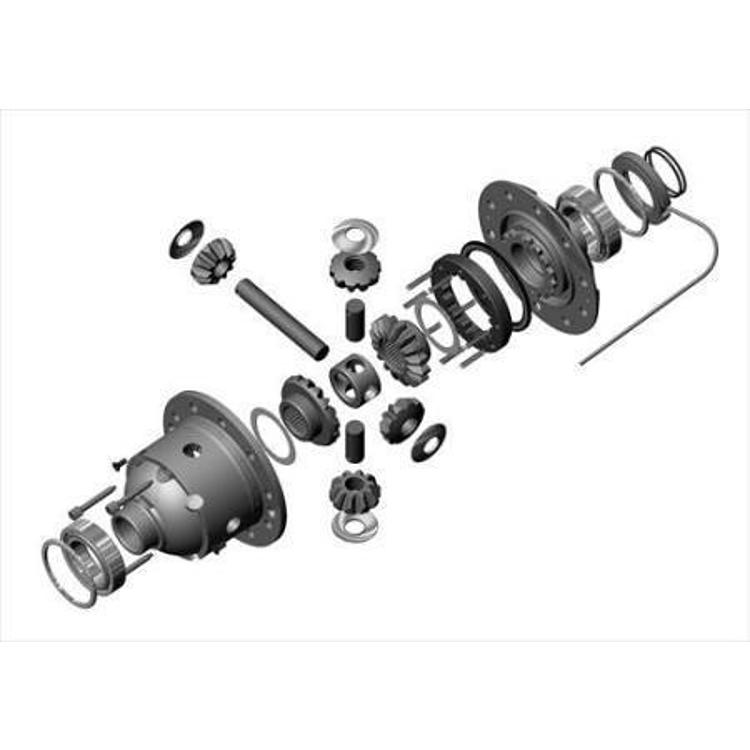
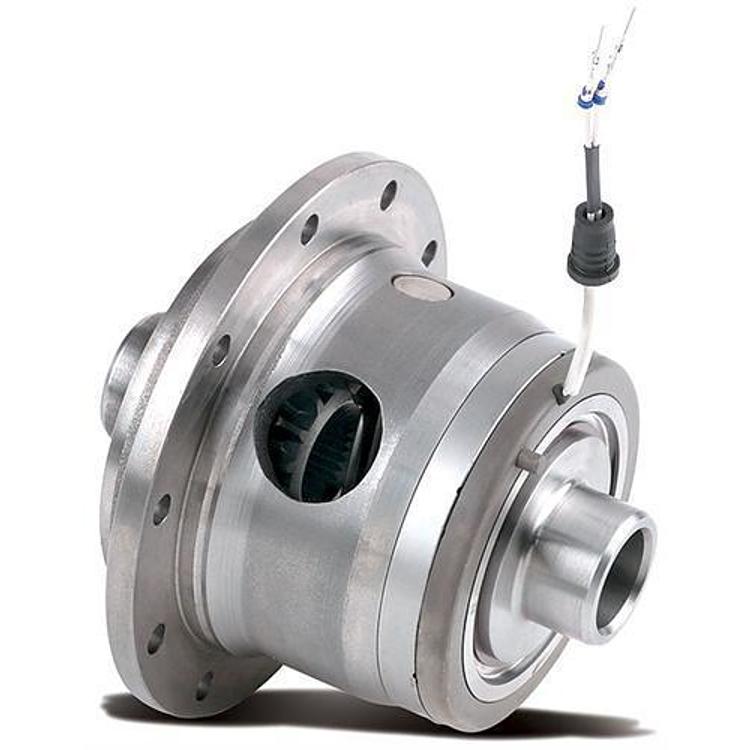
- Selectable lockers: the ARB Dana 30 27-spline Air Locker RD100 and the Eaton Dana 30 27-spline E-Locker 19817-010 stay open until you switch them on, so you can leave the front open for tight turns. That protects the U-joints at full lock.
- Automatic lockers: the Power Trax Lock Right Dana 30 27-spline locker 2210-LR engages under power by itself. In a front axle, that means torque reaches the joints whenever you apply throttle, including in a turn.
- Gear-driven limited slip: the Detroit TrueTrac Dana 30 27-spline front differential 912A584 biases torque through gears with no clutches and never fully locks, so it stays gentler on shafts than a true locker.
- Spline match: 35-spline shafts need a 35-spline carrier, such as the ARB Dana 44 JK Rubicon 35-spline Air Locker RD157 or the ARB Dana 44 Super 35-spline Air Locker RD109. More options sit under Dana 44 lockers and spools.
Deep gears do not raise the traction limit. They make it easier to reach, because the driveline can now deliver more torque at the same throttle. A re-geared axle with a locker on big tires reaches the numbers in the table easily.
Full-float vs semi-float: what does the axle shaft carry?
A semi-float shaft carries the vehicle’s weight and the drive torque, while a full-float shaft carries only torque because the hub holds the weight. That difference decides which steel suits the shaft and what happens to the wheel when the shaft breaks.
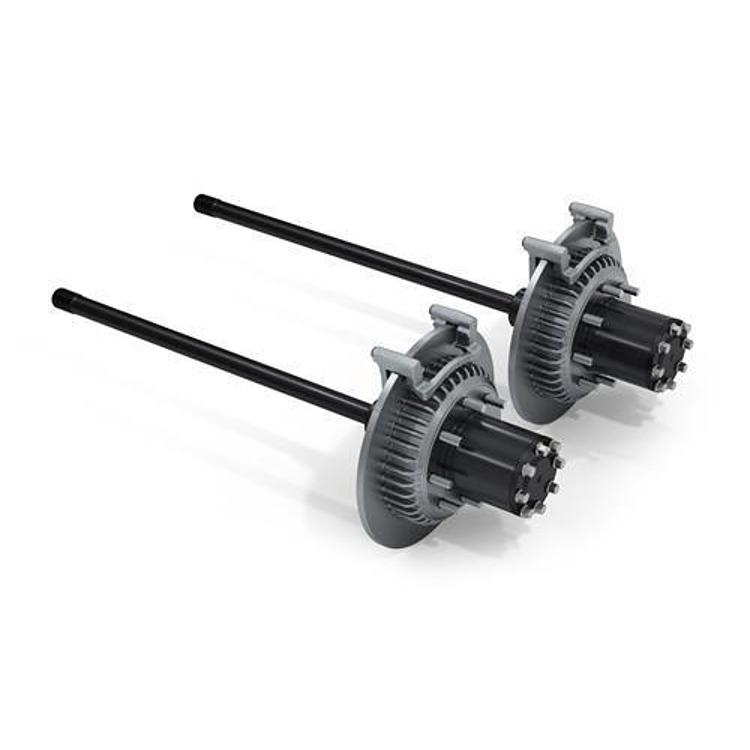
The Dana 44 rear is a semi-floating axle: the wheel bolts to a flange on the shaft, and one bearing near the end of the shaft carries the corner of the vehicle. That flange overhangs the bearing, so every turn of the wheel bends the shaft as it rotates. A through-hardened shaft is usually too brittle for the side loads on a flange that supports the vehicle.
A full-float axle, such as the truck rear Dana 60, hangs the wheel on a hub with two bearings on a spindle. If the shaft breaks, the hub keeps the wheel on the vehicle. A steering front axle behaves in a similar way: the unit bearing or hub and the knuckle carry the weight, so a front shaft sees torque and very little bending.
- Semi-float, press-on bearing: the Dana 44 rear in the Jeep TJ and JK, and in the XJ and YJ that came with one. A plate holds the bearing to the housing. If the shaft breaks inboard of the bearing, the plate keeps the wheel in place.
- Semi-float, C-clip: the Dana 35 rear in 1990-and-later YJ, XJ and TJ Jeeps. A clip inside the differential alone holds the shaft in, so a shaft that breaks outboard of the clip can leave the axle with the wheel. The bearing rollers also ride directly on the shaft, which needs a hard surface, and that is why C-clip shafts use 1050 steel.
- Full-float conversion: the TeraFlex rear 8-lug full float conversion kit 3043200 puts two bearings on a forged 4140 spindle on a Rubicon Dana 44 rear and uses 4340 case-hardened shafts. It changes the wheel pattern to 8-lug.
Should you upgrade front and rear Dana 44 shafts the same way?
No. Upgrade the front first and with 4340, because front shafts break at the joint and carry almost no bending. On the rear, pick the steel for the load: 1541H for heavy or side-loaded vehicles, and 4340 only on lighter rigs that need the twist strength most.
Front Dana 44 and Dana 30
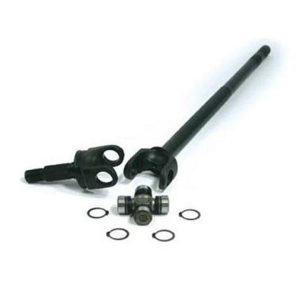
A complete kit replaces both inners, both outers and the joints in one job. The Alloy USA Dana 44 chromoly front axle kit 12176 uses 30-spline 4340 shafts and carries a 10-year warranty on the shafts and 3 years on the U-joints. If only the short shaft is breaking, a single stub such as the G2 Dana 30/44 JK Placer Gold front outer shaft is a smaller step.
Rear Dana 44
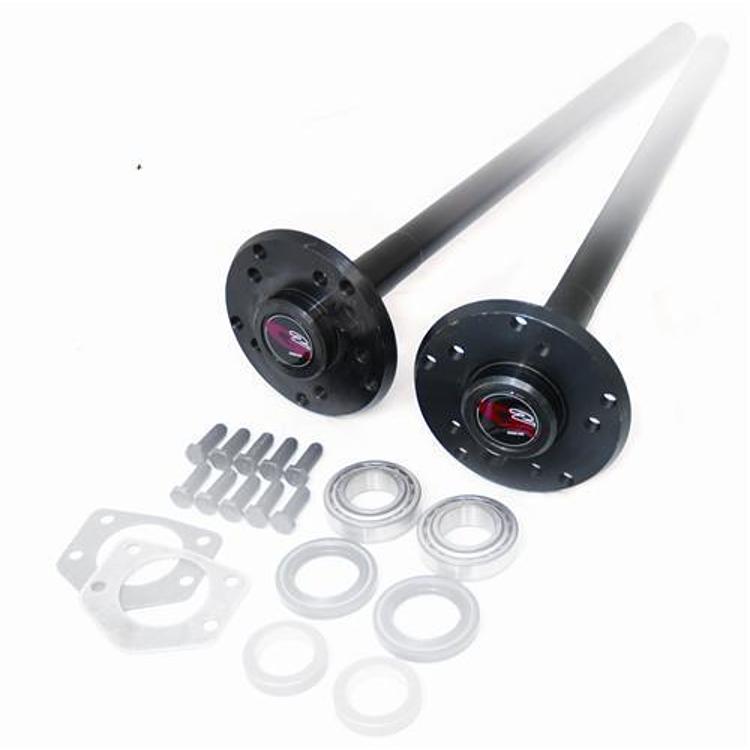
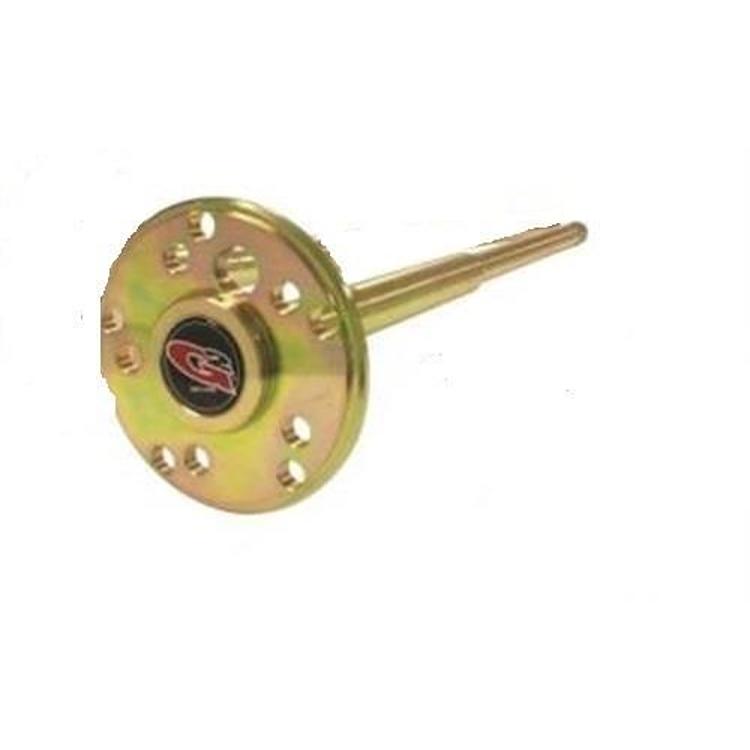
- 1541H: the G2 Dana 44 JK 07-09 replacement axle shaft 95-2052-1 is forged 1541H with 30 splines and a 5-on-5 pattern. It is the conventional heavy-duty step for a Jeep that carries weight.
- 4340: the G2 Placer Gold Dana 44 JK rear axle shaft 195-2052-1 is 4340 chromoly with 30 splines, and the G2 Dana 44 JK 35-spline Placer Gold rear shaft adds the larger spline and needs a 35-spline locker.
- Steel by application: the Alloy USA Dana 44 30-spline replacement shaft 21204C and the Alloy USA Dana 44 rear axle shaft 21147 are 1541H or 4140 steel depending on the application, so check the steel for your exact part number.
Is a stock axle shaft a useful fuse?
Yes, on some builds. A factory shaft or U-joint that breaks first can protect the carrier and ring gear, and a stub or joint is a quick trail repair. Strengthening the shaft does not remove the fuse. It moves the failure to the next weakest part, which may be harder to fix.
A broken outer shaft or joint comes out with the hub using hand tools, and you can carry the spare. A cracked carrier or a stripped ring gear means opening and setting up the differential again. A bent tube needs a shop. After a shaft upgrade, expect the load to reach these next:
- The U-joint: a 4340 shaft with strong ears often makes the joint the new fuse, which is a reasonable place to keep it. Carry a spare.
- The carrier and gears: the ring and pinion and spider gears take the load that no longer breaks the shaft.
- The housing: the JK front tube is thin, so an axle truss goes with the upgrade. A clogged breather also kills seals on any axle, as the Dana 44 axle vent guide shows.
- Seals: new shafts are the time for new inner and outer seals, such as the Crown Automotive Dana 30 inner axle shaft seal J8121781 and the Alloy USA Dana 30/44 outer axle tube seals 11102.
Which U-joints work with chromoly axle shafts?
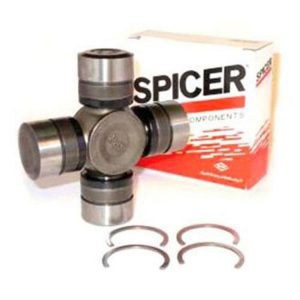
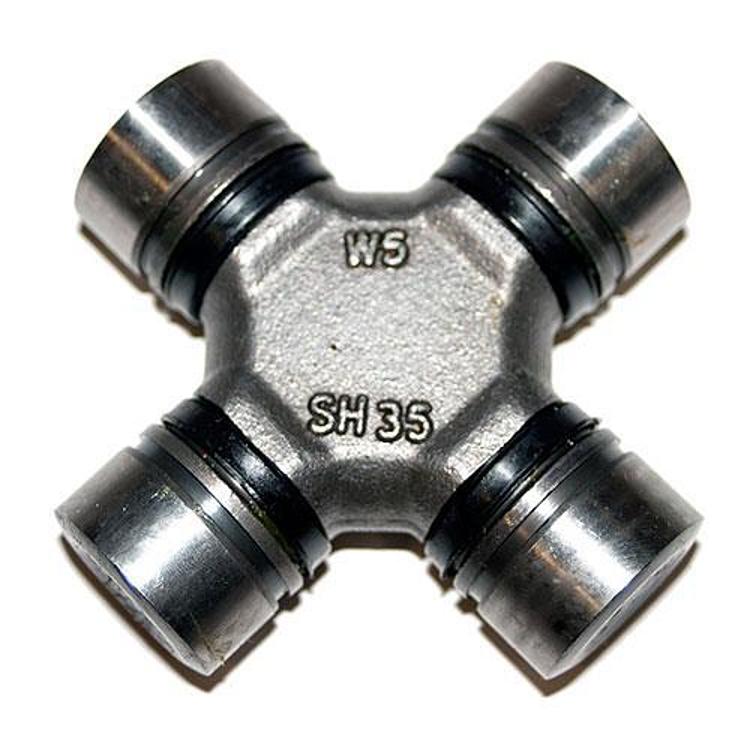
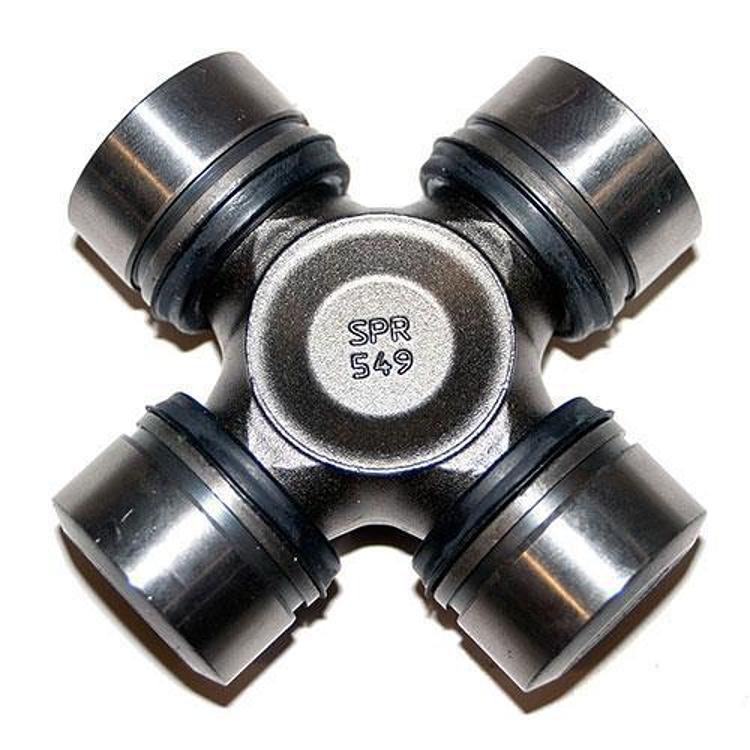
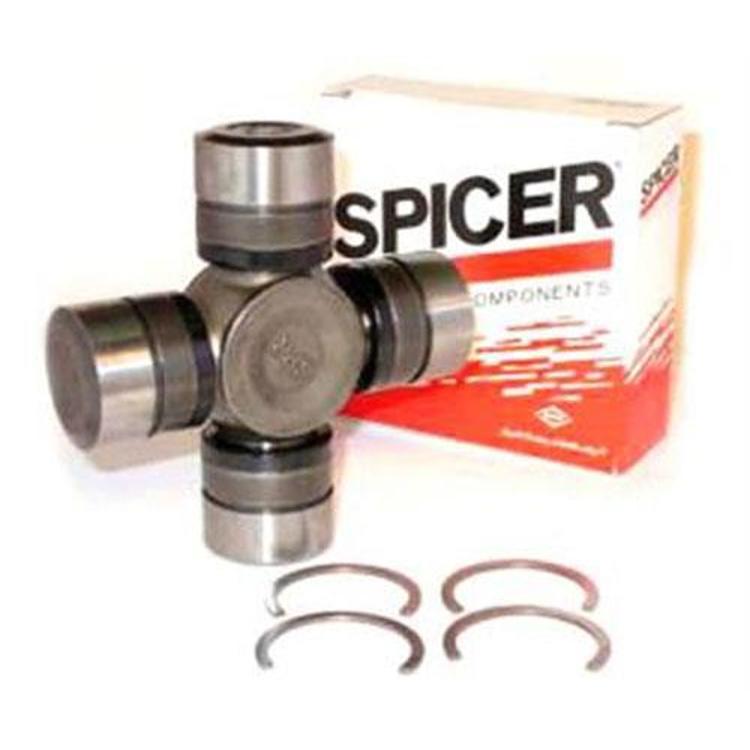
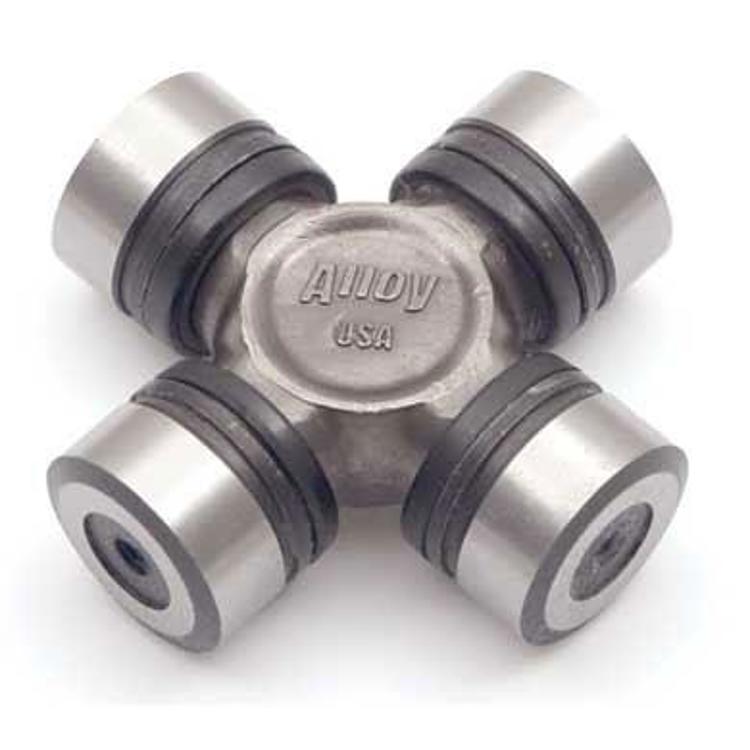
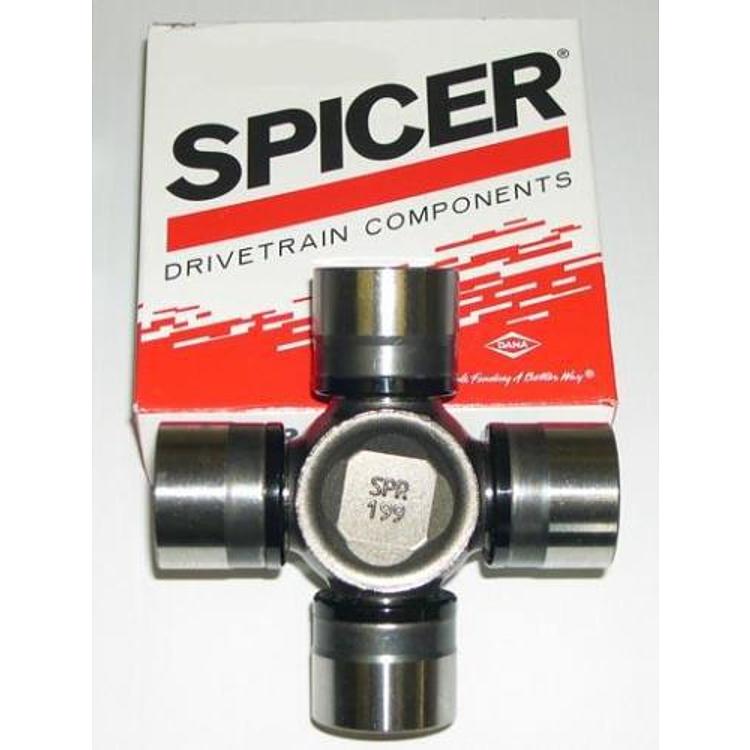
Match the joint size to the shaft yoke first, then choose the joint. Most Dana 30 and Dana 44 fronts use the 5-760X size, the JK Rubicon Dana 44 uses the wider 5-7166X and older axles may use the smaller 5-260X. Spicer’s bearingless Extreme joint is off-road only.
| U-joint | Cap diameter | Snap ring to snap ring | Grease fitting | Used on |
|---|---|---|---|---|
| Spicer 5-260X | 1.062 in | 2.188 in | No | Older Dana 30, small Dana 44 |
| Spicer 5-760X | 1.188 in | 2.188 in | No | Dana 30, Dana 35, Dana 44 |
| Alloy USA 11500 | 1.188 in | 2.188 in | Yes | Dana 44 |
| Spicer 5-7166X | 1.188 in | 2.405 in | No | JK Rubicon Dana 44 |
| Spicer SPL55-3X | 1.375 in | 3.00 in | No | Dana 60 |
Four things decide the joint:
- Cap size: the 5-260X and 5-760X have the same span but different caps, so a yoke bored for one will not accept the other. The Crown Automotive 8126637BC front axle U-joint is a 260-series joint with a 1.06-inch cap for the CJ, the 1984-1992 XJ and the YJ.
- Grease fitting: a greaseable cross can be serviced after water crossings, but it has a passage drilled through its center. A solid cross has more steel at the core and is replaced when worn.
- Clips: full-circle snap rings nearly eliminate ring ejection under load. The G2 Dana 44/30 full-circle snap rings 1400-118PP suit 5-760X joints; aftermarket shafts are machined for them and factory shafts need machining. See U-joint snap rings for other sizes.
- Bearingless joints: the Spicer Extreme U-joint has a 4340 cross with an enlarged trunnion and no needle bearings. It is rated for off-road use only, at the wheel end only, and it needs regular greasing.
Which vehicles use which chromoly front axle kits?
Dana 30 and Dana 44 kits are vehicle specific, because shaft lengths, spline counts and joints differ between generations. Choose by model year and axle, and confirm the axle tag first, since front axles changed between trims in several of these Jeeps and trucks.
- 1972-1986 Jeep CJ: the G2 Dana 30 CJ narrow-track 27-spline kit 98-2032-001 covers 1972-1981 narrow-track axles, and the G2 Dana 30 CJ wide-track 27-spline kit 98-2032-002 covers 1982-1986 wide-track axles. See the Jeep CJ5 and Jeep CJ7 pages.
- 1984-2001 Cherokee XJ, 1987-1995 Wrangler YJ, 1997-2006 Wrangler TJ: the G2 Dana 30 27-spline chromoly kit 98-2031-001 keeps the factory carrier, and the G2 Dana 30 30-spline chromoly kit 98-2031-002 needs a 30-spline aftermarket differential. On the YJ, both require a disconnect eliminator. See the Cherokee XJ, Wrangler YJ and Wrangler TJ pages.
- 2003-2006 Wrangler TJ Rubicon: the G2 Dana 44 TJ Rubicon front chromoly kit 98-2045-001 is a 4340 pair with 30 splines and 5-760X joints.
- 2007-2018 Wrangler JK: the G2 Dana 44 JK 35-spline Placer Gold front kit 198-2051-001 uses 4340 and the larger 5-7166X joint for the Rubicon Dana 44, and the G2 Dana 30 JK 27-spline chromoly kit 98-2050-001 fits 2007-2009 non-Rubicon axles. See the Wrangler JK page.
- Wagoneer and Grand Wagoneer SJ: the Alloy USA Dana 44 chromoly front axle kit 12174 fits the 1980-1990 Wagoneer SJ and the 1984-1991 Grand Wagoneer SJ.
- Ford: the G2 Dana 44 Ford F-250 front chromoly kit 98-2033-007 fits the 1969-1979 Ford F-250, and the G2 driver-side inner above fits the 1978-1979 Ford Bronco.
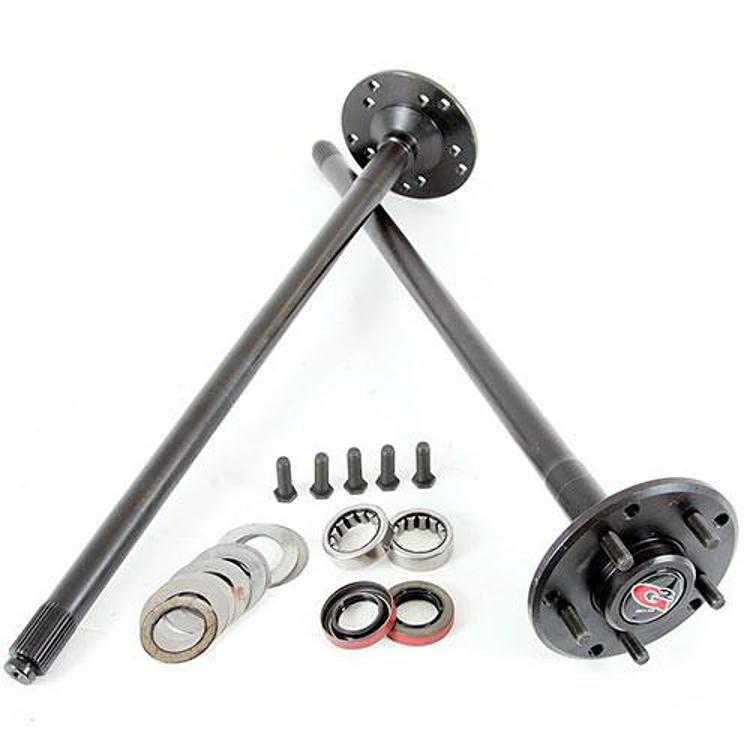
On the rear, the G2 Dana 44 YJ/XJ/TJ 30-spline rear kit 96-2033-1-30 is for drum brakes, and the G2 Dana 44 30-spline rear kit with disc brakes 96-2045-1-30 fits the disc Rubicon rear. The Alloy USA Dana 44 chromoly rear axle kit 12202 fits the 1994-1998 Grand Cherokee ZJ. A Dana 35 rear has its own parts: the Alloy USA Dana 35 chromoly rear axle kit 12200 keeps 27 splines in 4140 for C-clip axles, and the G2 kit shown above moves to 30.
Chromoly vs stock Dana 44 shafts: when should you upgrade?
Upgrade when a locker goes on the axle, when tires reach 37 inches, or when you have broken the same part twice. Open differentials on tires up to 35 inches rarely need chromoly: replace a broken part with a good stock-grade shaft and a quality U-joint, then fix why it broke.
| Setup | Front | Rear |
|---|---|---|
| Dana 44, open, 33-in tires | Stock shafts; new 5-760X when worn | Stock shafts |
| Dana 44, open, 35-in tires | Stock or 1541H replacements; 4340 if you wheel hard | Stock or 1541H |
| Dana 44, locker, 33- to 35-in tires | 4340 kit, full-circle clips | 1541H or 4340 |
| Dana 44, lockers, 37-in tires | 35-spline 4340, truss, or plan a Dana 60 | 35-spline shafts or full-float |
| Dana 30, locker, 33- to 35-in tires | 4340 kit, truss | Check the rear axle: Dana 35 needs its own upgrade |
Driving decides a lot. Easing off the throttle when a tire is in the air, and straightening the wheel before you climb, prevents more broken shafts than a steel upgrade does.
Replacement axle shafts: match stock or step up?
If a replacement axle shaft fixes a one-time break on a mild vehicle, match the original size in a quality steel. If the break repeats, or the vehicle has a locker, step up to 4340 on the front and choose 1541H or 4340 for the rear. Either way, replace the U-joint with a broken front shaft.
- Check the neighbors: look for shaft debris in the carrier, bearing damage and seal leaks.
- Confirm the numbers: axle model, side, length, spline count and U-joint size. A 27-spline stub and a 19-spline stub do not interchange, and a 6.11-inch stub and a 9.94-inch stub do not either.
Frequently asked questions
Are chromoly axle shafts stronger than stock Dana 44 shafts?
Yes in twist. Yukon Gear & Axle 4340 chromoly shafts are rated about 39 percent stronger than the 1040 steel used in factory axle shafts, and 1541H shafts about 20 to 25 percent stronger. The gain is in torsion. Chromoly does not make a shaft stiffer, and it is less suited than induction-hardened 1541H to the bending load on a semi-float rear shaft.
Do I need chromoly shafts for 35-inch tires on a Dana 44?
Not always. A Dana 44 with open differentials and a light right foot commonly lives on 35-inch tires with factory shafts. Add a locker, deep gears, hard rock crawling or a heavy build and chromoly front shafts become the sensible upgrade, because a locker can send the whole axle load through one shaft.
Is a 30-spline shaft stronger than a 19-spline shaft?
Yes. A Dana 44 rear shaft measures about 1.30 inches with 19 splines and 1.31 inches with 30 splines, so the outside diameter barely changes. The 30-spline shaft has finer, shallower teeth, which leaves more steel at the root of the spline, and the root is where the shaft is smallest.
Should a semi-float Dana 44 rear axle use 4340 chromoly or 1541H shafts?
1541H is the safer choice for a heavy vehicle or a vehicle that sees side loads, because a flanged semi-float shaft carries bending as well as torque and an induction-hardened shaft keeps a softer core. 4340 semi-float shafts exist and work on lighter trail rigs that need the extra twist strength. A full-float conversion takes the bending off the shaft altogether.
What U-joint goes with Dana 30 and Dana 44 chromoly shafts?
Most Dana 30 and Dana 44 chromoly kits use the Spicer 5-760X size: a 1.188-inch cap and 2.188 inches snap ring to snap ring. The 2007-2018 Wrangler JK Rubicon Dana 44 uses the wider 5-7166X, with the same 1.188-inch cap and 2.405 inches snap ring to snap ring.
Will chromoly shafts make something else break?
They can. A shaft that survives passes the load on to the next part in line: the U-joint, the carrier, the ring and pinion, the ball joints or the axle tube.
Pick the shaft steel and spline count after you settle on tires and a locker, since those two decisions set the load. Browse Dana 44 axle shafts, replacement axle shafts, front axle U-joints and Dana 44 U-joints to match parts to your axle, and read Dana 30 vs Dana 44 vs Dana 60 if a swap might serve you better.
Sources
- Yukon Gear & Axle, product catalog, Tech Talk section: steel types, strength percentages and through-hardening notes.
- Dutchman Motorsports, axle and rear end tech: factory steels, case depth, hardness, and the torsion and bending comparison.
- Dynatrac, axle shaft U-joint guide and Dana 60 axle shafts: U-joint sizes, ear failures and shaft steels.
- Dana Incorporated, Spicer Extreme U-joints press release, and Spicer Parts, Spicer Extreme U-joints.
- US Patent 4,173,501, Steel torsional element and method for making: torsional stress distribution and case-core fatigue.
- AZoM, AISI 4340 alloy steel: composition and heat treatment.
- R. Mueller, TMS, Failure Analysis: Fatigue and Fracture course notes: torsional fracture patterns and beach marks.
- Wikipedia, SAE steel grades, Dana 44, Dana 60 and Universal joint.
- Off Road Xtreme, Full float vs semi float axles: what each design carries.