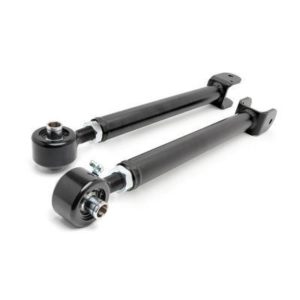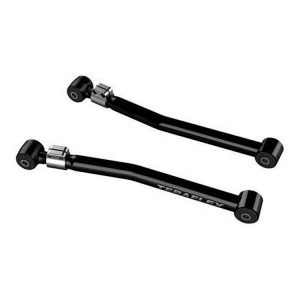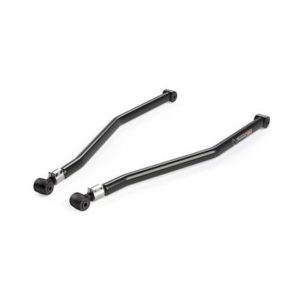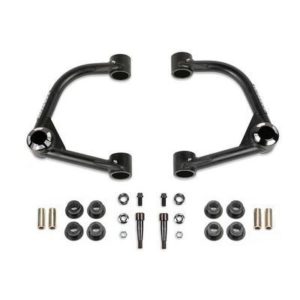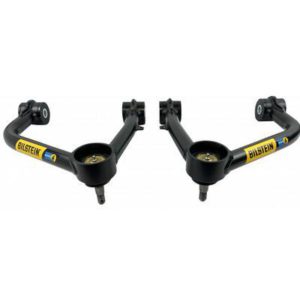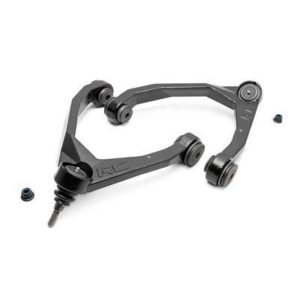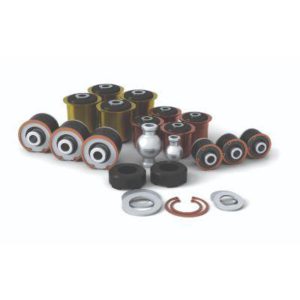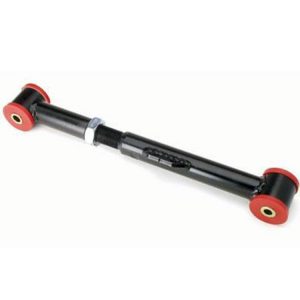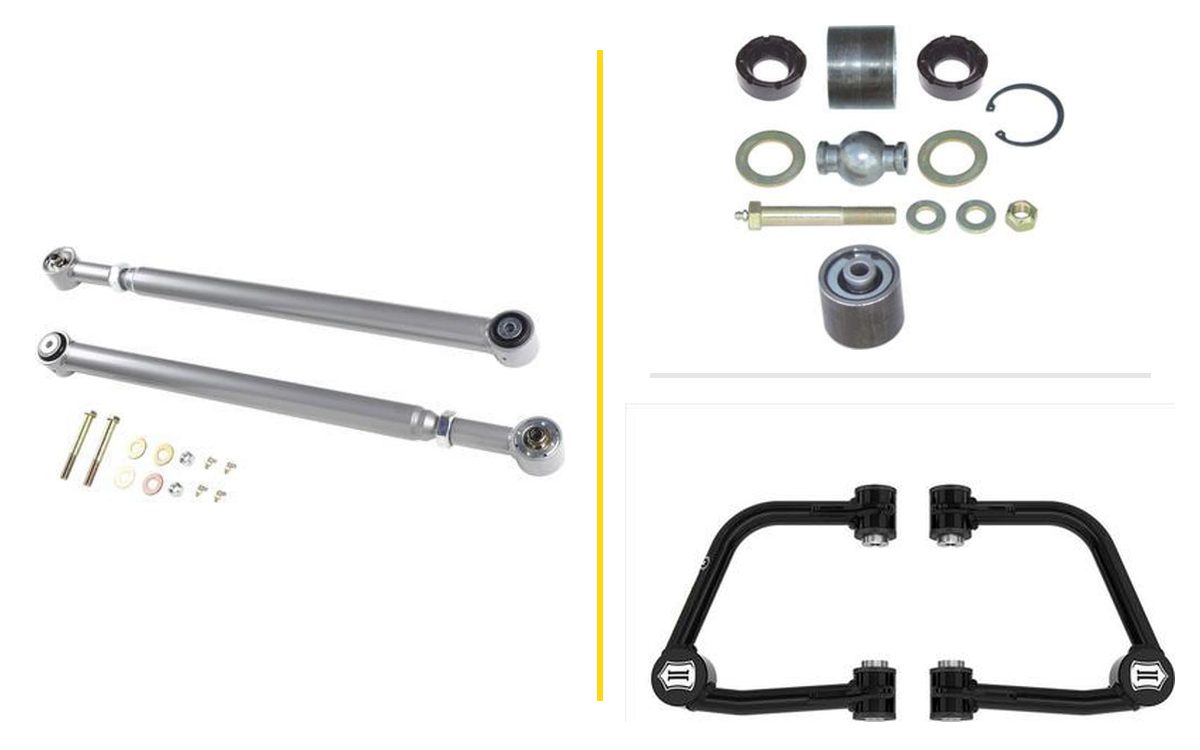
Control arms are the links that locate an axle or steering knuckle and set its caster and, on a solid axle, its pinion angle. Fixed arms suit lifts up to about 3 inches, adjustable short arms cover about 2 to 4 inches, and long arms suit about 3 to 6 inches on solid-axle Jeeps.
Key takeaways
- Rotation: on a solid front axle, arm length rotates the housing, so caster and pinion angle always move together.
- Driveline: Spicer wants universal joint angles at 3 degrees or less for maximum life and within 1 degree of each other end to end.
- Lift bands: TeraFlex sizes its JK arms at 2.5 to 3 inches for preset short arms, 2 to 4 inches for adjustable short arms and 3 to 6 inches for long arms.
- Arm length: a JK front lower grows from 22-5/8 inches to about 34 inches in a long arm system, which cuts the arm angle at a given lift by about a third.
- IFS: some road-driven trucks tolerate about 1.5 to 2 inches on factory upper arms; above that, upper control arms restore ball joint angle and caster.
- Torque: tighten rubber bushings at ride height, never with the suspension hanging.
Independent front suspension follows different rules: there the question is the upper arm and the angle of its ball joint.
What do control arms do on a solid axle and on IFS?
Control arms hold an axle or knuckle in position while letting it move up and down. On a solid axle they also set how far the housing is rotated, and on independent front suspension they set the path and tilt of each knuckle.
Solid-axle control arms: four links and a track bar
A link-and-coil solid axle uses four arms per axle, two lower and two upper, plus a track bar that stops side-to-side movement. That layout sits at both ends of the 1997–2006 Jeep Wrangler TJ, the 2007–2018 Wrangler JK, the Wrangler JL and the 2020–2026 Gladiator, which is why complete sets are called 8-arm kits. The Cherokee XJ uses the same four links up front and leaf springs at the rear. The track bar works with the arms, so a lift usually changes both.
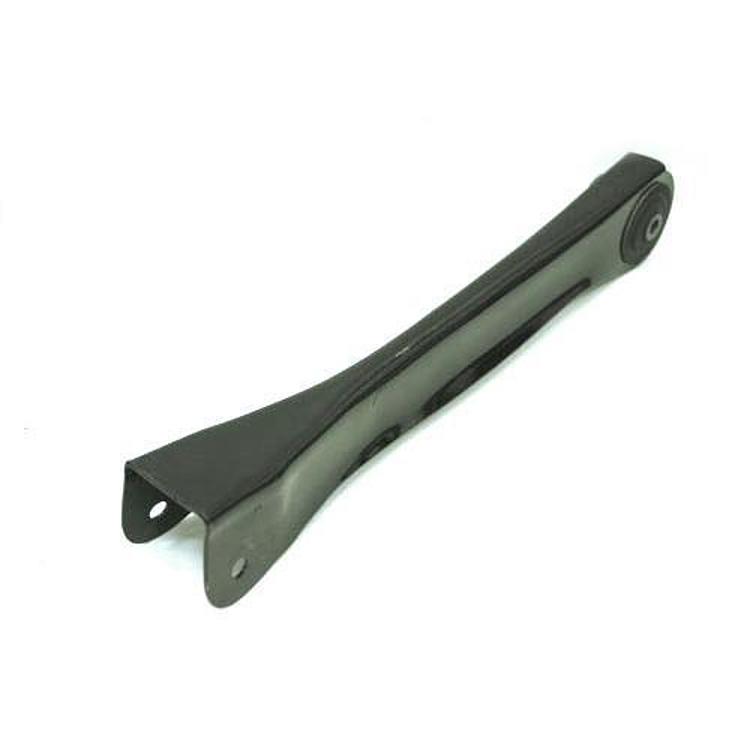
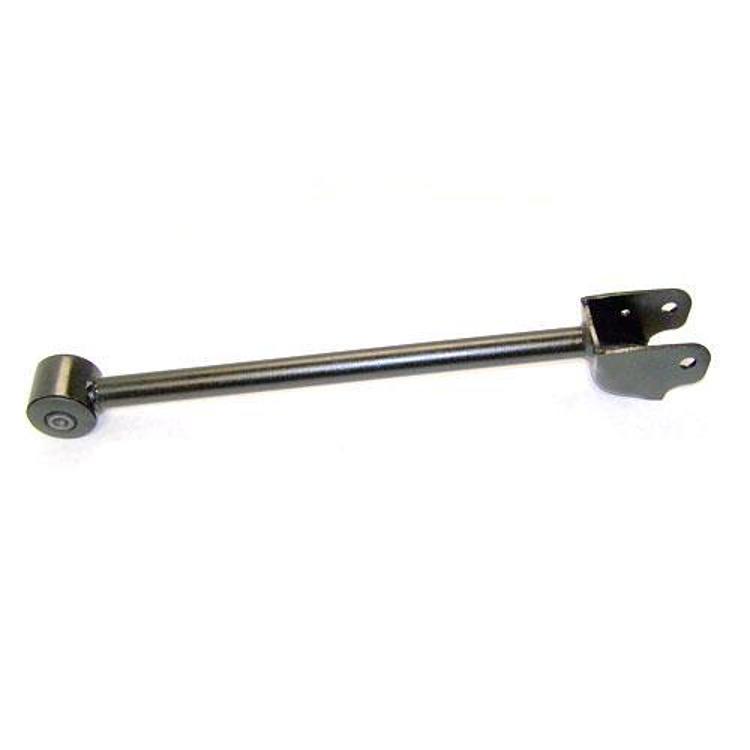
The factory parts are simple. A Crown 52087711 front upper arm for the XJ, ZJ, TJ and LJ is stamped steel. The Crown 52059976AC front upper arm for the JK is a tube with a clevis, a forked mount, at one end. Both are correct at factory height, and both have a fixed length.
IFS arms: an upper and a lower A-arm per side
Independent front suspension replaces the axle housing with two A-shaped arms per side, joined to the steering knuckle by ball joints. The 2021–2026 Ford Bronco, Toyota Tacoma, 4Runner and Silverado 1500 all work this way. The front differential is bolted to the frame, so the arms do not rotate it and set no pinion angle. The lift problem moves to the upper ball joint angle and to caster and camber, and the upper arm is the part that gets replaced.
The Bronco uses both systems: IFS in front and a solid rear axle on links. That is why parts like the ICON 44100T rear upper link kit exist next to its front upper arms.
How do control arms set pinion angle and caster?
Control arms set pinion angle and caster by rotating the axle housing. Changing the length of the upper arm, the lower arm or both tilts the housing, and the steering axis and pinion yoke tilt with it.
Caster is the tilt of the steering axis seen from the side. Positive caster leans the top of the axis toward the rear, which pulls the wheels back to center and keeps the vehicle tracking straight. Pinion angle is the slope of the differential pinion, the gear shaft that the driveshaft turns. A lift on factory-length links rotates a front axle so the pinion points higher and caster drops.
Which way does each arm move the axle?
- Longer front lower arms: push the bottom of the housing forward, adding caster and pointing the pinion lower. They also move the axle forward.
- Shorter front upper arms: pull the top of the housing rearward, with the same effect on caster and pinion.
- Longer front upper arms: reduce caster and raise the pinion toward the driveshaft.
- Longer rear upper arms: tip the rear pinion up. There is no caster at the rear, so the rear arms only have the driveshaft to satisfy.
On a front axle this creates a real trade-off, because one housing carries both angles. If the caster target and the pinion target disagree, set caster first on a vehicle that sees road speed, then fix the driveshaft side with a double-cardan shaft. The other option is to rotate the knuckle ends of the housing on the axle tubes, known as cut-and-turn, so caster and pinion can be set separately. The Dana 30, 44 and 60 axle guide covers the housings involved.
What pinion angle does the driveshaft want?
A universal joint runs smoothly when its working angle is small and matched at both ends of the shaft. Spicer gives these figures for driveline universal joints:
- Maximum life: 3 degrees or less; any angle above that shortens joint life and may cause vibration.
- Minimum: at least 1/2 degree at each end, so the needle bearings keep moving.
- Match: the angles at the two ends equal within 1 degree.
- Speed limit: the maximum recommended angle falls from 11.5 degrees at 1,500 driveshaft rpm to 5.8 degrees at 3,000 rpm and 3.2 degrees at 5,000 rpm.
A shaft with a single universal joint at each end needs the pinion roughly parallel to the transfer case output, so the two joint angles cancel. A double-cardan shaft has two joints close-coupled at the transfer case end, where it carries the large angle, so the pinion is aimed nearly straight up the shaft and its single joint keeps a small angle. That is why Pro Comp 55700 adjustable rear upper arms for the TJ and LJ matter on a Jeep with a tail shaft conversion, and why long-arm Jeeps often add slip yoke eliminator hardware and a new driveshaft. A transfer case lowering kit reduces the shaft angle further, at the expense of some belly clearance.
Rubber bushing, flex joint or Johnny Joint: which control arm joint is best?
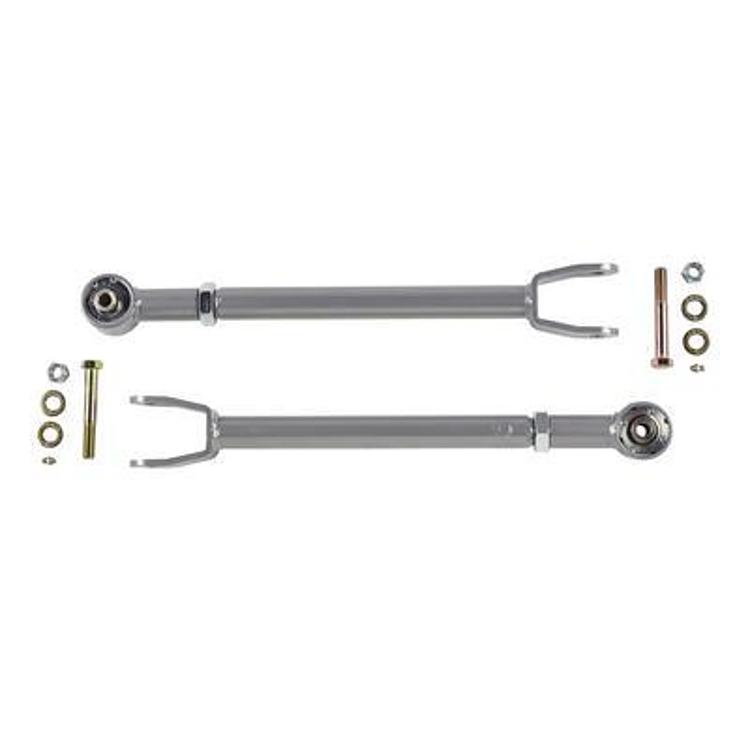
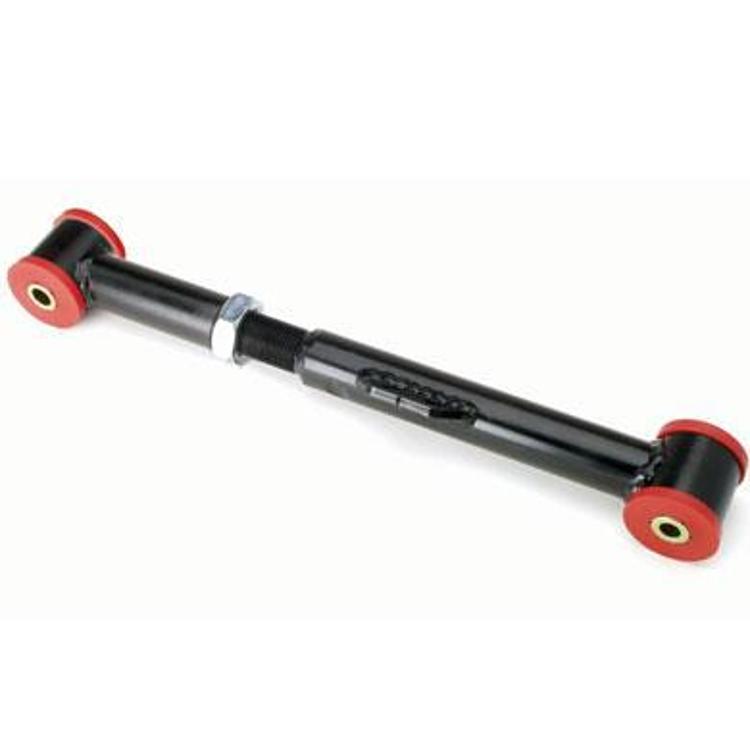
Rubber bushings ride the quietest and need no grease, but they limit articulation. Flex joints and Johnny Joints move much further but need regular greasing and periodic rebuilds, so the best joint depends on how far the suspension has to travel.
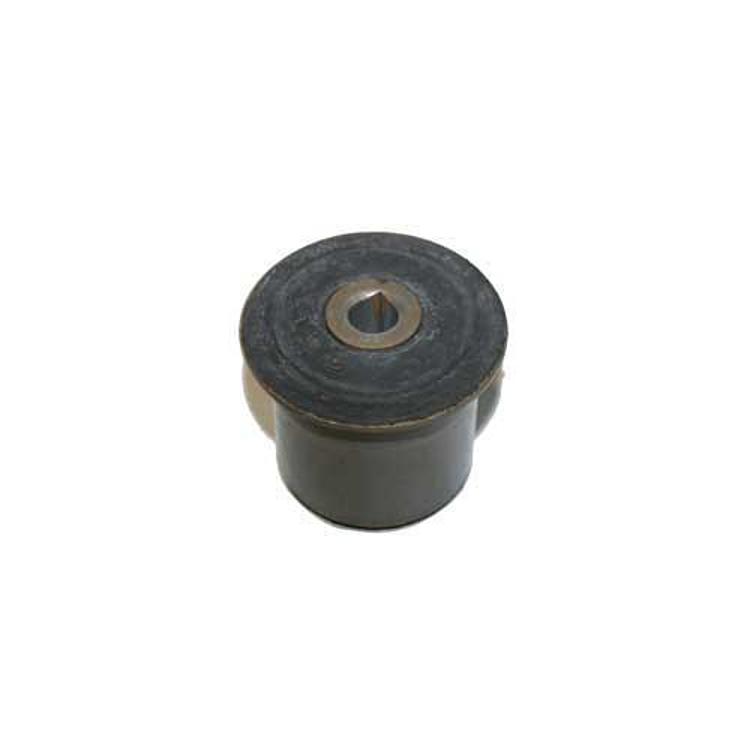
- Rubber bushing: a rubber sleeve bonded between metal sleeves, like the Crown 52087852 upper arm bushing. It moves by twisting, so it holds the arm centered and absorbs vibration, then resists as the angle grows. Control arm bushings wear by tearing and collapsing.
- Polyurethane bushing: a harder sleeve that rotates on its inner sleeve instead of twisting. Skyjacker JKLL24F front lower arms use greasable polyurethane at both ends. It can squeak if it runs dry.
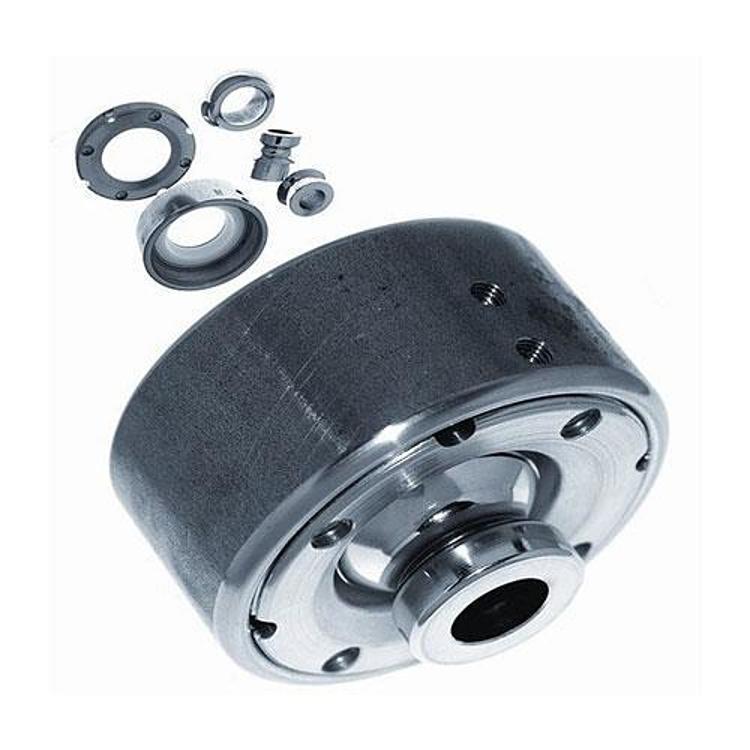
- Super-Flex joint: Rubicon Express encloses a ball between races of UHMW (ultra-high molecular weight) polyethylene in a threaded housing. The RE3794 heavy-duty Super-Flex assembly is rated for 32 degrees of misalignment and has a thick threaded insert for adjustment and rebuilding.
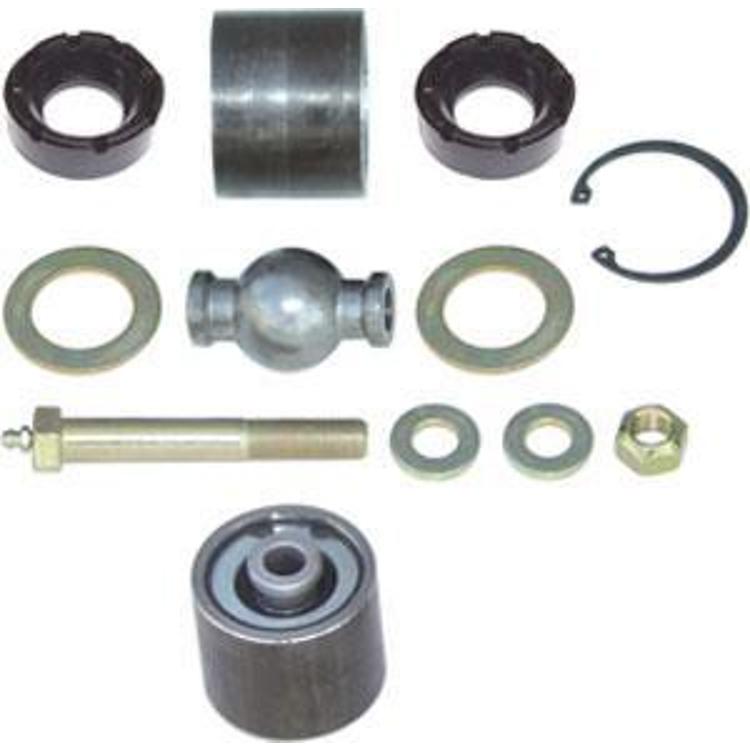
- Johnny Joint: Currie holds a heat-treated steel ball between two urethane bushings in a DOM (drawn over mandrel) steel shell. The Currie CE-9110 2.5-inch Johnny Joint is rated at 30 degrees in any direction and greases through its bolt. The Daystar KU70005BK Poly Flex joint is a similar polyurethane-encapsulated design.
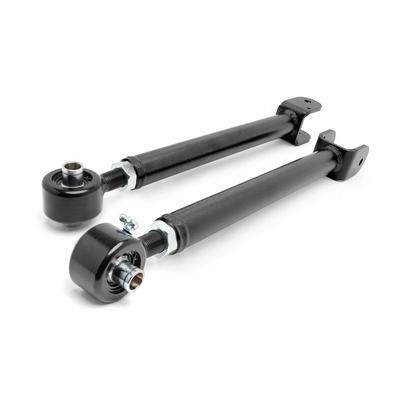
- Threaded ball joints: Rough Country X-Flex joints are rated at up to 20 degrees on upper arms such as the 11350 front uppers and 35 degrees on lower arms, and the Fabtech FTS50412 5-ton arm joint is rated at 33 degrees with a 1-inch ball.
| Joint type | Rated movement | Noise and ride | Service |
|---|---|---|---|
| Factory rubber | Limited; resists as it twists | Quietest, best at absorbing vibration | None until it tears, then replace |
| Polyurethane | More than rubber | Firm; can squeak when dry | Grease regularly |
| Super-Flex (UHMW races) | Up to 32 degrees (RE3794) | Quiet with non-metallic races | Grease; adjust and replace races |
| Johnny Joint (urethane) | 30 degrees standard; 40+ degrees narrow | Smooth and quiet on-road | Grease by hand gun; rebuild kit |
| Heim joint (rod end) | 22 degrees typical | Passes the most noise and vibration | Inspect often; replace when loose |
| Elastomer flex (MetalCloak Duroflex) | 34 degrees | Close to factory rubber | Sealed; pull and clean to rebuild |
Many kits mix joint types. The Rubicon Express RE3757 rear upper arms put a Super-Flex joint on one end and a rubber bushing on the other, which keeps a rubber element in each arm. TeraFlex Alpine IR arms use an inner sleeve that rotates a full 360 degrees inside a factory-lubricated, permanently sealed bushing. Flex joints for fabrication suit custom arms, and the weld-on versions are made to fit a tube you cut to length.
Fixed vs adjustable control arms: which do you need?
Fixed control arms are stronger replacements with one set length, and they suit a known lift of up to about 3 inches. Adjustable control arms change length on threads, so you can dial in caster, pinion angle and axle position at any height within their range.
When fixed arms are enough
A fixed arm has one length and nothing to come loose. The Rubicon Express RE3755 rear lower arms for the JK have a fixed length with a greaseable Super-Flex joint on one end, so their gain is articulation. Fixed arms can also correct geometry when the length is chosen for the lift. TeraFlex builds its Sport 4 FlexArm kit for 2.5 to 3 inches: the front lower moves from 22-5/8 to 22-13/16 inches and the rear upper from 17-7/16 to 17-11/16 inches. The Sport 8 FlexArm kit covers all four positions, front and rear, upper and lower.
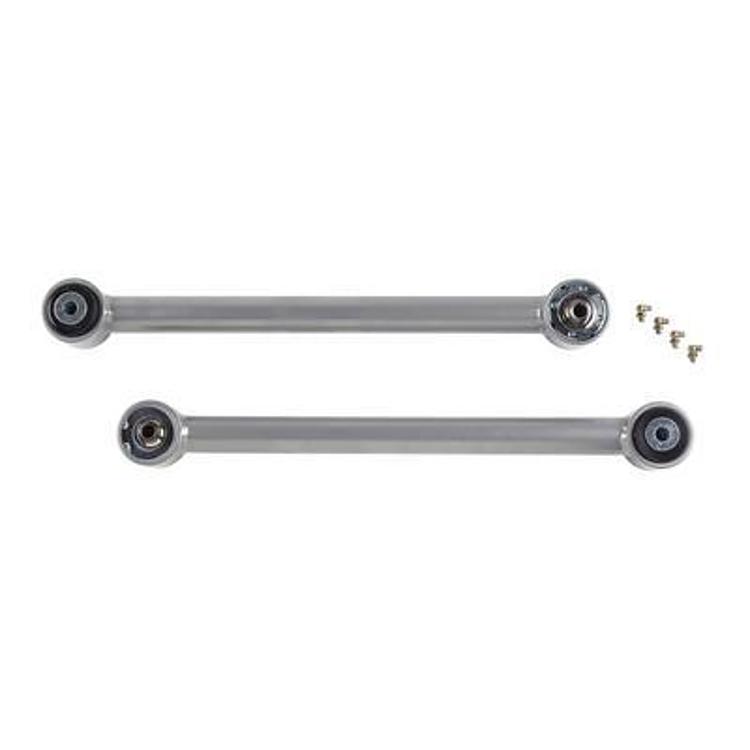
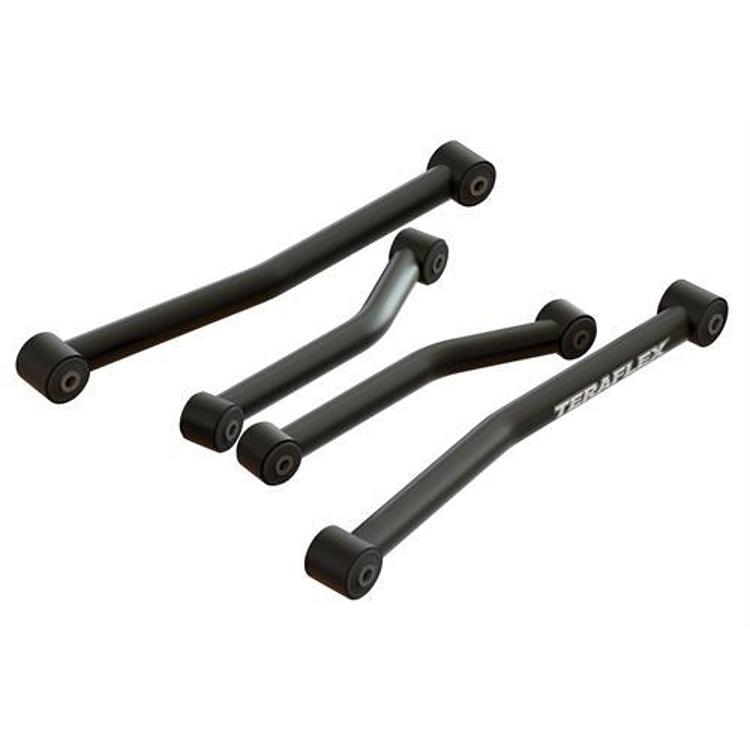
When adjustable arms earn their threads
At 3 inches, a JK needs arms that correct caster and pinion angle. TeraFlex answers with either preset Sport arms or adjustable arms at this height, and says a JK on 35-inch tires needs only four of them: the front lowers and rear uppers. Adjustability also re-centers the axle in the wheel well and can stretch the wheelbase for tire clearance. Typical ranges are short: the Rubicon Express RE3780 front uppers for the TJ, LJ, XJ, MJ and ZJ run from 15.25 to 16-1/8 inches. The TeraFlex 1415500 Alpine front lowers lock their threaded joint with an aluminum pinch collar.
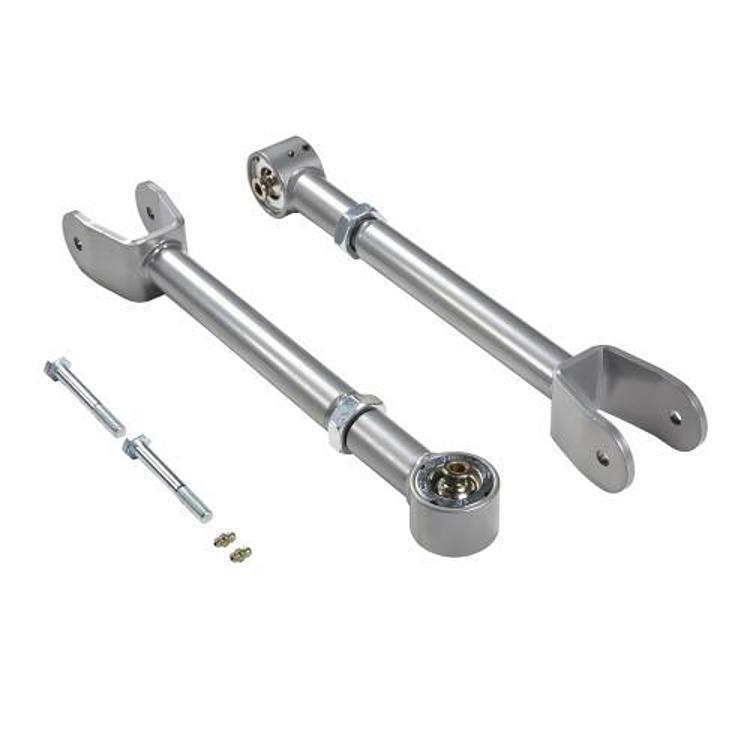
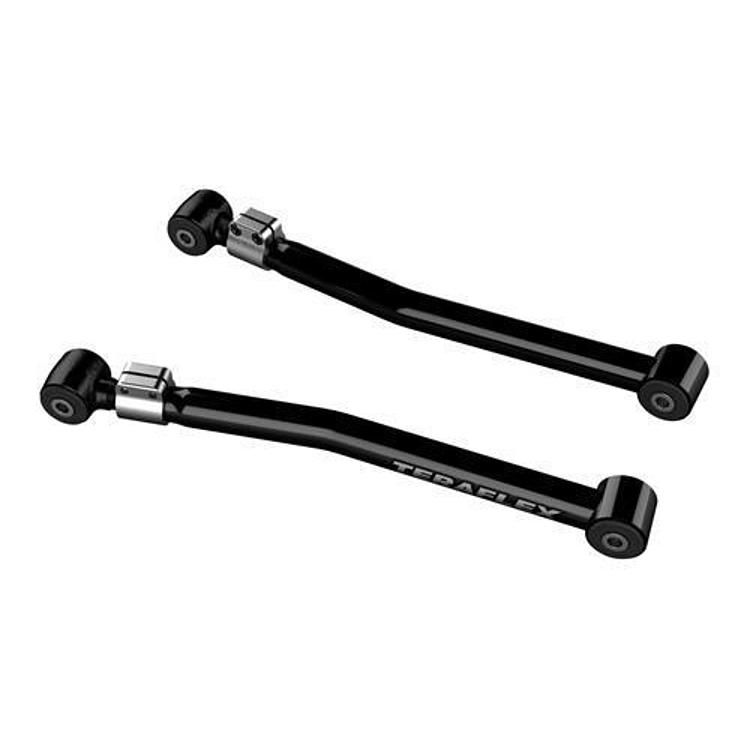
Other adjustable options for the JK include the ARB UCAJKFR front upper arms, built from 1.25-inch by 0.188-inch wall DOM tube with a dual-durometer bushing, and the Rough Country 11380 rear uppers. Pro Comp upper control arms come in the same two forms: Pro Comp 55100 adjustable front uppers fine tune front caster, and the 55700 rears set pinion. For the Gladiator, the TeraFlex 1417500 Alpine 8-arm kit bolts to the factory brackets and covers 0 to 4.5 inches.
The trade-off is maintenance. Threads add a joint that has to stay tight, a jam nut or pinch collar to recheck, and a length that has to match side to side. Some adjustable arms start longer than factory, such as the Alpine short front lower at 22-3/4 inches against 22-5/8, so check that the range starts where you need it. Replacement control arms come in all of these forms, so shop by position and lift range first.
Long arm vs short arm: what does the longer link change?
A long arm reduces the arm angle at any given lift, which cuts bushing stress, keeps the axle from pulling rearward as far through its travel and frees up articulation. It takes new frame brackets and, on most kits, a crossmember, and those usually hang lower than the factory mounts.
The geometry is plain trigonometry. Taking a level arm and a 4-inch height change at the axle, the JK factory front lower at 22-5/8 inches swings through about 10.2 degrees and draws the axle end back about 0.36 inch. A 34.5-inch long arm swings through about 6.7 degrees and draws back about 0.23 inch. At 10 inches of travel, the same two arms reach about 26 degrees and 17 degrees. Smaller swing angles mean less twist in a rubber bushing and less bind through travel, which is why long arms ride closer to factory.
| JK arm | Factory | Sport preset (2.5–3 in) | Alpine short (2–4 in) | Alpine long (3–6 in) |
|---|---|---|---|---|
| Front upper | 18-3/4 in | 18-3/4 in | 18-1/2 to 19-3/4 in | 27-3/8 to 28-7/8 in |
| Front lower | 22-5/8 in | 22-13/16 in | 22-3/4 to 24 in | 33-3/4 to 35-1/4 in |
| Rear upper | 17-7/16 in | 17-11/16 in | 17-5/8 to 18-7/8 in | 20 to 21-1/2 in |
| Rear lower | 19-3/4 in | 19-15/16 in | 19-3/4 to 21 in | 35-3/4 to 37-1/4 in |
What a long arm upgrade involves
A long arm upgrade moves the frame-end mounts toward the center of the vehicle. On a JK, the Rubicon Express JK4423FPR 3.5-inch long arm kit includes chromoly upper and lower arms, Super-Flex joints, PT-Meg Super-Ride bushings and a full-width transmission crossmember, with no welding. The JK4425R 5.5-inch kit for 2-door models adds lift springs, brake lines and control arm mounts.
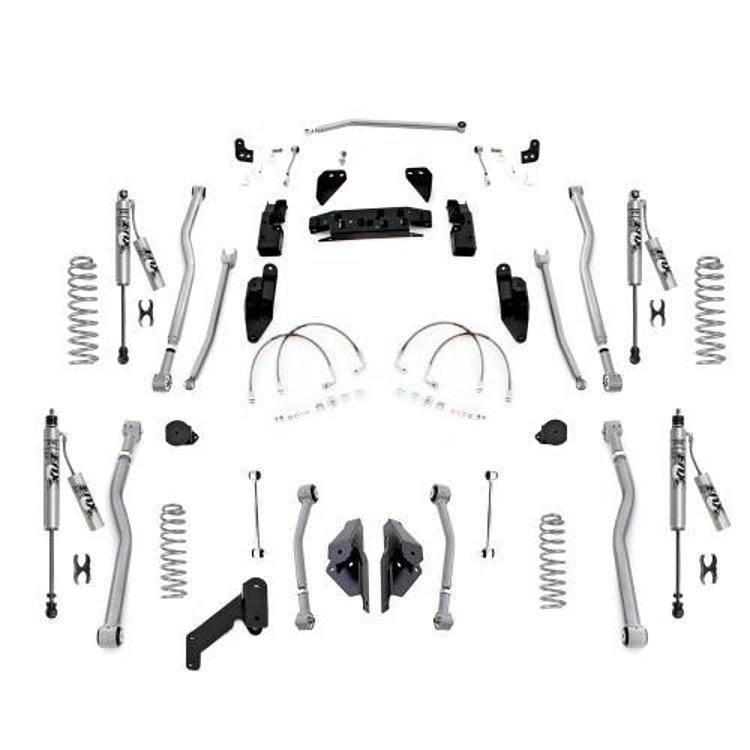
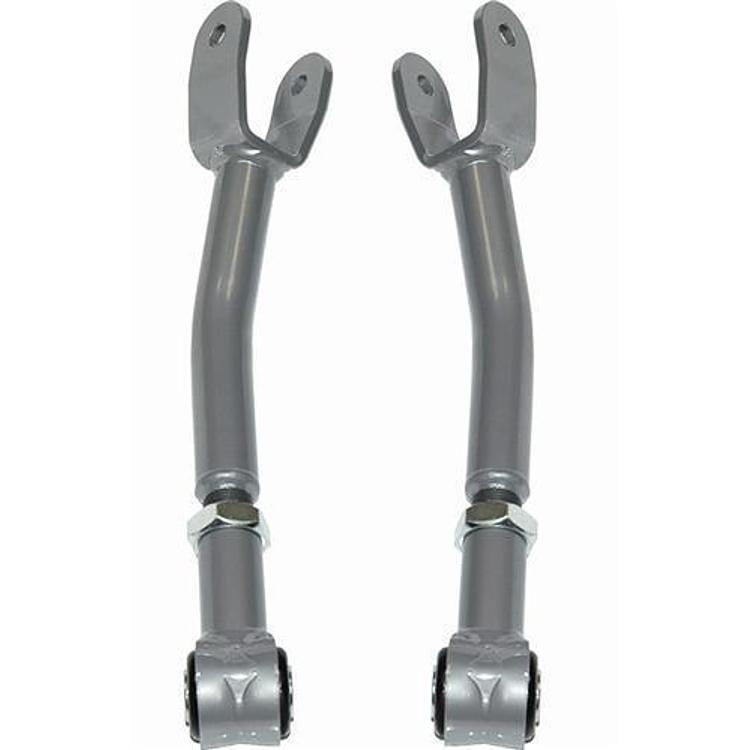
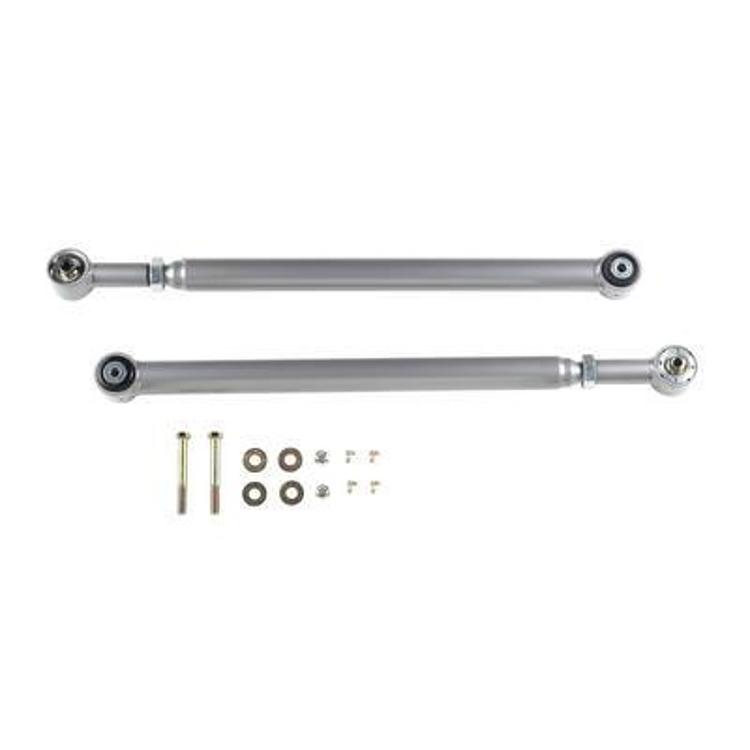
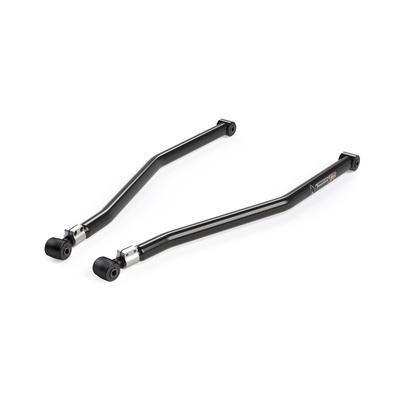
Individual pieces suit repairs and staged builds: RE4075 JK front upper long arms, RE4090 JK rear upper long arms and RE4525 rear lower arm mounts. The RE8330 long arm upgrade kit is built for owners who already run a Rubicon Express short arm system. The Gladiator TeraFlex 1418550 rear upper and 1418560 rear lower long arm pairs can be added to an existing lift with the 1968000 long arm bracket kit.
What about drop brackets?
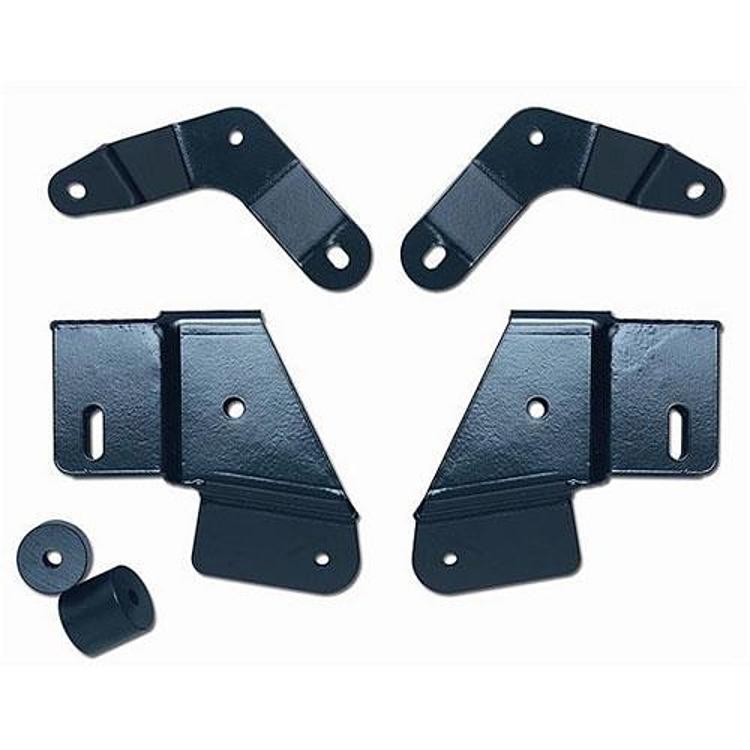
A control arm drop bracket is the middle ground. It lowers the frame mount and flattens the arm without changing arm length. The Rubicon Express RE9900 drop brackets move the XJ arms about 3 inches lower and 1/2 inch forward, and suit 5.5-inch lifts, used with the Rubicon Express RE9905 support brackets. See control arm drop brackets for other applications.
Long arm drawbacks: clearance and anti-squat
Long arms give up some clearance. The brackets and crossmember usually sit under the frame rails, where they become contact points on rock, and the longer lower arms run through the same space.
Anti-squat measures how much of the rear squat under acceleration the links cancel, and it comes from where the upper and lower rear links would intersect if extended. Link angles set that point, so mount heights matter as much as arm length. Steep links raise anti-squat, and too much makes the rear axle hop on hard climbs. A long arm kit changes those angles, and TeraFlex tunes anti-squat into the lengths of its Sport, short and long arms. The traction bars vs ladder bars guide explains how the same axle forces behave on leaf-sprung trucks.
Upper control arms on IFS trucks: why does ball joint angle matter?
Upper control arms on IFS trucks matter because a lift lowers the knuckle relative to the frame, which pushes the upper ball joint toward the end of its range. An aftermarket arm repositions that joint at lifted ride height, restores caster and gives the wheel more usable droop.
Factory upper arms are designed for factory height. Lifted trucks run the upper ball joint closer to its limit, so it can bind at full droop, especially around 2 to 3 inches of lift. A lifted truck can also run out of caster adjustment on the factory adjusters, and some factory arm designs can contact the coil bucket at lifted height and droop. Warning signs include alignment that will not come into range, a harsh ride at full extension, front-end clunks, wandering steering and uneven tire wear. Choose arms designed for your truck, since cup angle and arm shape are specific to each platform.
Uniball, high-angle ball joint or factory-style ball joint?
- Uniball: a spherical bearing, usually stainless with a PTFE (Teflon-type) liner, that articulates with little bind. The Fabtech FTS22336 Bronco upper arms use 1-inch FK uniballs in 4130 chromoly tube and add a degree of caster. The open design lets dirt, water and road salt reach the bearing, which is why ICON offers a billet cap.
- High-angle ball joint: a sealed, greasable joint built for more articulation. The ICON Delta Joint PRO is rated at 90 degrees from one extreme to the other in the ICON 48400DJ tubular and 48500DJ billet Bronco kits. The 4 Wheel Parts 52005B Bronco arms also use a high-angle joint and PTMEG bushings.
- Greasable ball joint: the Rough Country 19401A forged GM arms use POM ball joints and factory-style Clevite rubber bushings for 2007–2016 GM 1500s. They fit 2.5 to 3.5-inch or 7-inch lifts, not 5 to 6-inch lifts or factory height.
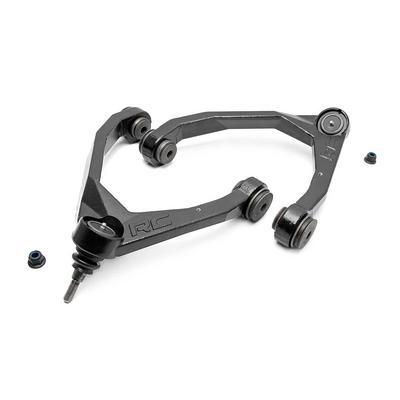
Pro Comp and other upper arms for Toyota, GM, Ford and Ram
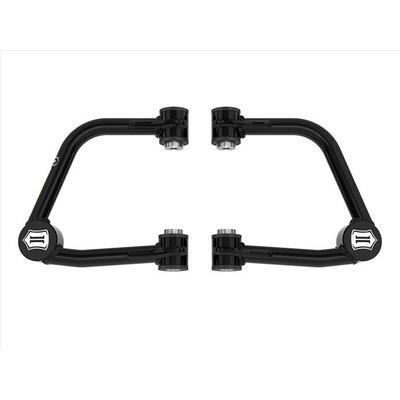
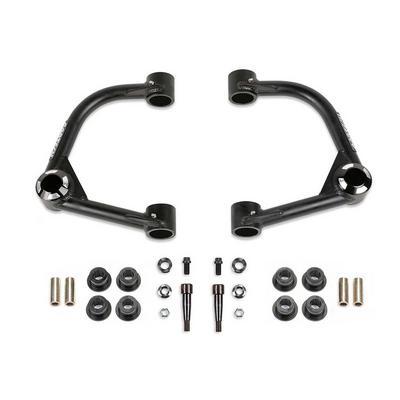
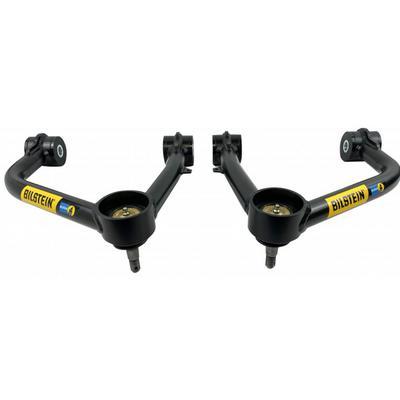
- Toyota: the Bilstein B8 51-304683 adds caster and improves ball joint pivot angle on the Tacoma, and pairs with the shocks in the Bilstein 5100 vs Fox 2.0 comparison. Pro Comp 57015B Pro Series arms fit the 2003–2024 4Runner, and Pro Comp 57003B uniball arms fit the 2010–2024 4Runner and 2007–2014 FJ Cruiser. Pro Comp 57016B arms and the Rough Country 76700 for a 3.5-inch lift fit the 2007–2021 Tundra.
- GM: Pro Comp 51040B arms fit 2007–2016 Sierra 1500 and Silverado 1500 trucks, and Fabtech FTS21128 uniball arms cover 0 to 6 inches on 2007–2018 models.
- Ford: Pro Comp 52003B arms fit the 2019–2021 Ranger.
- Ram: the Rough Country 31201 for a 3-inch lift fits the 2012–2018 Ram 1500 and 2019–2024 Ram 1500 Classic.
Old Man Emu gives a useful sense of scale: on about a 2-inch lift, its arms add 2.5 to 3.5 degrees of caster and up to 1.5 degrees of camber, and they keep a sealed, greasable factory-type ball joint instead of a uniball. The alignment, caster and camber kits suit trucks that only need a small correction within the range of their factory arms.
Which control arms fit your lift height?
Match the arm to the lift: factory or fixed arms up to about 3 inches, adjustable arms from about 3 inches, long arms from about 5 inches or sooner for ride, and upper arms on IFS from about 2.5 inches.
| Lift | Solid-axle Jeep | IFS truck or SUV |
|---|---|---|
| 0–2 in | Factory arms are normal; adjustable arms are optional for alignment. TeraFlex Alpine for the JT starts at 0 in. | Some road-driven trucks stay on factory upper arms up to about 1.5 to 2 in. |
| 2.5–3 in | Preset short arms such as TeraFlex Sport, or adjustable arms to fine tune at 3 in. | Upper arms become common: Rough Country 19401A from 2.5 in, Rough Country 31201 at 3 in on Ram, Fabtech FTS22336 on Bronco. |
| 3.5–4.5 in | Adjustable short arms (TeraFlex Alpine short: 2–4 in on JK, 0–4.5 in on JT) or a long arm kit (JK4423FPR at 3.5 in; TJ Enduro LCG at 3 or 4 in). | Upper arms expected: Rough Country 76700 at 3.5 in on Tundra, Fabtech FTS21128 for 0–6 in on GM. |
| 5–6 in | Long arms are the usual choice: TeraFlex Alpine long (3–6 in), JK4425R at 5.5 in, TJ Pro LCG at 4 or 5 in, or RE9900 drop brackets on an XJ at 5.5 in. | Upper arms are typically part of the lift. Check the arm's lift range: Rough Country 19401A does not fit 5–6 in lifts. |
For a side-by-side look at springs, tires and arms on one platform, read the JK 2.5 vs 3.5 vs 4.5-inch lift comparison.
How do you grease and service control arms?
Grease flex joints and polyurethane bushings at chassis-service intervals with a hand gun and the grease recommended for that joint or bushing. Rubber and sealed joints take no grease, so inspect them for tears and play, then rebuild or replace what has worn.
Greasing by joint type
- Johnny Joints: use a hand pump gun and non-synthetic hi-moly grease. The joint holds little grease, and over-greasing or a pneumatic gun can damage it.
- Super-Flex and threaded joints: grease through the fitting at chassis-service intervals, and after deep water or mud. Wipe the fitting first so grit stays out of the race.
- Polyurethane: grease often enough to prevent squeaks. A squeak usually means the bushing is dry.
- Delta Joints: sealed, greasable and rebuildable. The standard joint ships pre-greased with waterproof moly grease, and the PRO’s fitting on the 48400DJ kit sits under a billet dust cap.
- Uniballs: PTFE-lined and not greased; keep the dust cap on, inspect and replace.
- Rubber and sealed IR bushings: no grease. TeraFlex factory-style bushings are maintenance free.
Rebuilding worn joints
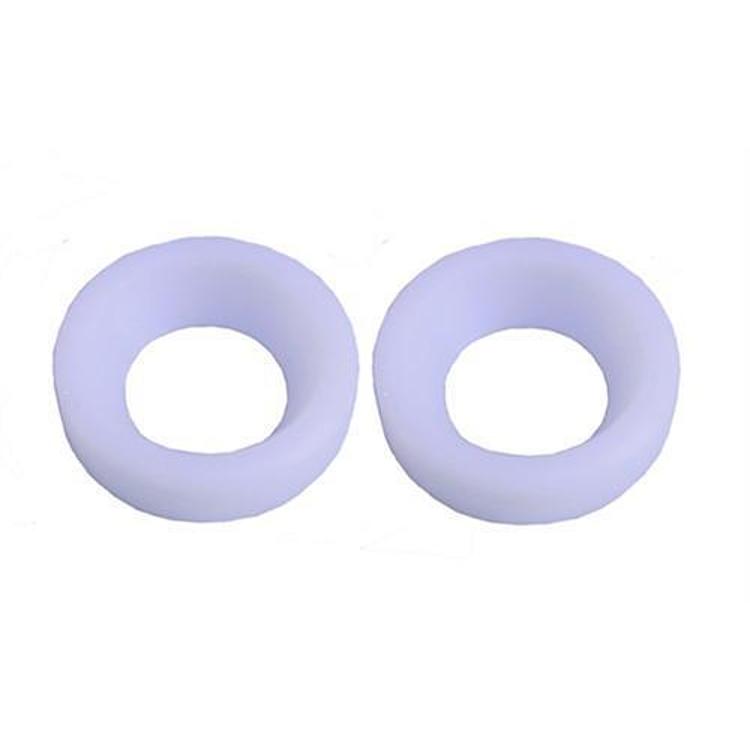
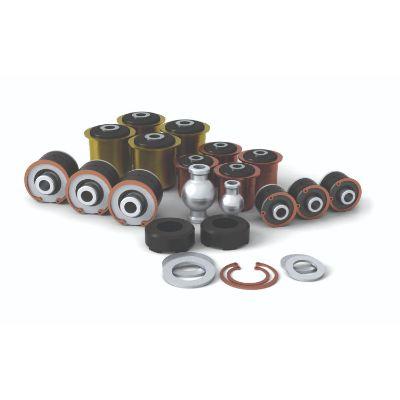
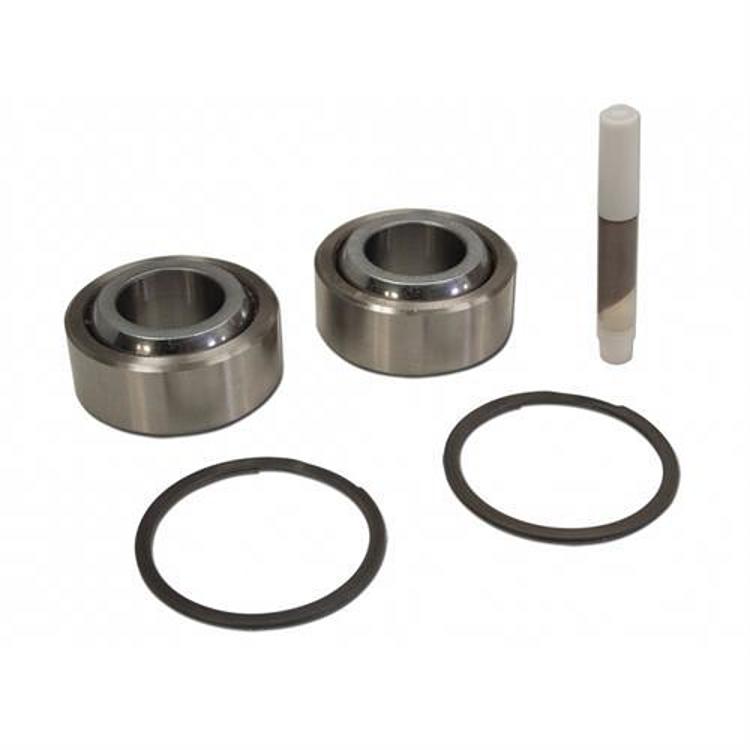
Most flex joints rebuild with a small kit. A Currie 2.5-inch Johnny Joint rebuild kit replaces the two urethane halves, washers and snap ring in a standard-width joint; narrow bodies take a different kit. Rubicon Express makes RE3799 large Super-Flex replacement races and the RE3772 1/2-inch drive assembly tool. TeraFlex offers the 1952200 kit for eight JK short arms and the 1952600 kit for four lower short FlexArms. For ICON uniball arms, the ICON 614500 service kit supplies two uniballs and retainer rings.
What to inspect
- Rubber: cracks, tears or a sleeve sitting off center. Worn arm bushings are one of the causes covered in the death wobble guide.
- Joints: rock the arm by hand with the vehicle supported. Play, binding or a notchy feel means it is time to rebuild.
- Tubes and mounts: bent tubes, cracked welds and ovaled bolt holes in the brackets.
- Threads: jam nuts and pinch collars tight, with thread showing equally side to side.
- IFS ball joints: torn boots, play and a loose taper at the knuckle. See ball joints for solid-axle knuckle replacements.
Installing arms the right way
- One side at a time: change one arm at a time so the axle stays in place.
- Match lengths: measure center to center and set both arms on an axle to the same length.
- Torque at ride height: MOOG explains that torquing rubber bushings with the suspension hanging twists them too far and can cause early failure. Put the vehicle on the ground, bounce it to settle, then torque to the arm maker's figure.
- Re-center and recheck: reset the track bar after changing arm length, then recheck the hardware after the first few drives.
- Align: check caster and toe on an alignment rack, and measure driveshaft angles with an inclinometer on a level floor.
Frequently asked questions
Do I need adjustable control arms for a 2.5-inch lift?
Usually not on a Jeep Wrangler JK. A 2.5-inch spring lift can run on factory arms, and TeraFlex sizes its fixed Sport arms for 2.5 to 3 inches when you want stronger arms with corrected lengths. At 3 inches and up, a JK needs arms that correct caster and pinion angle, either preset for that height or adjustable.
At what lift height do long arms make sense?
Long arms start to make sense at about 3 inches and become the usual choice at 5 to 6 inches on a solid-axle Jeep. TeraFlex sizes its JK short arms for 2 to 4 inches and its long arms for 3 to 6 inches. Between 3 and 4 inches, the choice depends on how much ride quality and articulation you want from the build.
Do lifted IFS trucks need upper control arms?
Some trucks, mainly road-driven ones, tolerate about 1.5 to 2 inches of front lift on factory upper arms. Above that, the upper ball joint runs closer to its limit, caster often falls out of range and droop can bind. Aftermarket upper control arms reposition the joint and restore caster, so they are common from about 2.5 inches up.
Can control arms fix both caster and pinion angle on a front axle?
Only up to a point. Caster and pinion angle share one axle housing, so rotating the housing with the arms moves both at once. Adding caster points the pinion lower. If the two targets cannot be met together, set caster first on a road-driven vehicle and solve the driveshaft angle with a double-cardan shaft, or rotate the knuckles on the axle tubes.
How often should I grease flex joints?
Grease them at normal chassis intervals, and after deep water or mud. A small amount is enough. Johnny Joints hold little grease and can be damaged by over-greasing, so use a hand pump gun and a non-synthetic, hi-moly grease. Sealed rubber bushings and sealed IR bushings take no grease at all.
Is a Johnny Joint the same as a heim joint?
No. A heim joint, or rod end, runs a metal ball in a metal or PTFE-lined race, so it passes more noise and vibration into the frame. A Johnny Joint holds a steel ball between urethane bushings inside a steel shell. It is rated at 30 degrees of movement in any direction against 22 degrees for a standard heim joint.
Start with your lift height and your arm position, then pick the joint that suits how you drive. Browse control arms, long arm upgrades, flex joints and control arm bushings for the parts named here.
Sources
- TeraFlex, JK Wrangler/Unlimited: Control Arm and HD Forged Adjustable Track Bar Guide: arm lengths, lift ranges and joint designs.
- TeraFlex, TJ and LJ Suspension Lift Guide: short arm and long arm systems by lift height.
- TeraFlex, Frequently Asked Questions: when a JK lift needs control arms.
- Spicer, Driveline Operating Angle Calculator: minimum, matched and maximum universal joint angles.
- Spicer, Measuring Angles: how to measure driveline angles.
- MOOG, Rubber Bushing Torquing Tip: torquing suspension bushings at ride height.
- RockJock, CE-9110RK Johnny Joint Rebuild Kit: contents, movement and greasing.
- ICON Vehicle Dynamics, Delta Joint and Uniball billet cap: joint designs and uniball exposure.
- ARB, A Call to Arms: Upper Control Arms: caster and camber on IFS lifts.
- JBA Offroad, Do Lifted Trucks Need Upper Control Arms?: ball joint angle, droop and warning signs.
- MetalCloak, What Are Control Arm Bushings? and Duroflex Control Arms: bushing types compared, Duroflex misalignment and rebuild.