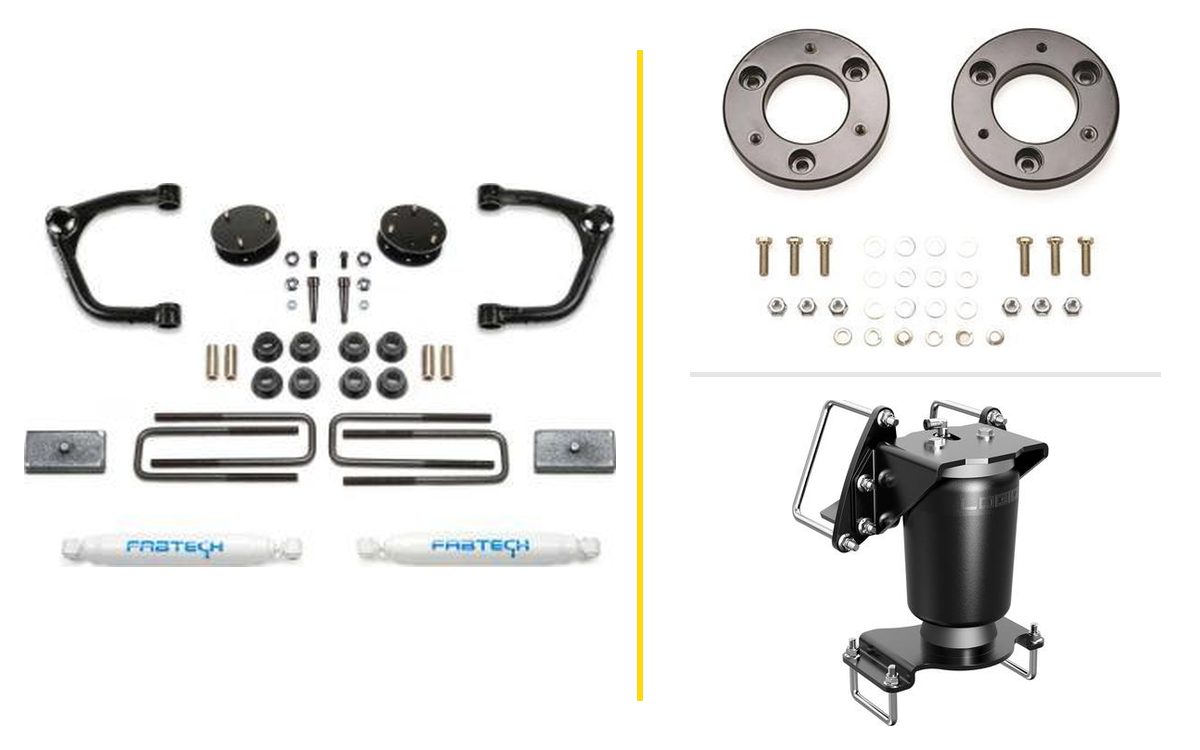
A leveling kit vs a lift kit comes down to changing the stance or changing the whole truck. A leveling kit raises only the front, usually 1.5 to 3 inches, to remove factory rake. A lift kit raises both ends and adds parts that correct the geometry, so the same 3 inches means different things in each.
Key takeaways
- Leveling removes rake: a front-only kit trades the truck’s built-in load margin for a level look and room for slightly larger tires, typically 1.5 to 3 inches.
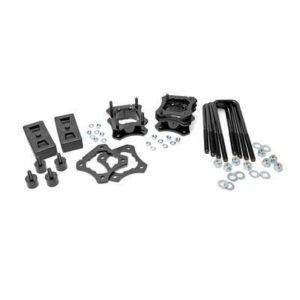
- A real lift raises both ends: a 3-inch kit for independent front suspension usually adds upper control arms, a relocated differential, strut spacers and matching rear blocks.
- Tires are the honest measure: most half-ton kits at this height clear 33-inch tires, and 35s take the right kit, wheel backspacing and sometimes trimming.
- Height steepens the angles: on independent front suspension (IFS), CV axles and ball joints run at steeper angles, and the worst of it comes at full droop, when the wheel hangs at the bottom of its travel.
- Load leveling is a different job: air bags and helper springs hold up a loaded rear end. They do not raise ride height unloaded in any useful way, and they never raise the truck’s ratings.
Why do trucks have factory rake?
Trucks leave the factory nose-low so the rear has room to settle under a load. Rake is the height difference between a lower front and a higher rear. Weight in the bed or on the hitch compresses the rear springs and brings the truck close to level, as ReadyLift explains in its leveling kit guide.
An empty Chevrolet Silverado 1500 or Ford F-150 looks nose-down because it is set up for the day it carries something. Remove the rake and the truck looks better empty, but it reaches nose-high sooner when it is loaded.
To see how much rake your truck has, park on flat ground and measure from the ground to the fender lip at each corner. The front-to-rear difference is a close estimate of how much lift a leveling kit can add before the nose passes the tail. Do this with the tires and load you normally run.
Leveling kit vs lift kit: what is the difference?
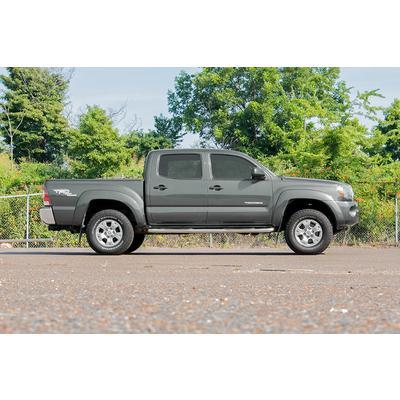
A leveling kit raises the front to match the rear and leaves the rest of the truck alone, while a lift kit raises both ends and includes the parts needed to keep geometry in range. The two overlap around 2.5 to 3.5 inches, which is why part names can be confusing. What matters is what comes in the box.
| Leveling kit | 3-inch lift kit | Load-leveling kit | |
|---|---|---|---|
| What it does | Removes rake | Raises the whole truck | Holds up the rear under load |
| Where | Front only | Front and rear | Rear, usually |
| Typical parts | Strut spacers, coil spacers or torsion keys | Spacers or coil-overs, upper control arms, differential drop, rear blocks, shocks | Air springs, urethane springs or a load-leveling leaf |
| Tire room | Usually 1 size up, often 32 to 33 in | Often 33 in, some kits 35 in | None |
| Unloaded height | Front up, rear unchanged | Both ends up | Essentially unchanged |
| Alignment needed | Yes | Yes | No, in normal use |
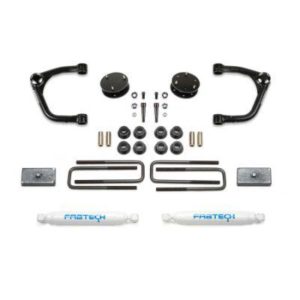
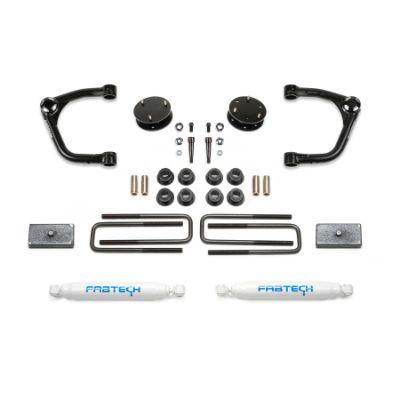
The word “kit” hides a wide range. The Rough Country 7592 torsion keys are two forged keys and shock spacers. The Fabtech K1129 3-inch lift has upper control arms, front spacers, rear blocks, U-bolts and rear shocks. Both raise the front of a GM half-ton, but they do very different amounts of work.
What types of leveling kits are there?
There are three common types, and your front suspension decides which one applies: strut or coil spacers for coil-sprung fronts, torsion keys for torsion-bar fronts, and replacement coil-overs for coil-over fronts when you also want better damping.
Strut spacers and coil spacers
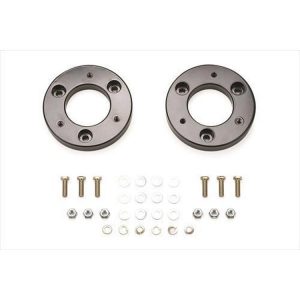
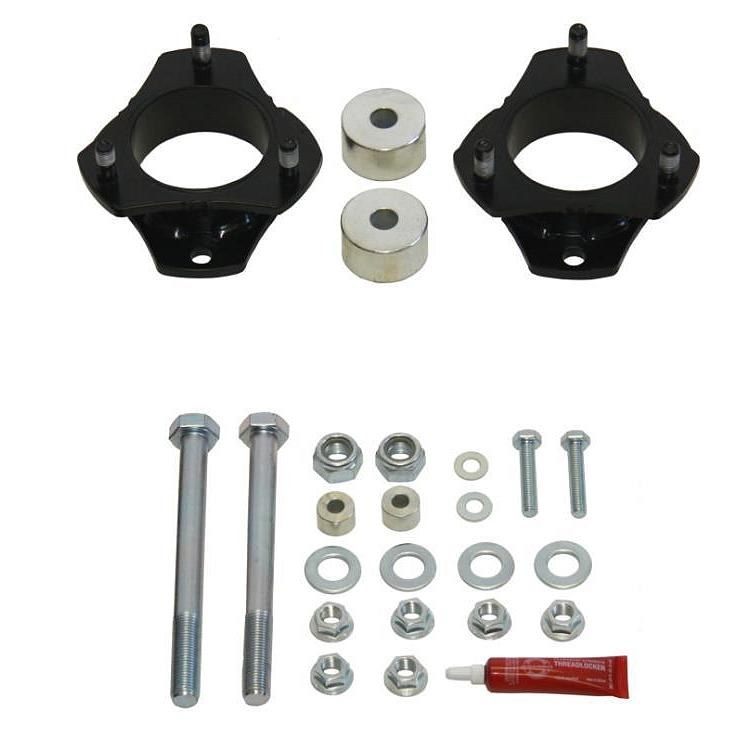
A strut spacer bolts to the top of a factory coil-over strut and pushes the assembly down, which raises the truck. The strut itself stays in place, along with its spring and damping. The Fabtech FTL5107 billet spacers work this way on 2007-2017 Silverado 1500 trucks and 2007-2018 GMC Sierra 1500 trucks, and the Rough Country 743 strut extensions do the same for the Toyota Tacoma from 2005 to 2023. On IFS the strut sits inboard of the wheel, so a spacer can be thinner than the lift it produces. The shims in the Rough Country 87001 kit for the Tundra show the ratio: each 1/4-inch plate adds about 3/8 inch of lift.
At the top of the range, the Pro Comp 62200 steel spacers give 3 inches on the 2004-2014 F-150, and the Daystar KT09125BK polyurethane spacers give 3 inches on the 2007-2017 Toyota Tundra.
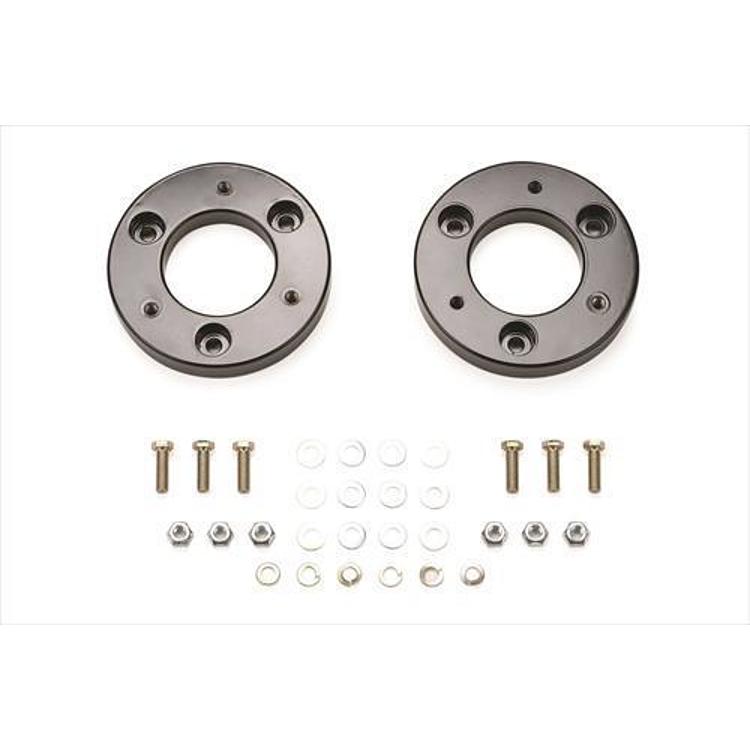
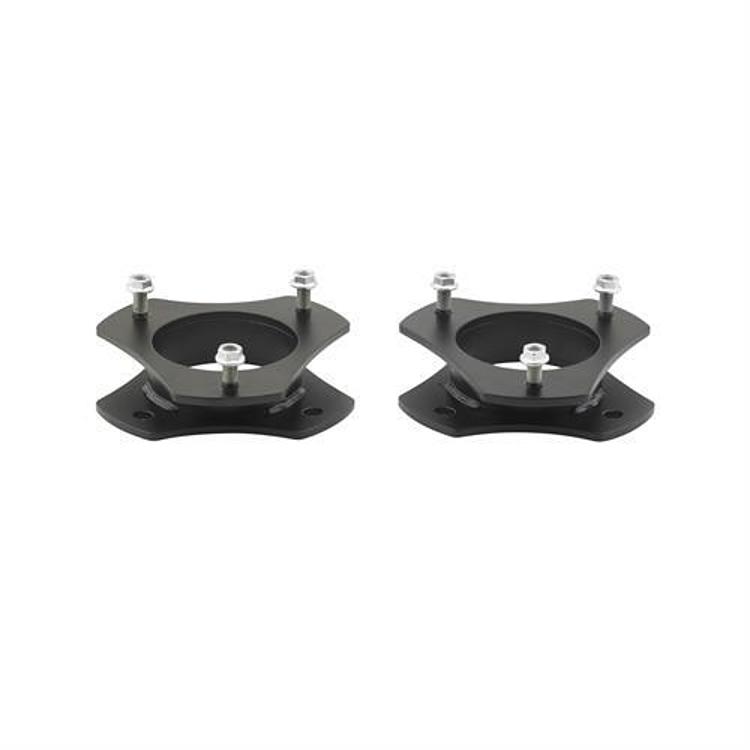
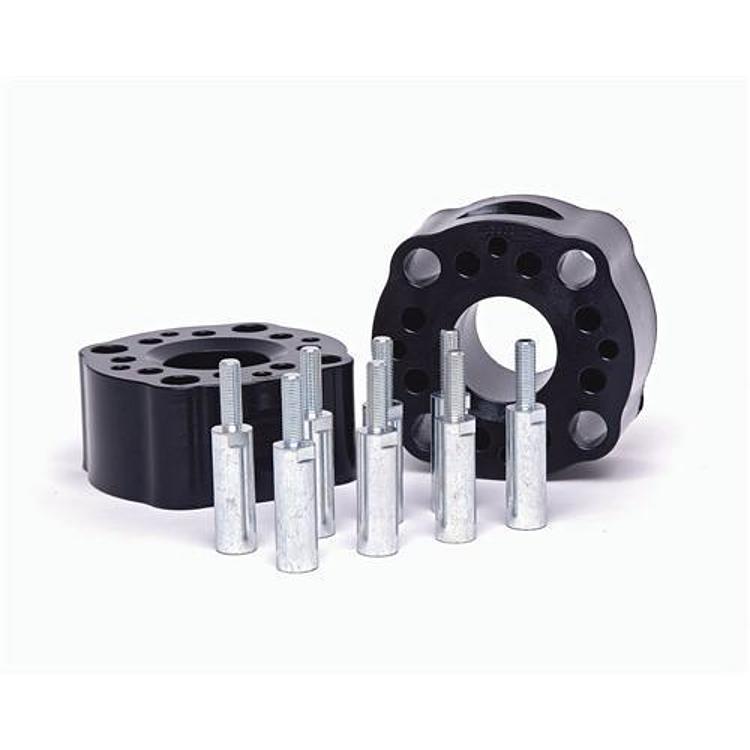
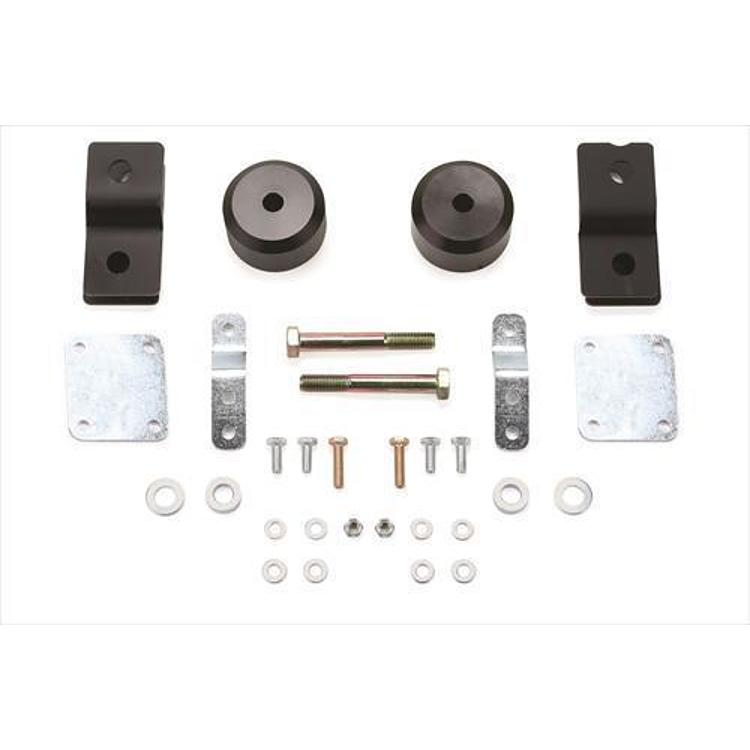
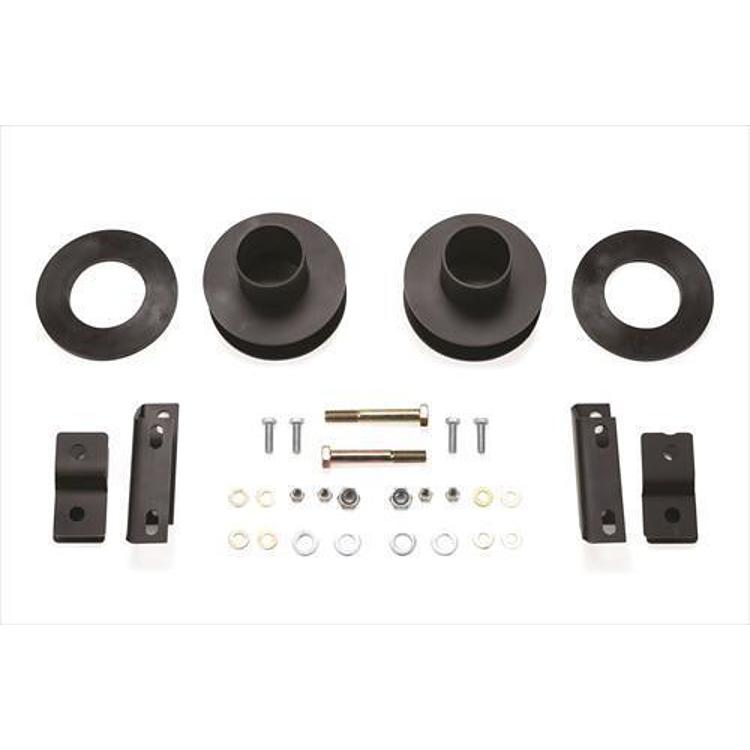
A coil spacer sits on the coil spring bucket instead of on top of a strut. This is the usual method on solid front axle trucks, such as the 4WD Ford F-250 Super Duty. The Fabtech FTL5205 adds 2 inches on 2005-2015 F-250 and F-350 Super Duty trucks, and the FTL5206 adds 2.5 inches on 2011-2015 trucks. A solid axle has no IFS-style CV shafts to worry about, but its track bar and drag link angles still change.
Torsion keys
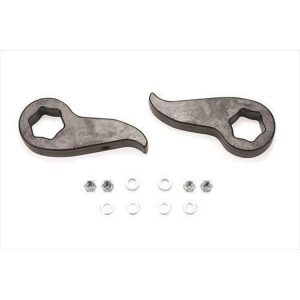
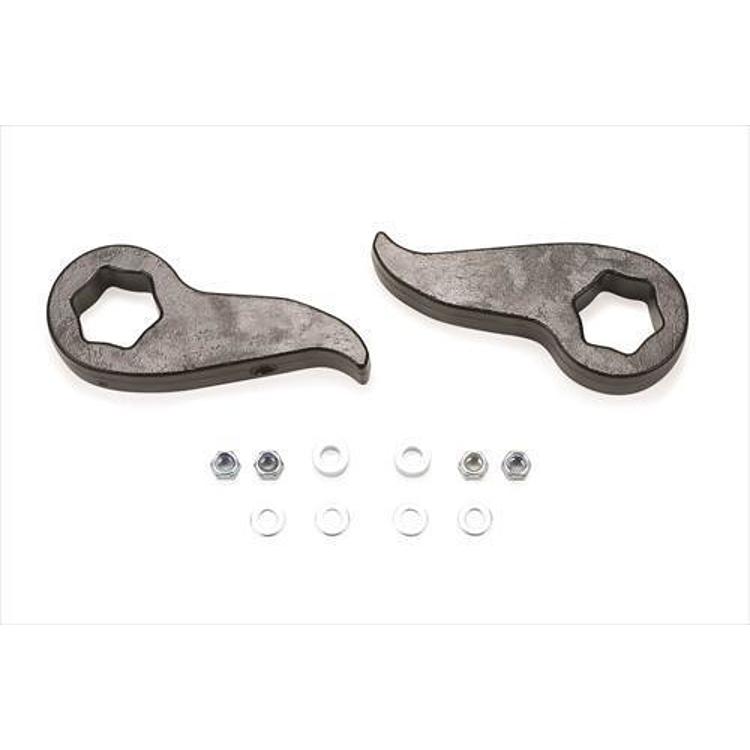
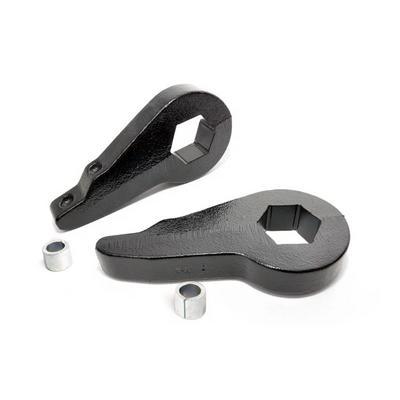
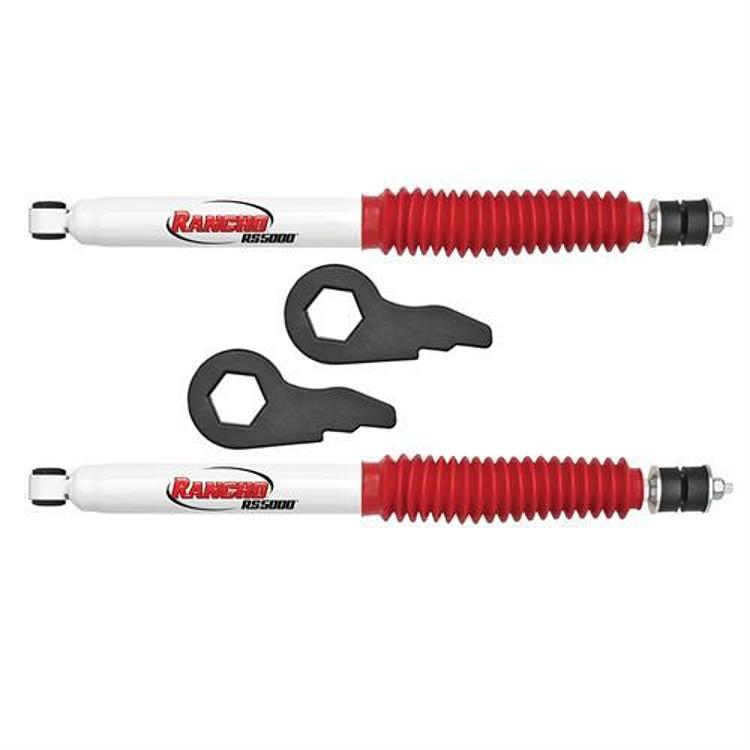
A torsion key is the lever that sets how far a torsion bar is twisted, and that twist sets front ride height. An aftermarket key re-clocks the bar to raise the front. Common uses are the 1.5 to 2-inch keys for 1999-2006 GM 1500 trucks, the Fabtech FTL5105 for 2011-2018 GM 2500 HD and 3500 HD trucks such as the Silverado 2500 HD, the Skyjacker C102KE for 2001-2010 GM HD trucks, and the Rough Country 7544 keys for the 1997-2003 F-150. Some 2WD GM 1500 trucks of those years use front coil springs instead of torsion bars, so confirm what your truck has before ordering keys.
Do not simply crank the factory adjusters further. ReadyLift explains that a factory key that tops out in the cross member leaves zero rebound past that height, and its suspension FAQ adds that this can push the factory shock past its range, so it tops out and fails quickly. That is why many kits include shock extensions, and why some, like the Rancho RS66300R5, come with new front shocks. Removing a loaded key safely takes a tool such as the Pro Comp 67965 unloading tool. See every option under torsion bar keys.
Coil-overs and complete strut assemblies
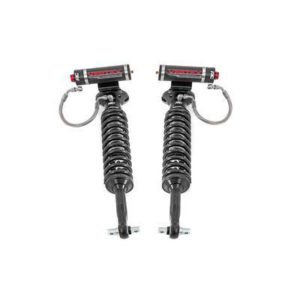
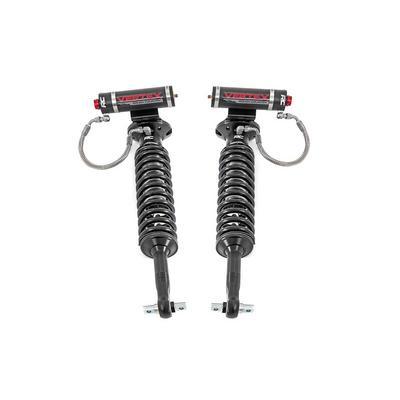
A coil-over leveling kit replaces the factory strut with a new shock and spring set for more height. Because it changes the damping too, this type can improve the ride instead of just preserving it. The Rough Country 689012 Vertex coil-overs give the 2014-2026 F-150 2 inches of lift with 8-stage adjustable reservoir shocks. The Icon 91711 2.5 VS coil-overs offer a range of 0 to 3 inches rather than one fixed height.
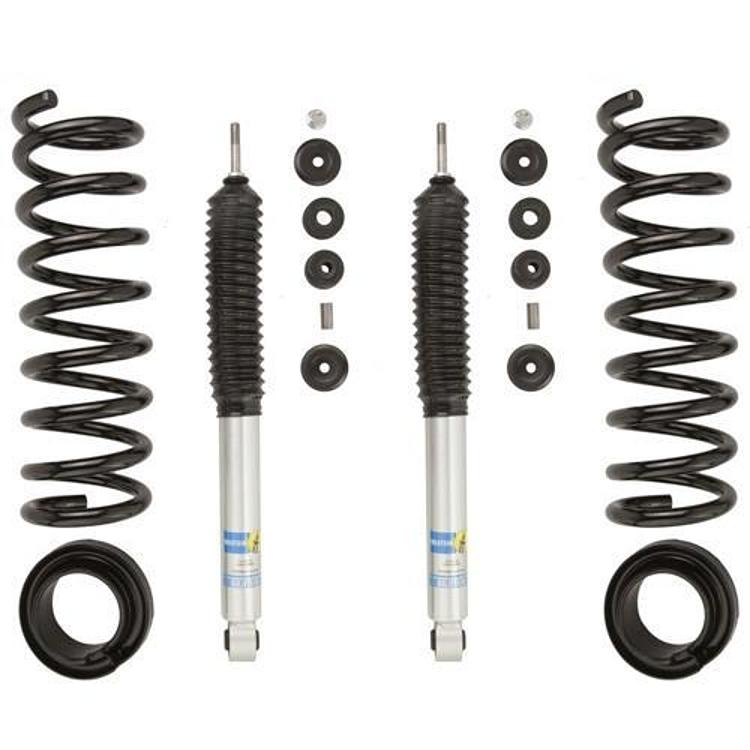
Some kits sit between the two. The Bilstein B8 5112 pairs a 46 mm monotube shock with tuned springs for 2 to 2.75 inches, the Bilstein B8 5162 pairs B8 5160 reservoir shocks with matched coils for 2 inches on the 2014-2026 Ram 2500, and the Rough Country 501022 is a complete strut replacement for the 2006-2008 Ram 1500. For how those damper designs differ, read twin-tube vs monotube vs reservoir shocks.
What does a 3 inch lift kit add over a 3 inch leveling kit?
A 3-inch lift kit adds rear height and the front-end parts that keep geometry in range at that height. A 3-inch leveling kit gives the same front number, but usually leaves control arms, the differential and the rear of the truck as they were.
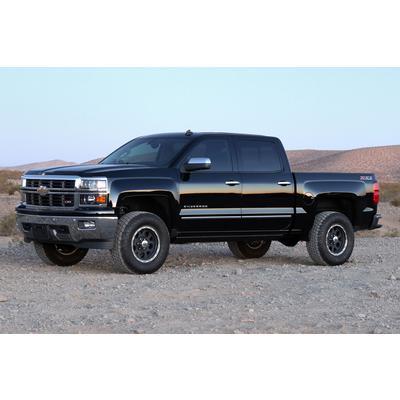
The Fabtech kits for GM half-tons show the difference clearly. The K1059M for 2007-2015 and 2017-2018 trucks and the K1071 for 2014-2015 and 2017-2018 trucks both keep the factory coil-overs on a steel spacer, then add the following:
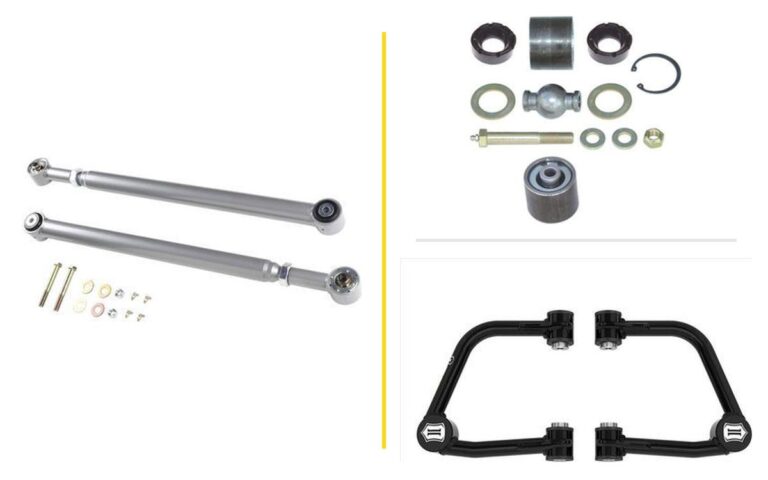
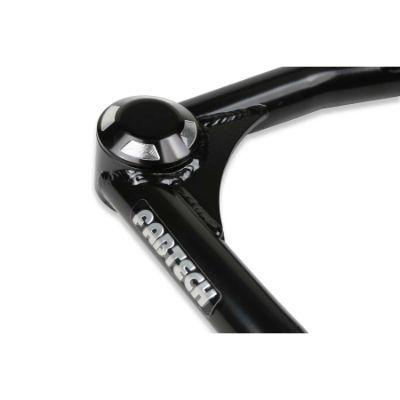
- Upper control arms: tubular arms with extended range ball joints on the K1059M, or chromoly arms with Uniballs on the K1071.
- A relocated front differential: lowered to keep CV angles in range at the new height.
- A skid plate: a 1/4-inch steel plate protects the underside.
- Rear lift: 1 1/2-inch blocks and U-bolts, with new rear shocks.
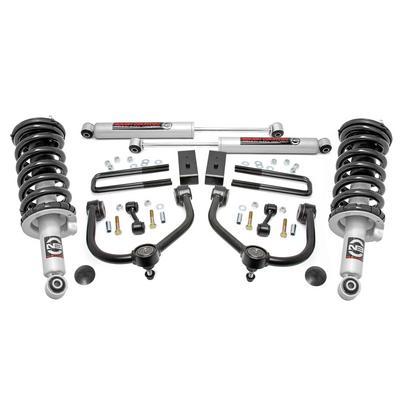
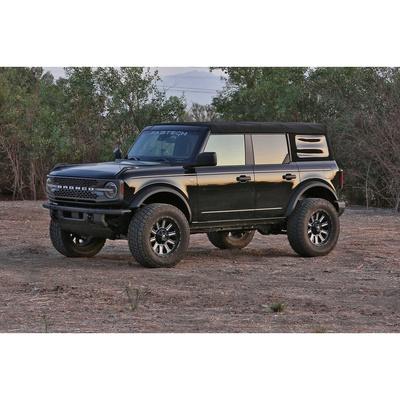
Other trucks get a similar recipe. The Rough Country 83431 for the 2017-2021 Nissan Titan pairs tubular upper arms with lifted front struts and fabricated rear blocks. The Skyjacker TC536STBN for the 2016-2019 Tacoma and the Skyjacker TU730STBB for the 2007-2019 Tundra use new performance struts up front instead of spacers, with a block-and-spacer rear lift and new rear shocks. The Fabtech K2383 for the 2021-2026 Ford Bronco adds Uniball arms with extra caster and a rear track bar bracket to re-center the axle.
Solid-axle vehicles have no CV shaft angle at the differential to manage, so a 3-inch kit there is about springs and links. The Fabtech K4047 for the Jeep Wrangler JK has four coil springs, front and rear shocks, sway bar links, bump stops, a rear track bar bracket, a brake hose extension and parking brake cable brackets. Its springs are built for the two-door, so confirm the height it gives on a four-door Unlimited. Our JK lift height comparison covers that platform in depth.
Where do 3 inches actually go?
A 3-inch kit does not put 3 more inches under every part of the truck. The lift raises the frame and body relative to the wheels, and parts that stay with the wheels gain nothing:
- Frame, body and rockers: the full 3 inches, which is where tire room comes from.
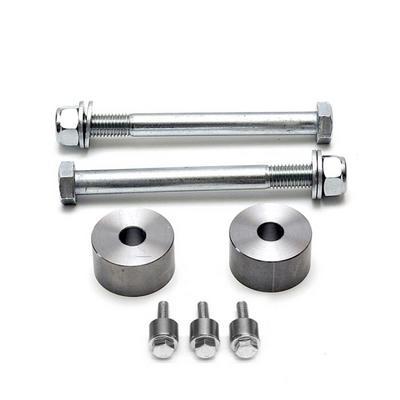
- IFS front differential: less than the full lift if the kit lowers it. A differential drop gives back some of the height to protect CV angles, and the ReadyLift 47-5005 lowers it about 1 inch.
- Solid axle housings: nothing from the lift, because the axle moves with the wheels. Only taller tires raise an axle housing.
- Tires: half of the diameter gain goes under the axle. Going from a 33-inch to a 35-inch tire raises the axle 1 inch.
What size tires fit with 2 to 3 inches of lift?
Expect 32 to 33 inches on most half-ton and midsize IFS trucks with a 2 to 3-inch kit, and 35 inches only on specific kits, with the right wheels. The kit maker’s limit depends on wheel width and backspacing, so a tire that fits one setup can rub on another.
| Kit | Front lift | Truck | Largest tire |
|---|---|---|---|
| Rough Country 743 | 2 in | Tacoma 2005-2023 | 32 in |
| Daystar PATL230PA | 2.5 in | Tacoma 2005-2016 | 32 in |
| Rancho RS66300R5 | 2.25 in | Silverado and Sierra 1500 1999-2006 | 33 in |
| Rough Country 87001 | 2.5 to 3 in | Tundra 2007-2021 | 33 in |
| Fabtech K1071 | 3 in | Silverado and Sierra 1500 2014-2015, 2017-2018 | 33 in |
| Rough Country 83431 | 3 in | Titan 2017-2021 | 33 in |
| Fabtech K2383 | 3 in | Bronco 2021-2026 | 35 in |
| Fabtech K4047 | 3 in | Wrangler JK, 2007-2018 except 2016 | 35 in |
| Fabtech K3056 | 2.5 in | Ram 3500 2013-2016 | 325/60R20 (about 35.4 in) with minor trimming |
Width and offset matter as much as height. The ReadyLift 2-inch leveling kit for the 2019-2020 Ram 1500 takes a 34 x 11 on a 9-inch wheel with 6 inches of backspacing, and the 3.5-inch front, 2-inch rear system a 35 x 12.5 on a 9-inch wheel with 5 inches of backspacing. 35 x 12.50 tires fit the Zone Offroad 3-inch system for the 2015-2020 F-150, on 18×9 or 20×9 wheels with 5.5 inches of backspacing. More backspacing moves the tire inward, toward the upper control arm.
A 275/70R18 is about 33.2 inches tall, a 285/70R17 about 32.7 inches, a 315/70R17 about 34.4 inches and a 325/60R20 about 35.4 inches. Our tire size conversion guide shows the math, and you can compare sizes under tires.
Bigger tires change more than clearance. New wheels and tires can add over 50 pounds of unsprung weight per corner, and weak factory shocks are often why a truck feels different afterward. Moving from 33-inch to 35-inch tires also makes the effective axle ratio about 6 percent taller, which the engine and brakes both feel.
How do lifts change CV axle and ball joint angles on IFS trucks?
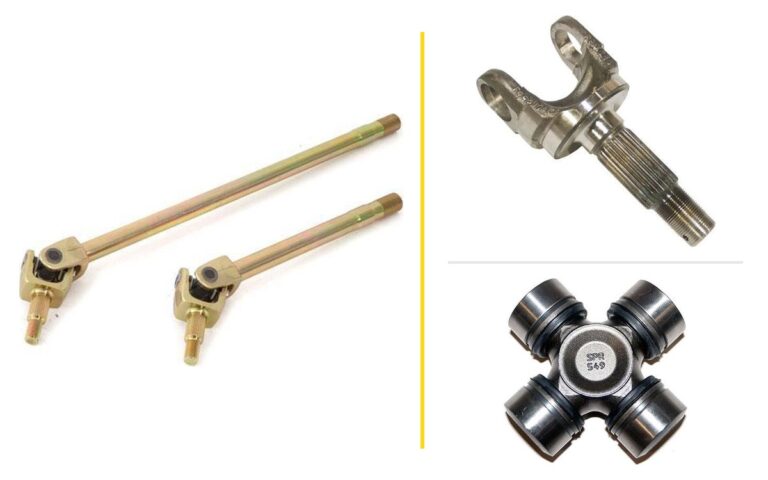
Lifting an IFS truck moves the differential up with the frame while the wheels stay on the ground, so CV axles run at a steeper angle and ball joints sit closer to the end of their travel. A constant velocity (CV) axle is the shaft that carries power from the front differential to each front wheel, and it has a joint at both ends. TrakMotive, a CV axle maker, warns that those angles can cause binding, premature wear and vibration, and points to leveling kits that leave the differential at factory height as a particular case.
The type of spacer changes when the worst angle occurs:
- Top-mount strut spacers: the strut keeps its full stroke, but the spacer lets the wheel hang lower at full droop. That is the steepest CV angle the truck will see.
- Preload spacers and torsion keys: droop stays limited at the factory point, so the wheel has less down-travel from ride height. The truck spends more time near the limit, and the ride can feel harsher on rebound.
- Two-piece spacers: Zone Offroad combines a top-mount spacer with a preload spacer so its 3-inch F-150 kit reaches height without over-extending the suspension and drivelines at full droop.
Differential drops are the direct fix for the CV side. Kits such as the K1071 relocate it as standard, the Daystar PATL230PA for the Tacoma includes drop-down spacers, and the ReadyLift 47-5005 for the 2007-2021 Tundra is a stand-alone part. Common signs of a CV joint that is suffering are a torn outer boot, grease thrown inside the wheel, clicking on tight turns and vibration under power.
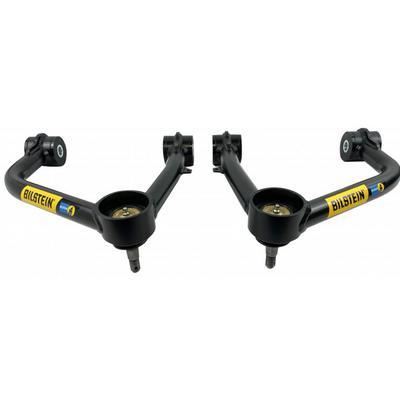
Ball joints are the other half. A factory upper control arm tips upward as the truck rises, and the upper ball joint runs closer to its limit. Replacement arms put it back in range. Zone Offroad uses an indexed ball joint cup to return the joint to neutral, the Bilstein B8 upper control arms for the 2005-2023 Tacoma add caster and improved pivot angles, and Uniball arms swap the ball joint for a bearing with more movement. Tie rod ends also run at a greater angle, so inspect them more often on a lifted truck.
Is a load leveling kit the same as a leveling kit?
No. A leveling kit raises the front of an empty truck, while a suspension load leveling kit supports the rear of a loaded one.
A load leveling system adds spring support only when a load calls for it. The main types are:
- Air helper springs: bags between the frame and the axle or leaf pack. The Air Lift LoadLifter 5000 kit 57398 for 2005-2010 Super Duty trucks is adjustable from 5 to 100 psi and rated up to 5,000 lb, and the Firestone Ride-Rite 2600 kit fits 2017-2019 Super Duty trucks. Air Lift 1000 springs are the lighter choice for coil-sprung vehicles, rated up to 1,000 lb and adjustable from 5 to 35 psi.
- Compressor kits: the Rough Country 10005C for 2007-2018 GM 1500 trucks adds onboard air, so pressure can change without a gas station stop. The Rough Country 10017 for the 2015-2020 F-150 uses the same double convoluted bags, and the ReadyLift ReadyAIR kit for the 2009-2014 F-150 arrives factory assembled.
- Urethane helper springs: SumoSprings are microcellular polyurethane, so there is no air to adjust or leak. The SSR-201-40-2 set is rated for 2,600 lb per pair at 50 percent compression.
- Load-leveling leaf springs: the ARB Old Man Emu CS001F has a two-stage leaf pack. One stage carries the truck empty, the other engages under load.
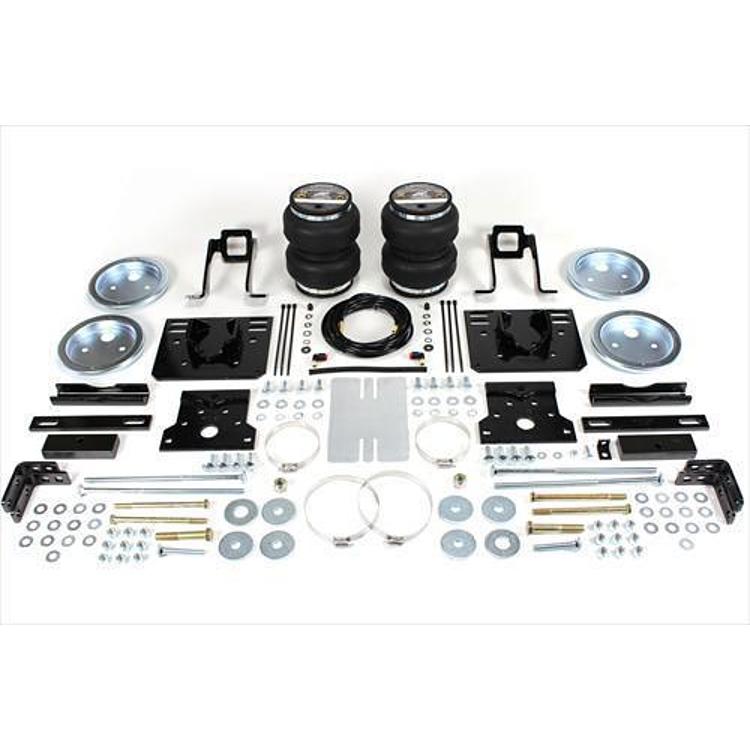
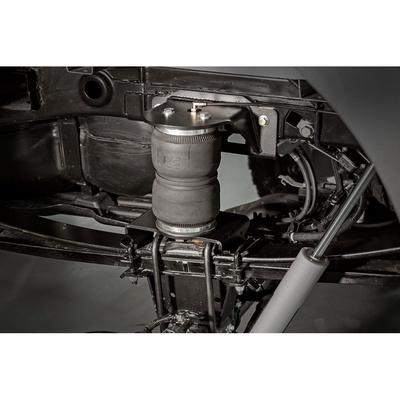
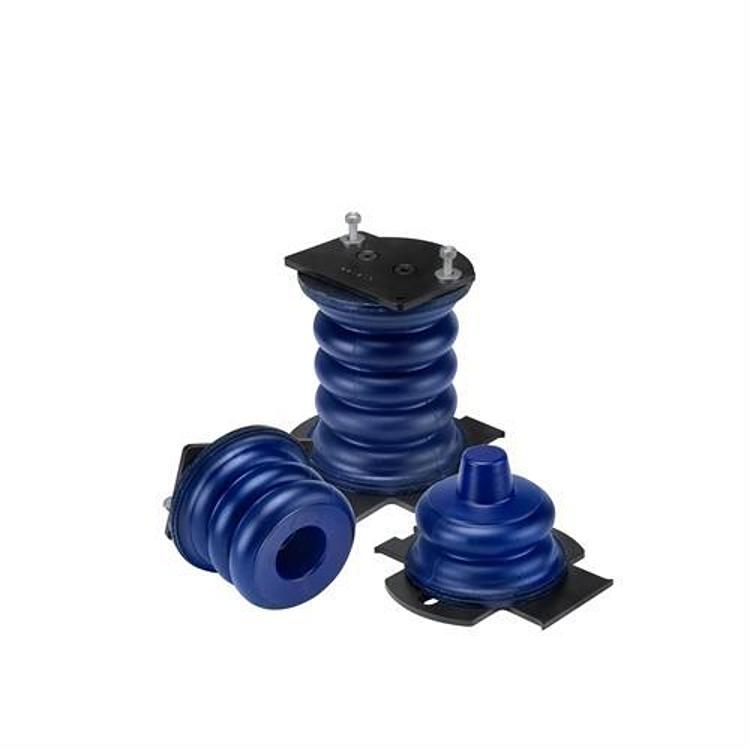
The ratings limit is firm. Never exceed the vehicle maker’s gross vehicle weight rating (GVWR), the total weight the truck is rated to carry. Airbags do not increase payload, GVWR, rear axle capacity, tire capacity, receiver limits or towing capacity. A helper spring makes a load ride better. It does not make a heavier load legal. Check compatibility first if the truck has factory air or adaptive shocks: the Air Lift 57204 kit, for one, does not fit trucks with MagneRide. Browse the full range under suspension load leveling kits and load leveling kits and components.
What is a rear leveling kit?
A rear leveling kit is usually a small permanent spacer for a vehicle whose tail sits low, not a load system. The Daystar KC09116BK is a 1-inch polyurethane rear coil spacer, the Daystar KF09112BK raises the rear of the 2003-2007 Ford Expedition, and the TeraFlex 1155120 adds 0.5 inch to help a 2018-2021 Jeep Wrangler JL carry bumpers-bumpers-tire-carriers-winch-mounts-2, a winch and a larger spare. These spacers suit a fixed load. They do not adjust for a trailer.
How do leveling and lift kits affect towing?
Neither kit raises the tow rating, and a leveled truck gives up the rake that would otherwise absorb tongue weight. Hitch a trailer to a level truck and it can go nose-high quickly, which aims the headlights up and lightens the steering axle.
- Leave some rake if you tow: the Rough Country 87001 for the Tundra sets front height with shim plates, each adding about 3/8 inch of lift. Fewer shims leave a slight nose-down stance for trailers and loads.
- Add a weight distribution hitch: a system such as the Smittybilt 87550 uses spring bars to move tongue load forward. Air bags cannot do this: they correct the rear height, but they do not return weight to the front axle or control sway.
- Use rear helper springs for squat: pairing them with a weight distribution hitch covers both height and axle load.
- Match the ball height: rear lift raises the receiver, so the trailer can ride nose-up unless the ball drops to match. A 4-inch drop ball mount is one option, and drop hitches and ball mounts covers the rest. Check that its rating suits your trailer.
Rear blocks deserve a closer look on a tow vehicle. They sit between the leaf pack and the axle and add leverage for axle wrap under hard acceleration. The Pro Comp 62203 3-inch blocks are tapered to help retain driveshaft angles, and the Fabtech FTS200 add-a-leaf for older Toyota pickups is an alternative that adds a leaf instead of a block. If wheel hop shows up, read traction bars vs ladder bars. Browse the parts under block and U-bolt kits and add-a-leaf kits. Never stack blocks unless the kit maker specifically allows it.
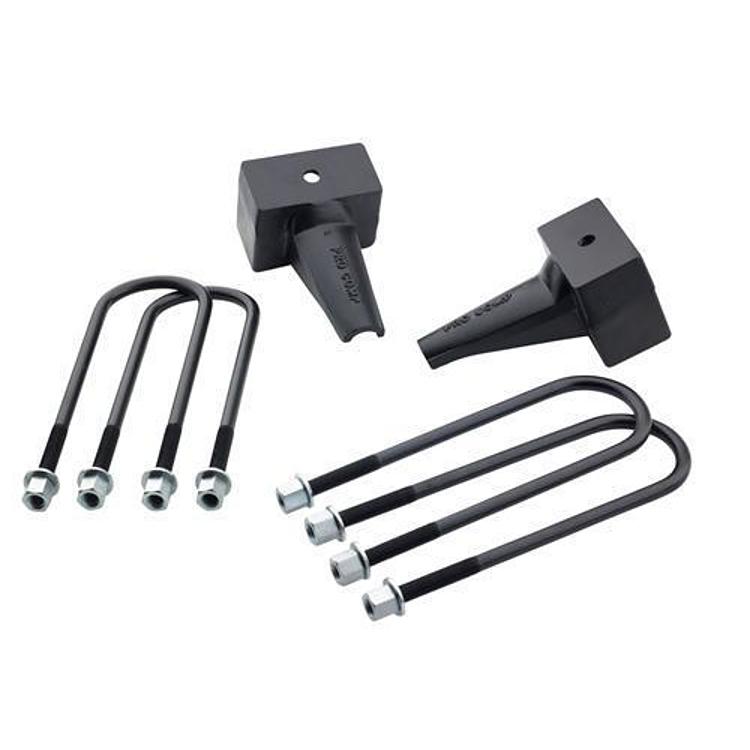
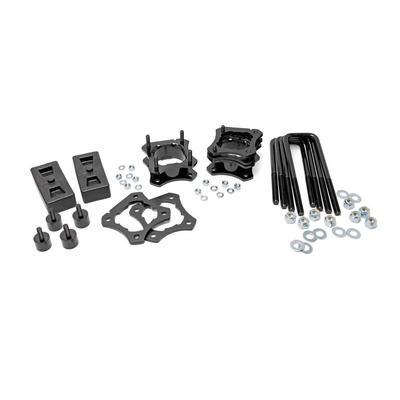
That kit shows what a “3 inch leveling kit” often becomes in practice. The Rough Country 87001 sets 2.5 to 3 inches in front and adds 1.5-inch rear blocks on the 2007-2021 Tundra, so it is already close to a mild lift. The Rough Country 50000 for the 2019-2023 Ranger goes all the way: it carries “leveling kit” in its name, yet it lifts both ends 3.5 inches with tubular upper control arms and differential drop brackets.
Will a leveling kit or lift kit ruin the ride?
Top-mount spacers keep the factory spring and damper and generally ride close to factory, while lost droop travel, cranked torsion keys and larger tires are what make a truck feel harsher. Height itself matters less than remaining travel and tire weight.
- Spacers: the spring rate does not change, and a spacer on a tired strut still leaves you with a tired strut. Coil spacers on solid-axle trucks are known for keeping factory ride quality as long as the shocks still have travel, which is why the Fabtech K3056 includes longer front shocks.
- Torsion keys: the bar’s rate stays much the same, but lost rebound makes the truck feel stiff as the wheel drops into holes.
- Coil-overs and tuned spring kits: new damping is the one route that can improve ride, especially with heavier tires.
- Rear changes: blocks leave spring rate alone, while add-a-leaf kits usually make the rear firmer. The rear shock must also be long enough for the new height, and many kits include new shocks for that reason.
- Bump stops: kits often add stop extensions so tires and parts do not contact at full compression. See bump stops.
Do you need an alignment after a leveling kit?
Yes, always. Any change in front ride height changes toe, and IFS trucks also shift camber and caster.
- Toe: tie rod angle changes with height, so toe almost always moves.
- Camber: on A-arm suspension, raising ride height tends to push camber positive. Factory cams can run out of adjustment at the top of the leveling range.
- Caster: height tends to take caster away, which reduces steering return and stability on the highway. Aftermarket arms such as the K2383 add it back, and the Rough Country Titan arms are designed to make alignment easier.
- Solid axles: toe stays closer to its setting, but caster, drag link angle and track bar position all change. An off-center axle needs an adjustable track bar or bracket, and looseness there can lead to death wobble.
- Other checks: aim the headlights, confirm brake lines and ABS wires have slack at full droop, recheck hardware torque per the kit instructions, and correct the speedometer if the tire size changed.
Which kit fits which truck?
Identify the front suspension first, because it decides the kit type and whether CV angles are part of the job.
| Truck type | Front suspension | Leveling option | Next step up |
|---|---|---|---|
| GM half-ton 2007-2018 | IFS, coil-over strut | Fabtech FTL5107, 2 in | Fabtech K1059M, 3 in (not 2016) |
| GM half-ton 2019-2026 | IFS, coil-over strut | Strut spacer or coil-over | Fabtech K1129, 3 in |
| GM half-ton 1999-2006 | IFS, torsion bar on 4WD | Rough Country 7592, 1.5 to 2 in | Keys with shocks, Rancho RS66300R5, 2.25 in |
| GM 2500 HD and 3500 HD 2011-2018 | IFS, torsion bar | Fabtech FTL5105, 2.5 in | Choose a full lift kit with control arms |
| Ford F-150 2014-2026 | IFS, coil-over strut | Rough Country 689012, 2 in | Spacers with upper control arms, 3 in |
| Ram 1500 2011-2015 | IFS, coil-over strut | Fabtech FTL5301, 2 in | Strut kit with rear lift |
| Toyota Tundra 2007-2017 | IFS, coil-over strut | Daystar KT09125BK, 3 in | Rough Country 87001, 2.5 to 3 in with rear blocks |
| Toyota Tacoma 2016-2019 | IFS, coil-over strut | Rough Country 743, 2 in | Skyjacker TC536STBN, 3 in |
| Ford Super Duty 4WD 2005-2015 | Solid axle, coil spring | Fabtech FTL5205, 2 in | Coil springs and shocks |
| Ram 2500 2014-2026 | Solid axle, coil spring | Bilstein B8 5162, 2 in | Coil springs and shocks |
| Jeep Wrangler JK | Solid axle, coil spring | Coil spacers | Fabtech K4047, 3 in (not 2016) |
Leveling kit or lift kit: which should you pick?
Pick a leveling kit if you want a level stance and one tire size up, and pick a lift kit if you want 33s or 35s with geometry that stays in range. Use this as your starting point:
- Daily driver, light loads: a 1.5 to 2.5-inch leveling kit is enough.
- Tow or haul often: keep the rake or level only part of it, then add helper springs and a weight distribution hitch. Skip the big front number.
- Want 33-inch tires on a half-ton: a 2.5 to 3-inch front kit with rear blocks works, and upper arms make it last.
- Want 35-inch tires: choose a true lift designed for them, with arms and a differential drop on IFS.
- Off-road use on IFS: prioritize travel. A lift with upper control arms and a differential drop, or a coil-over kit, is a better choice than a spacer alone.
- Sagging only under load: you do not need a lift at all. You need a load-leveling system.
Frequently asked questions
Is a 3 inch leveling kit too much?
It depends on how much rake the truck has. Three inches is the top of the normal leveling range, and on many half-ton trucks it raises the nose past the height of the tail, which is why kits such as the Rough Country 87001 for the Tundra pair up to 3 inches in front with 1.5-inch rear blocks. Measure the difference between front and rear first. If 3 inches is more than the gap, add rear lift or choose a kit with new upper control arms.
What size tires fit a 3 inch lift kit?
Most 3-inch kits for half-ton independent front suspension trucks clear 33-inch tires, and some reach 35 inches with the right wheel. The Fabtech K1071 for the Silverado 1500 is built around 33s, the Fabtech K2383 for the 2021-2026 Bronco around 35s. Wheel width and backspacing decide the final fit, so follow the numbers for your exact kit.
Does a leveling kit hurt CV axles and ball joints?
It increases the working angle of both. Raising the frame makes the CV axles run steeper from differential to wheel and tips the upper ball joint closer to the end of its travel. A modest lift within the kit maker’s limits is a common setup, but front-end parts tend to wear faster than they do at factory height, especially at the top of the range and with heavy tires. A differential drop and corrected upper control arms reduce those angles.
Do I need an alignment after a leveling kit?
Yes. Raising the front changes toe, camber and caster on independent front suspension, and toe alone can wear a set of tires quickly. Have the truck aligned right after the install at the height it will actually run, and recheck after the first few hundred miles if the suspension has been settling.
Does a load leveling kit increase towing capacity?
No. Air helper springs and urethane helper springs support the load and correct squat, but they do not change payload, gross vehicle weight rating, axle ratings or the towing limit the truck maker publishes. Never exceed the factory GVWR, and air spring kits do not increase towing capacity.
Can I tow with a leveled truck?
Yes, within the truck’s ratings, but a leveled truck has no spare rake, so tongue weight pushes it nose-high sooner. That raises the headlights and takes weight off the steering axle. A weight distribution hitch restores front axle load, and rear helper springs bring back the rear height. Leaving a little rake in the setup also helps.
When you know the truck and the goal, start with leveling kits or complete lift kits, add control arms and differential drop kits where the angles call for them, and look at load leveling kits if the truck works for a living.
Sources
- ReadyLift, Leveling Suspension Kits 101: rake, spacer types and typical leveling heights.
- ReadyLift, Torsion Keys: how keys set height and why cranking factory keys removes rebound.
- ReadyLift, Suspension FAQs: shock top-out, unsprung weight and tire fit.
- ReadyLift, Ram 1500 Leveling and Lift Kits: tire limits at 2 and 3.5 inches.
- Zone Offroad, 3-inch Adventure Series Lift Kit for the 2015-2020 F-150: indexed ball joint cups, two-piece strut spacers and wheel specs.
- TrakMotive via AftermarketNews, Lifted truck and off-road CV axle applications: CV angles on lifted and leveled IFS trucks.
- Air Lift, LoadLifter 5000 kit 57204 and Air Lift 1000: load capacity, pressure ranges and the GVWR limit.
- SuperSprings International, SumoSprings Explained: microcellular polyurethane helper springs.
- Equal-i-zer, Airbags vs. Weight Distribution Hitches: what each system changes and what ratings stay fixed.