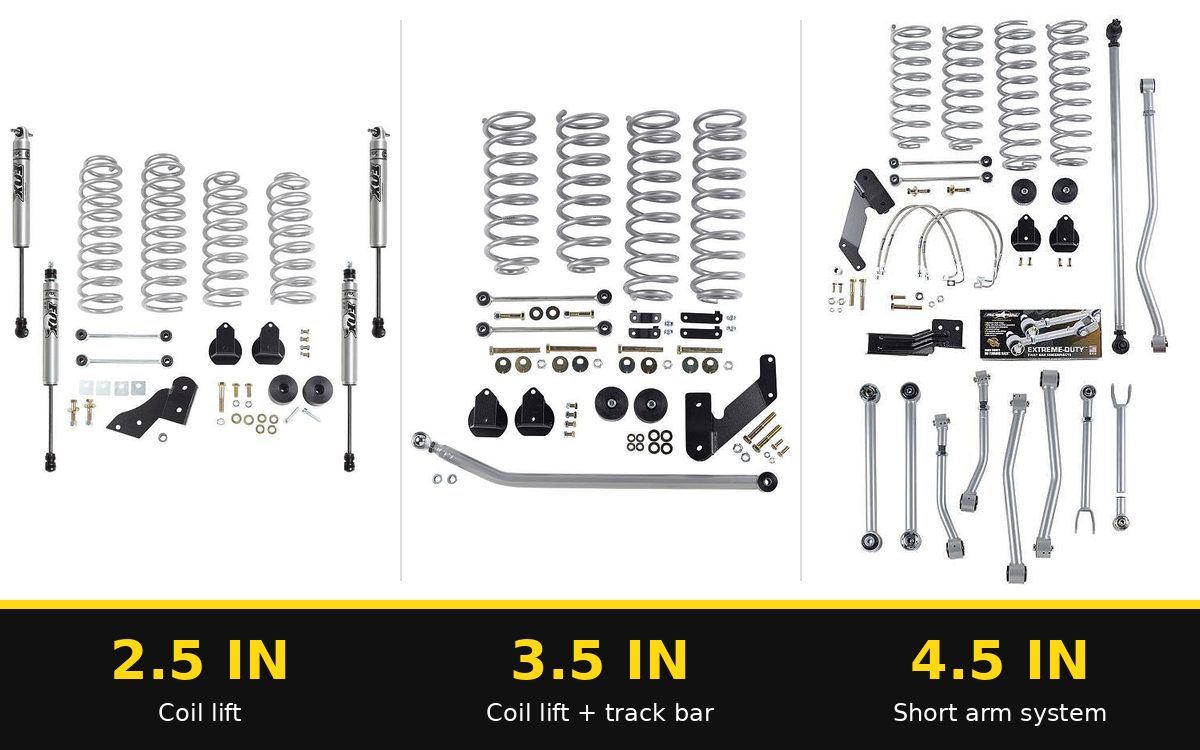
Jeep JK lift heights come in three common sizes, 2.5, 3.5 and 4.5 inches, and each one is really a choice of tire size and how much of the suspension you want to rebuild. The 2007-2018 Wrangler JK rides on coil springs at all four corners, so a lift starts with taller springs, but the higher the Jeep goes, the more of the track bars, control arms, brake lines, shocks and driveshafts have to change with it. Below: what each height clears, what it needs beyond springs, short arm against long arm, how each one rides, and which one fits the way you use your Jeep Wrangler JK.
Key takeaways
- 2.5 inches is the bolt-on height: springs or spacers, bump stops, end links and a rear track bar bracket. It clears 33-inch tires easily and 35s with 4.5-inch backspacing wheels.
- 3.5 inches is the most popular JK height for 35s. It adds an adjustable front track bar and caster correction to the parts list, and the factory control arms can stay.
- 4.5 inches is the home of 37-inch tires. It needs adjustable control arms, longer brake lines, and a plan for the driveshafts and the 2012-2018 exhaust crossover.
- Short arm or long arm: short arms bolt to the factory mounts; long arms move the frame mounts back for flatter angles, better ride and more flex.
- Tires drive the rest: 35s and 37s call for 4.56 to 5.13 gears, and 37s on a Dana 30 front axle are hard on it.
JK basics that decide how it lifts
The JK is a body-on-frame Wrangler with a solid axle at each end, and both axles are located by four control arms and a track bar. The arms hold the axle fore and aft and set its rotation (caster up front, pinion angle at both ends), and the track bar keeps the axle centered side to side. Coil springs carry the weight, and separate shocks control it. That layout lifts easily: taller coils raise the body, and nothing else has to come apart to get the first couple of inches. It is also why every extra inch changes geometry. Each arm and the track bar swing in an arc, so as the frame rises they pull the axle backward, rotate it, and shift it toward one side.
- Two-door and Unlimited: the two-door JK has a 95.4-inch wheelbase, the four-door Unlimited 116 inches. The Unlimited is heavier, so the same coil sits lower on it, and lift kits list separate springs for each body. The short two-door clears break-over obstacles with less lift; the Unlimited is calmer on steep climbs and at highway speed.
- Sport and Sahara axles: a Dana 30 front and a Dana 44 rear, with open differentials and, on most of them, 3.21 or 3.73 gears.
- Rubicon axles: Dana 44 front and rear with electric lockers, 4.10 gears, an electronic front sway bar disconnect and the 4:1 Rock-Trac transfer case.
- Engines: the 3.8-liter V6 for 2007-2011 and the 3.6-liter Pentastar V6 for 2012-2018. The Pentastar years also changed the exhaust routing near the front driveshaft, which matters at the taller heights.
The front axle is the biggest difference between trims for anyone lifting. A Dana 30 lives happily on 33s and works on 35s driven with some care; on 37s its smaller ring gear, axle shafts and tubes are the weak link, and many 4.5-inch builds on Sport models end up with a Dana 44 swap or an aftermarket housing such as Spicer’s Ultimate Dana 44 for the JK, which is rated for tires up through 37 inches. The Dana 30 vs Dana 44 vs Dana 60 comparison covers the strength gap axle by axle.
2.5-inch lift: the bolt-on height
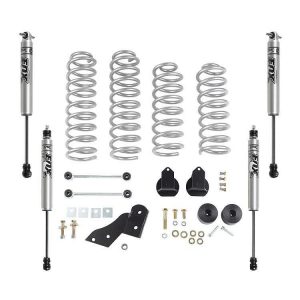
A 2.5-inch lift is the smallest true suspension lift most JK owners buy, and it does one thing very well: it fits 33-inch tires with room to spare and levels the factory nose-down rake. It comes in two forms. A spacer kit, such as the Rough Country 635 Series II, sets spacers on top of the factory coils, so the spring rate stays stock. A coil kit, such as the Rubicon Express RE7141FP, replaces all four springs with taller ones, which also lets the spring rate be matched to a front winch bumper or a heavy spare.
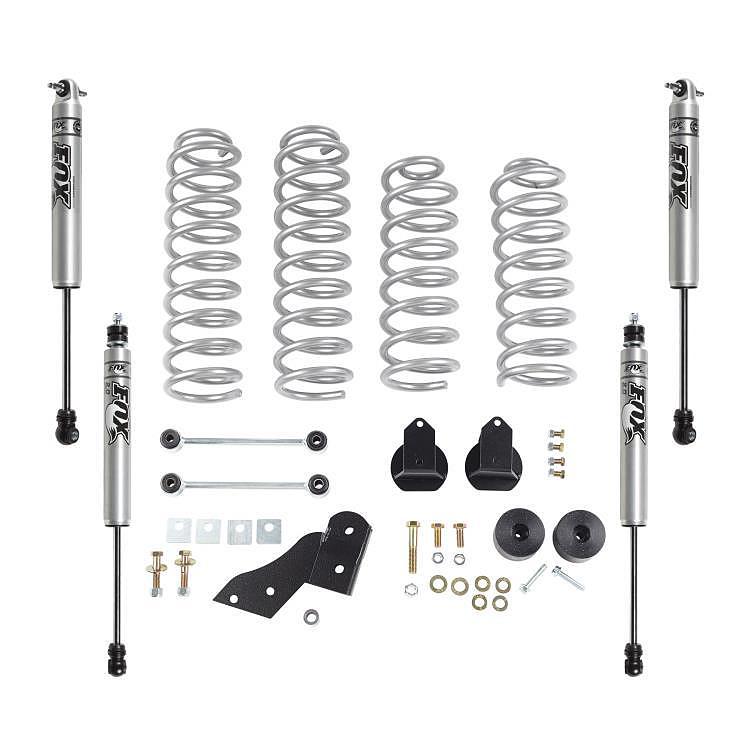
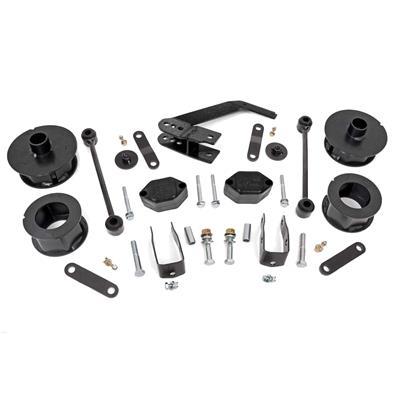
At this height the factory control arms, front track bar and brake lines usually stay. What a good 2.5-inch kit adds:
- Rear track bar bracket: it raises the axle end of the rear track bar to recenter the rear axle. Both the Rubicon Express and Rough Country kits include one.
- Longer sway bar end links: they put the sway bars back near their factory angle so the Jeep does not lean more in turns.
- Bump stop extensions: they stop the axle before a larger tire reaches the fender at full compression.
- Caster correction: the RE7141FP includes alignment washers for front caster, and caster correction is recommended but not required on the TeraFlex 2.5-inch base kit.
- Brake line relocation brackets: the TeraFlex 2.5-inch kits use them to give the rear lines more slack instead of replacing them.
- Shocks: a 2.5-inch lift extends past factory shock travel, so the kit either includes longer shocks or needs shock extensions.
On tires, 33s fit a 2.5-inch JK with almost any wheel. TeraFlex 2.5-inch coil and spacer kits are rated for 35-inch tires, on aftermarket wheels with 4.5 to 4.75 inches of backspacing or less, which moves the tire outward so it clears the control arms and the frame at full lock. A 35 on 2.5 inches works, but the tire uses the whole fender at full stuff, so expect some contact with the flare off road unless the bump stops are extended. On the road, a 2.5-inch lift drives almost like stock, which is why the 2.5 to 3-inch range is the most everyday-friendly JK lift.
3.5-inch lift: the 35-inch tire sweet spot
Searches for a “Rubicon Express 3.5 lift JK” outnumber every other height for a reason: 3.5 inches is where a JK fits 35-inch tires with real up-travel and still keeps its factory control arms if you want it to. The extra inch over a 2.5-inch kit puts the front track bar and the caster outside what brackets and washers can fix, so a complete 3.5-inch kit carries more parts.
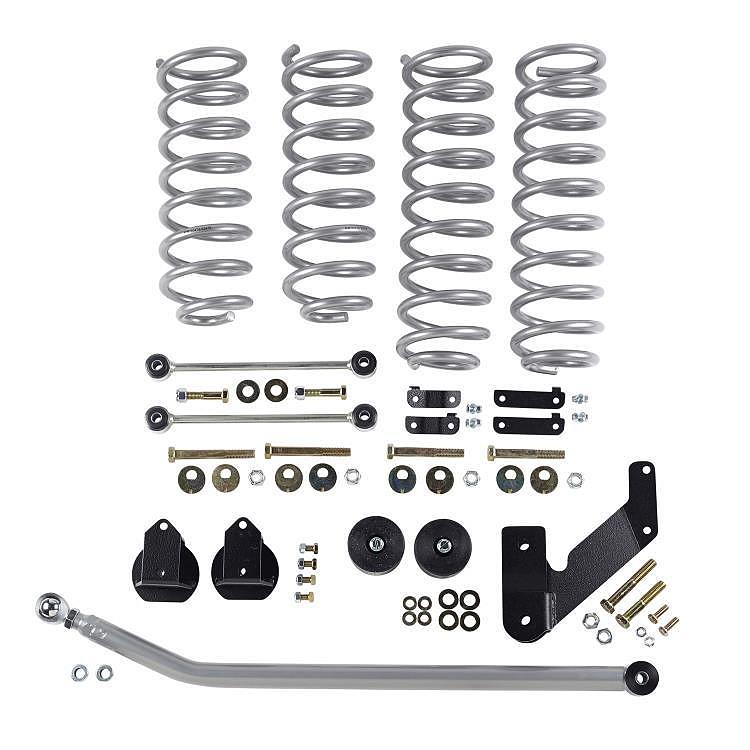
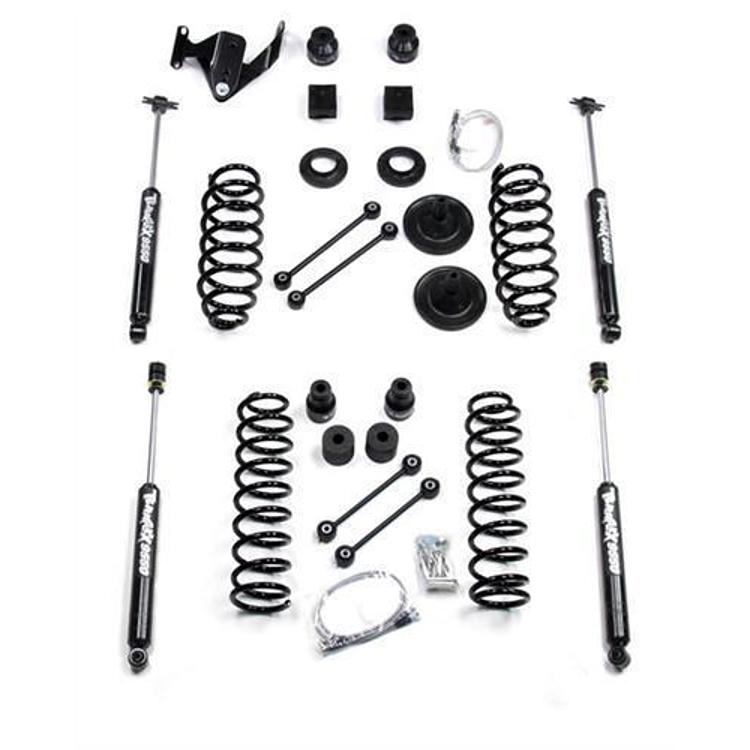
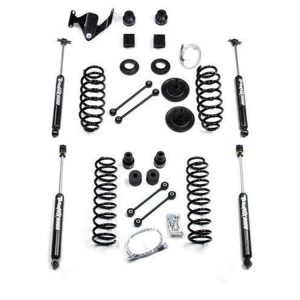
The Rubicon Express RE7122 3.5-inch standard coil kit is a good template for the height. It includes front and rear coil springs, front and rear cam bolts for caster and pinion angle, front and rear bump stops, an adjustable front track bar, a rear track bar bracket and longer sway bar end links, and it is rated for 33 or 35-inch tires. TeraFlex’s 3-inch kits work the same way: the TeraFlex 1251200 for the 2007-2015 Unlimited clears a 35×12.50 tire on wheels with 4.5 inches of backspacing or less and adds front sway bar disconnects, rear sway bar links, a rear track bar bracket and bump stops. The TeraFlex 3-inch coil base kit needs longer preset or adjustable control arms and an adjustable front track bar.
Rubicon Express sells the 3.5-inch JK lift in several levels, and the names tell you what is in the box:
- Standard coil: springs, track bar, cam bolts, bump stops and end links, factory control arms.
- Progressive coil: the same kit with progressive-rate springs that start soft and firm up as they compress.
- Sport: adds a high steer kit and control arm geometry correction brackets, with rear cam bolts for pinion angle.
- Super-Flex: adds adjustable Super-Flex front lower control arms, an adjustable front track bar and sway bar disconnects.
- Super-Flex short arm: replaces the control arms with Super-Flex arms on the factory mounts.
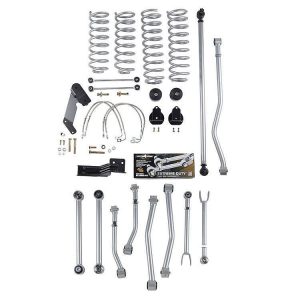
- Extreme-Duty long arm: long arms with new frame brackets, covered further down.
- Shock suffixes: no letter means no shocks; T is twin-tube, M monotube, FP FOX Performance and FPR FOX with reservoirs.
With the factory arms, a 3.5-inch JK rides close to stock but the arm angles are steeper, so caster drops and the steering returns to center less eagerly. Cam bolts recover some of it; adjustable lower control arms recover all of it. The front track bar matters just as much. A stock bar at 3.5 inches sits at a steep angle and pulls the axle toward the frame mount side, and an adjustable bar such as the Skyjacker JKFTBA717 sets it back under the center. Shocks at this height must be the right length for the lift, and they are worth choosing with care: the Bilstein 5100 vs FOX 2.0 comparison covers the two most common upgrades.
4.5-inch lift: room for 37s, and a longer parts list
At 4 to 4.5 inches, a JK clears 37-inch tires, and it stops being a spring swap. The TeraFlex 4-inch JK systems are rated for a 37-inch tire, and the 4-inch coil base kit requires adjustable control arms, an adjustable front track bar, longer shocks and caster correction, with an adjustable rear track bar recommended. Rubicon Express builds its 4.5-inch JK kits as complete systems for the same reason: the RE7124 Super-Flex short arm kit comes with adjustable upper and fixed lower control arms, Super-Flex spherical joints, PT-Meg bushings, the springs, extended bump stops and longer front and rear stainless brake lines.
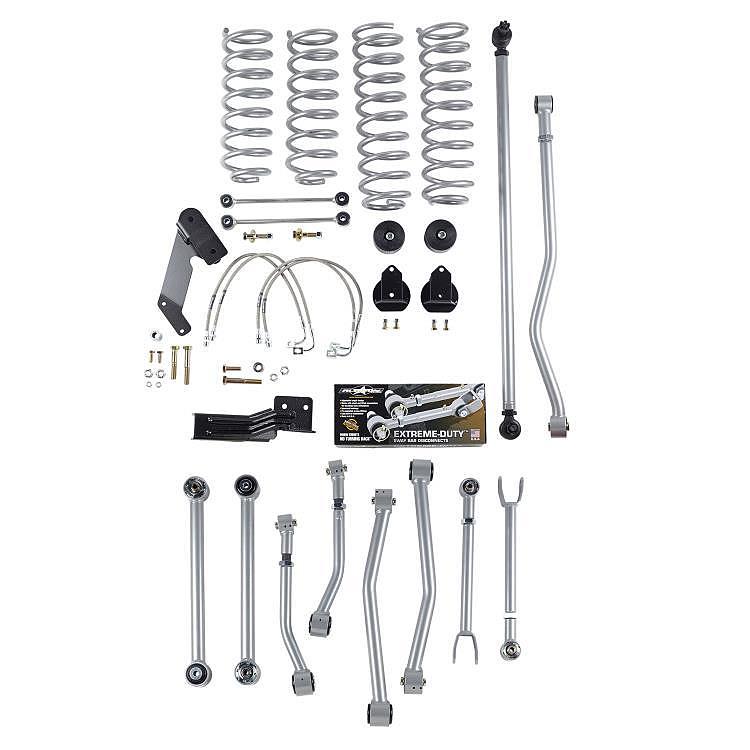
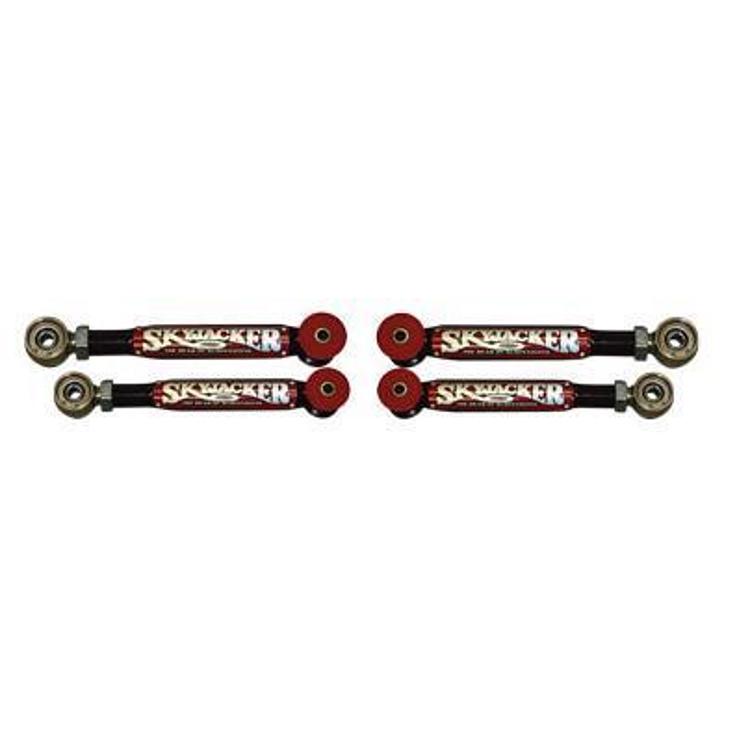
Here is what a 4.5-inch build needs beyond the springs:
- Control arms: adjustable arms set caster up front and pinion angle at both ends, and lengthen the wheelbase back toward stock. Adjustable rear uppers such as the Skyjacker JKULR26-SX are the arms that set rear pinion angle.
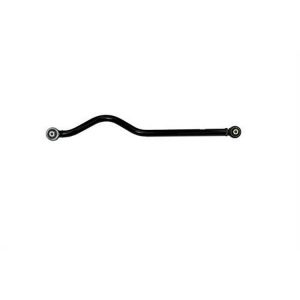
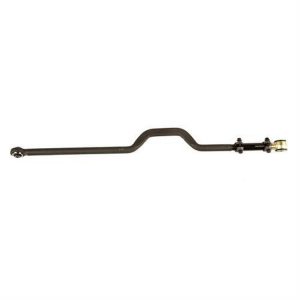
- Track bars: adjustable front and rear bars. The Rugged Ridge 18305.06 rear track bar covers JK lifts of 2 to 5.5 inches on the factory mounts; a front track bar relocation bracket lowers the axle-side mount on the front bar to flatten its angle.
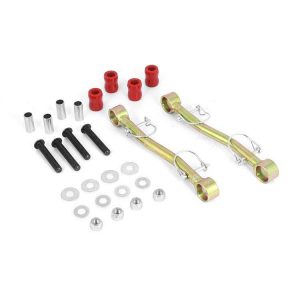
- Sway bar end links: front links sized for the height, such as the Rugged Ridge 18321.21 quick disconnect links for 4 to 5 inches of lift.
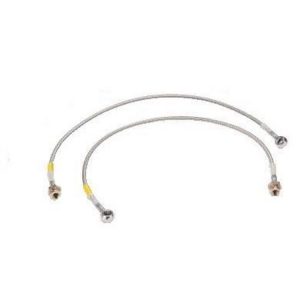
- Brake lines: brackets no longer give enough slack at full droop. The Skyjacker JKFBL60 front lines are made for 4 to 7 inches of lift.
- Bump stops: front and rear extensions so a 37 stops short of the fender and the shock never becomes the bump stop.
- Shocks: longer than any 2.5 or 3.5-inch shock, matched to the kit’s travel.
- Exhaust: on 2012-2018 JKs, TeraFlex requires exhaust spacers or another exhaust change for front driveshaft clearance when the extended front shock is longer than 24.5 inches.
- Driveshafts: covered in their own section below.
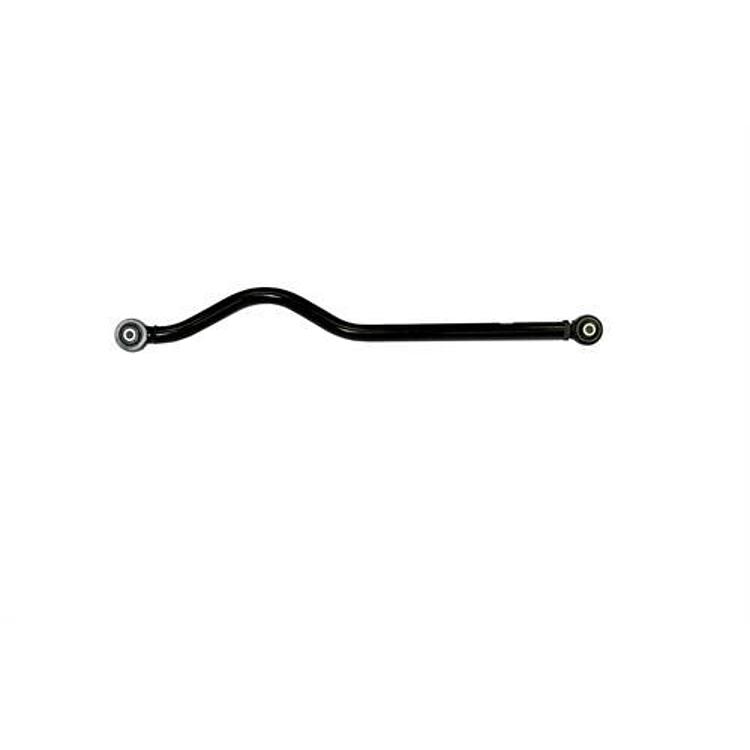
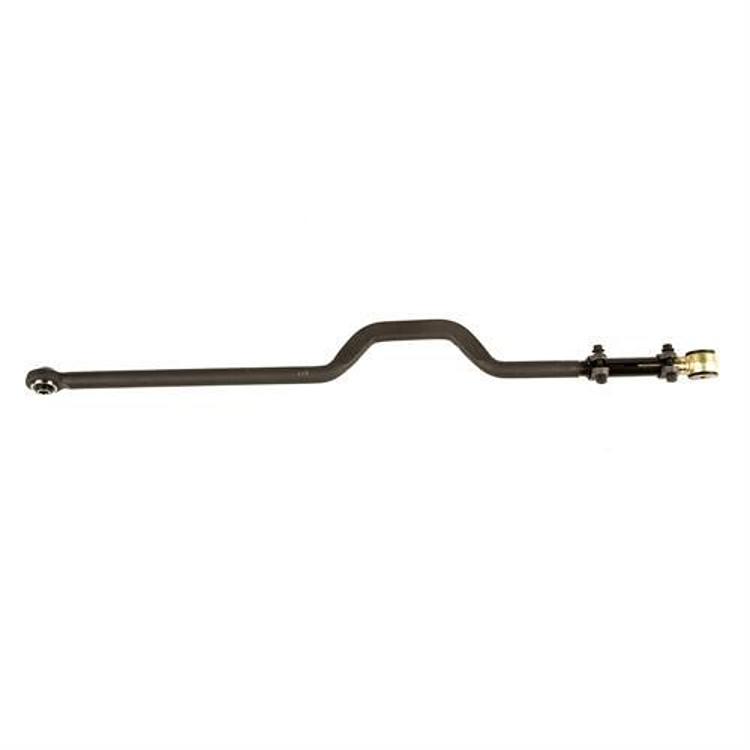
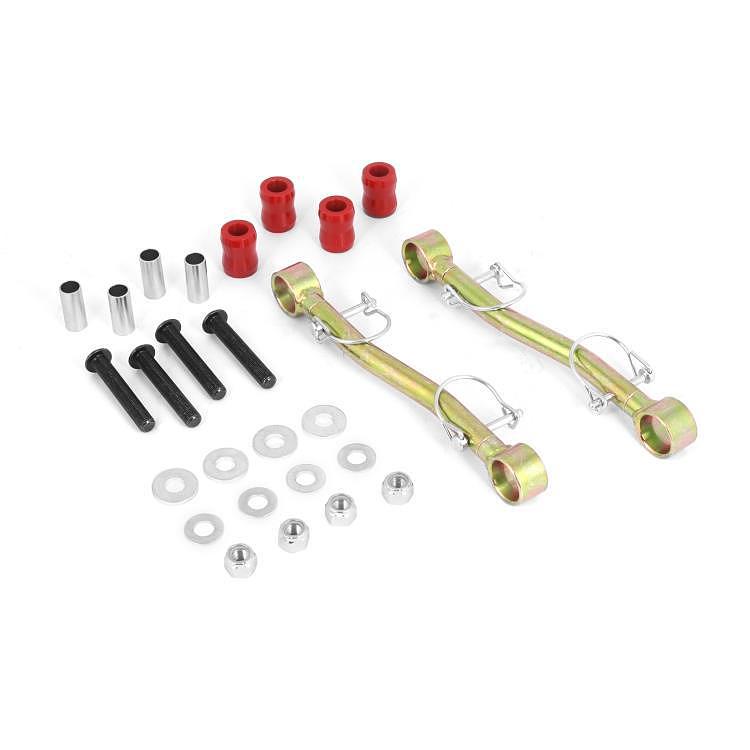
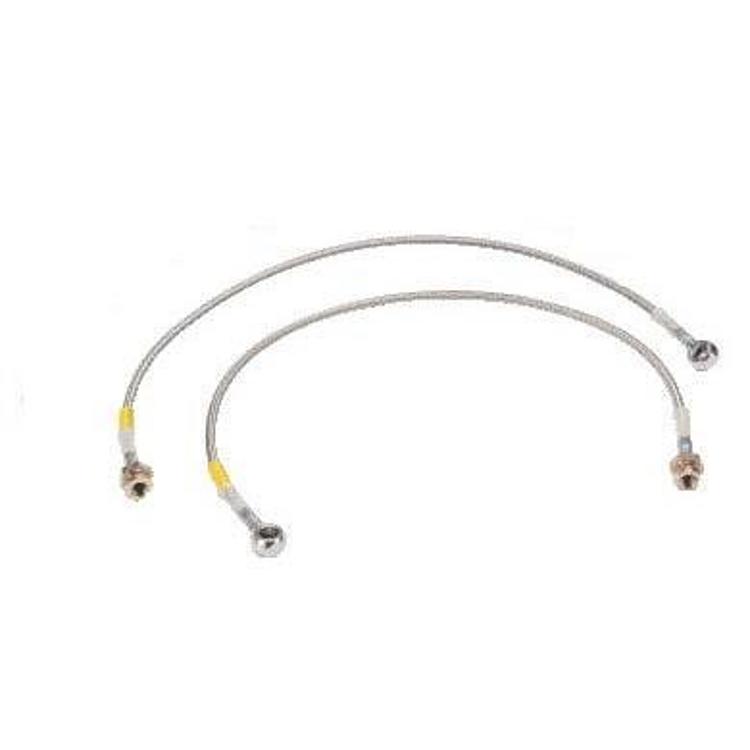
On tires, 35s fit a 4.5-inch JK with room to spare and 37s fit with aftermarket wheels of 4.5 inches backspacing or less. Many owners still trim the pinch seam or fit flat or high-clearance fenders to keep a 37 out of the bodywork at full articulation. The Rubicon is the better base here because of its Dana 44 front; on a Sport or Sahara, 37s are the point where the Dana 30 front should be replaced.
Short arm vs long arm kits
At 3.5 inches and up, the big decision is not the height but where the control arms mount. Short arm kits use the factory frame mounts with longer or adjustable arms. Long arm kits replace the factory frame brackets with new ones farther back, so the lower arms run much longer and flatter.
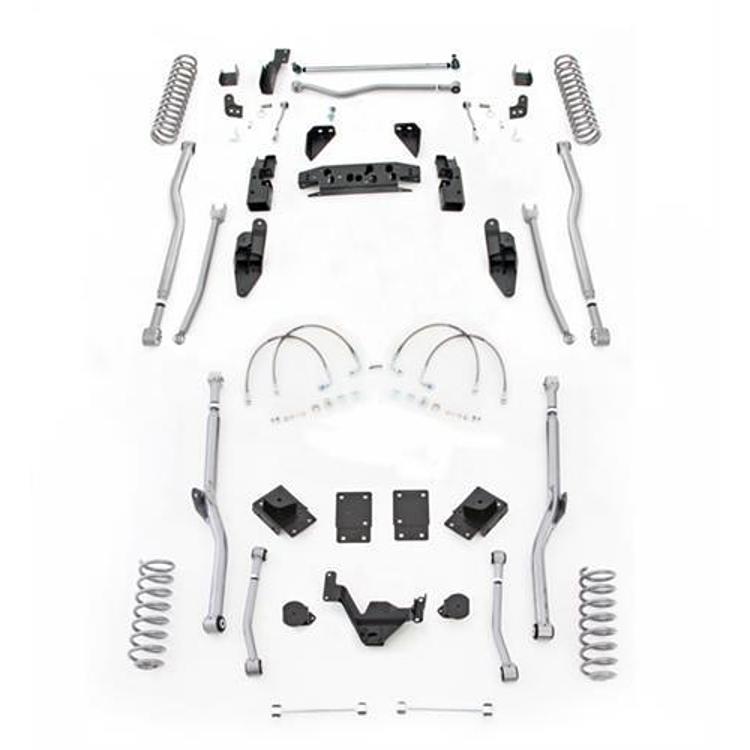
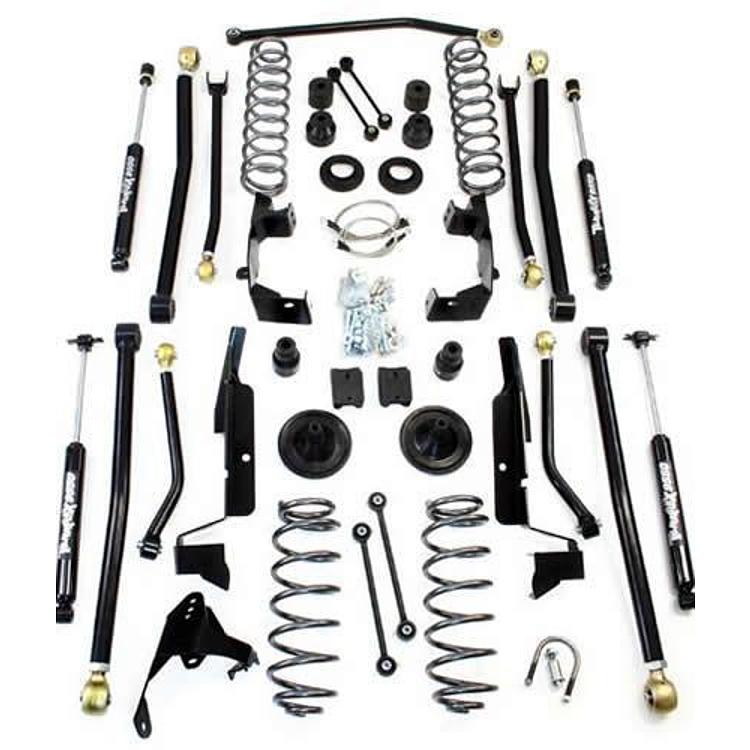
- Arm angle: a short arm at 4.5 inches points steeply down to the axle. A long arm stays flatter, so the axle moves straighter up and down and caster and pinion change less through the travel.
- Ride: a longer arm swings through a gentler arc, so wheelbase and caster change less as the axle moves and the bushings bind less, which is why long arm JKs ride softer over sharp edges and track straighter at speed.
- Articulation: TeraFlex points out that long arm brackets put the frame end of the arm closer to the factory orientation on taller lifts, which reduces bushing stress at full droop. More flex with less bind is the reason rock crawlers choose them.
- Install: short arms bolt on in a day. Long arm kits such as TeraFlex’s Alpine CT4 require cutting off the factory control arm brackets and welding on new mounts. The Rubicon Express JK4R24 is designed to install without welding and adds a full-width transmission crossmember for frame rigidity.
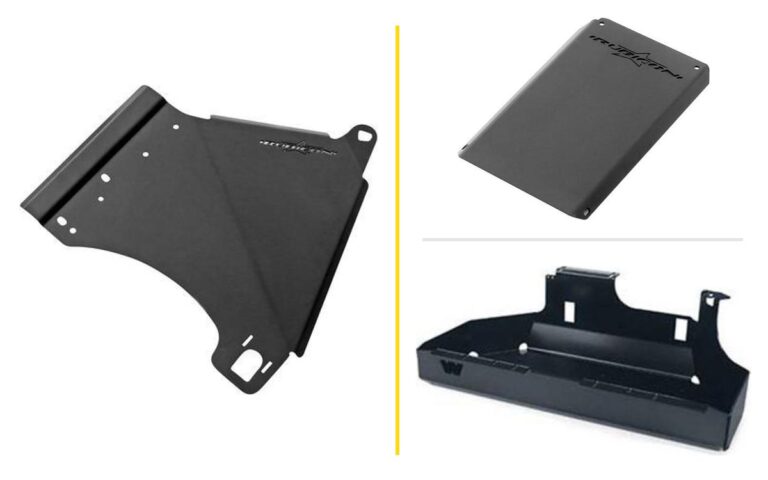
- Clearance: long arm brackets hang lower under the belly. Most kits answer that with a crossmember or a belly pan that doubles as skid protection.
The Rubicon Express JK4R24 and the TeraFlex 1257400 Elite LCG are typical long arm systems for the JK. The Elite LCG is rated for 37×12.50 tires on 4.5-inch backspacing wheels, and every JK needs driveshaft modifications with it. For a Jeep that is mostly driven on pavement on 35s, a short arm kit at 3.5 inches is the simpler build; for a Jeep that sees rock trails every month on 37s, long arms at 4 to 4.5 inches pay off in ride and flex.
Driveshafts, steering and death wobble
Two systems get worse with every inch of lift: the driveshafts and the front steering. Both are the reason a JK at 4.5 inches needs more planning than a JK at 2.5.
Driveshafts
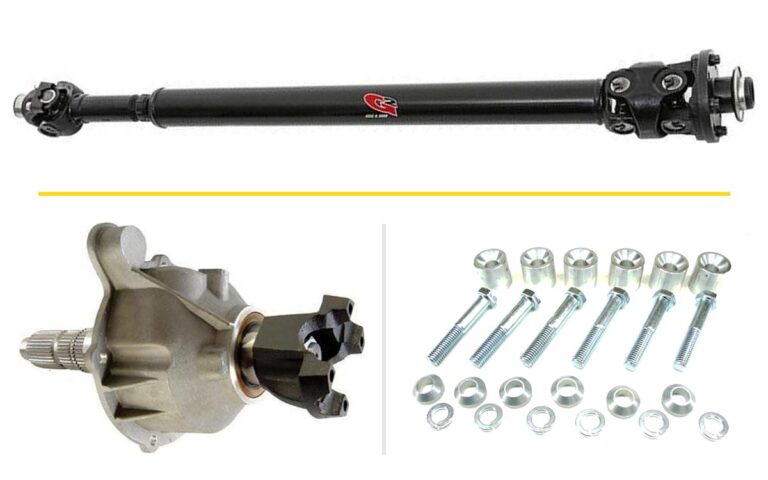
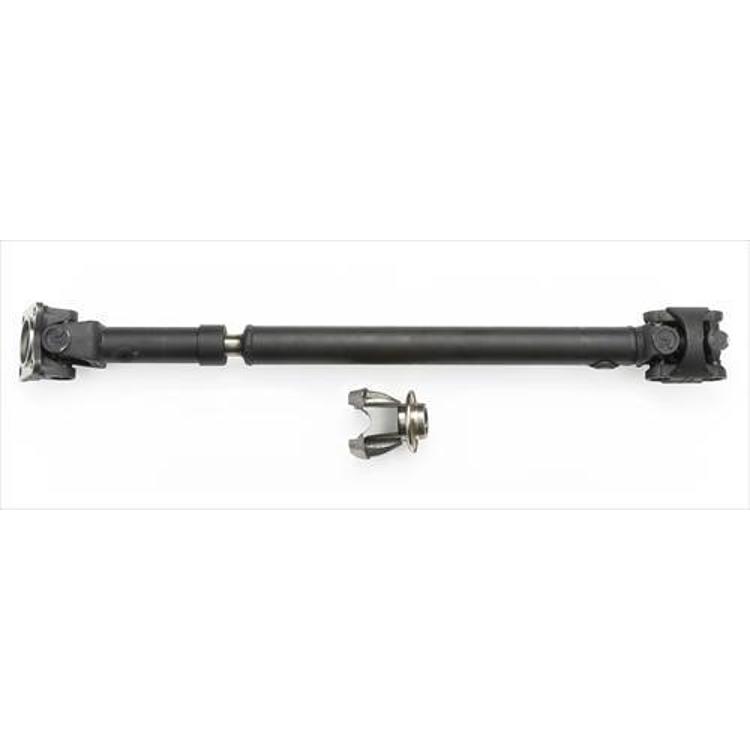
Lifting raises the transfer case with the body while the axles stay put, so both driveshafts run at steeper angles and need more length at full droop. The JK transfer case already has fixed output flanges, so the slip yoke eliminator that TJ owners install is not part of a JK lift; the problems are joint angle and slip travel. At 2.5 inches the factory shafts are fine. At 3.5 inches most JKs keep them, sometimes with a slight vibration that the pinion angle adjustment cures. At 4 to 4.5 inches, TeraFlex highly recommends driveshaft modifications with its 4-inch base kit, and the usual fix is a high-angle CV shaft such as the extended-length Fabtech FTS94057 front CV drive shaft. The short rear shaft on the two-door has the steepest angle of any JK shaft and is usually the first to vibrate. Set the pinion angle with the adjustable arms so it points at the transfer case output when you fit a CV shaft.
Steering and death wobble
Death wobble, the violent front-end shake that starts after a bump at speed, is not caused by a lift itself, but a lift takes away the margins that hide it. The usual causes on a lifted JK are:
- Track bar: worn bushings or ball joint, loose bolts at the frame bracket, or a stock bar left at a steep angle.
- Low caster: too little caster lets the front wheels shimmy instead of tracking straight.
- Worn steering joints: ball joints and tie rod or drag link ends with play.
- Tires: out-of-balance or out-of-round tires, which become more likely as tires get heavier.
The fixes follow the list: recenter the axle with an adjustable track bar and torque its bolts, then check them again after the first drives; set caster back near factory with cam bolts or adjustable lower arms; replace worn joints; balance the tires. A steering stabilizer damps the steering but does not cure wobble; a larger stabilizer only helps 35s and 37s feel steadier once the front end is right.
Ride quality and on-road manners by height
- 2.5 inches: closest to stock. A spacer kit keeps the factory spring rate; a coil kit may be a bit firmer or softer depending on the rate. The Jeep stays planted on the highway, and the 33s barely change braking or acceleration.
- 3.5 inches: a slightly higher center of gravity and more body roll unless the end links are right. With caster restored and a good set of shocks, a 3.5-inch JK on 35s makes a comfortable daily driver.
- 4.5 inches: the tallest Jeep, the heaviest tires and the most roll. A short arm 4.5 rides firmer over sharp bumps, while a long arm 4.5 rides better than either short arm height. 37s add unsprung weight that the brakes, steering and gearing all feel.
Fuel economy falls with every inch of lift and every inch of tire, since a taller Jeep pushes more air and heavier tires take more energy to turn. For a full picture of how the JK compares with its rivals as a daily and trail vehicle, see the Wrangler vs Bronco vs 4Runner comparison.
Regearing for 35s and 37s
Bigger tires turn each axle revolution into more distance, which is the same as taller gears: a JK with 3.21s on 35s feels sluggish, hunts gears on the highway and works the transmission hard. Regearing restores the effective ratio. Common choices:
- 33-inch tires: 4.10 gears on a Sport or Sahara; the Rubicon’s 4.10s are fine as they are.
- 35-inch tires: 4.56 or 4.88 gears. The automatic and the 3.8-liter V6 lean toward 4.88.
- 37-inch tires: 4.88 or 5.13 gears.
Both axles must get the same ratio. Rear Dana 44 sets for the JK such as the Rough Country 4.56 ring and pinion and the Rough Country 4.88 set pair with a matching front set; the full range is in the ring and pinion category. If the front Dana 30 is coming out for a Dana 44 anyway, buy the new axle in the right ratio: Spicer offers its Ultimate Dana 44 for the JK in 3.73 through 5.38 with open, electric or air lockers.
JK lift heights compared
| 2.5 inches | 3.5 inches | 4.5 inches | |
|---|---|---|---|
| Common tire size | 33s; 35s with 4.5-4.75 in backspacing | 35s | 35s easily, 37s with 4.5 in backspacing |
| Springs | Spacers or coils | Coils | Coils |
| Front track bar | Stock | Adjustable | Adjustable, often with relocation bracket |
| Rear track bar | Bracket | Bracket | Adjustable bar recommended |
| Control arms | Stock | Stock or adjustable | Adjustable short or long arms |
| Caster correction | Washers, recommended | Cam bolts or arms | Required |
| Brake lines | Stock with relocation brackets | Stock with brackets or longer lines | Longer lines |
| Driveshafts | Stock | Usually stock | CV shafts recommended |
| Gears | Stock or 4.10 | 4.56 to 4.88 | 4.88 to 5.13 |
| Front axle | Dana 30 or 44 | Dana 30 driven with care, or 44 | Dana 44 or stronger |
Which JK lift height is right for you
The short answer
- Daily driver on 33s, light trails: 2.5 inches. A coil kit like the RE7141FP or a spacer kit, plus shocks of the right length.
- Daily driver and weekend trails on 35s: 3.5 inches with an adjustable front track bar and caster correction, like the Rubicon Express RE7122, then regear.
- Trail-first Jeep on 37s: 4.5 inches with adjustable arms, long arms if the Jeep spends real time on rocks, CV driveshafts, new gears, and a Dana 44 front on a Sport or Sahara.
- Two-door owners: the short wheelbase needs less lift for the same break-over, so a two-door often runs the same tire as an Unlimited at the lower height.
Buy the height once. Moving from 2.5 to 3.5 inches later reuses only some of the parts, and moving from 3.5 to 4.5 means new arms, lines and shafts. Decide on the tire first, then the height that clears it, then the axle and gears that can turn it.
Frequently asked questions
Can I run 35-inch tires on a 2.5-inch JK lift?
Yes, with the right wheels and bump stops. TeraFlex 2.5-inch JK coil and spacer kits are rated for a 35-inch tire, on aftermarket wheels with about 4.5 inches of backspacing or less, and those kits add front bump stop extensions so the tire stops short of the fender at full compression. Expect the tire to come close to the fender and the flare when the suspension is fully stuffed and the wheel turned, and expect a noticeable loss in acceleration and braking until the axles are regeared. For 35s with full up-travel and no rubbing, 3 to 3.5 inches is the more comfortable height.
What comes in the Rubicon Express 3.5-inch JK lift kit?
The RE7122 standard coil kit has front and rear 3.5-inch coil springs, front and rear cam bolts for caster and pinion adjustment, front and rear bump stops, an adjustable front track bar, a rear track bar bracket and longer sway bar end links. It keeps the factory control arms and comes without shocks; suffixes such as T, M, FP and FPR add twin-tube, monotube or FOX shocks. The Super-Flex versions of the 3.5-inch kit add aftermarket control arms.
Do I need a long arm kit for a 4.5-inch JK lift?
No. Short arm kits such as the Rubicon Express RE7124 reach 4.5 inches on the factory control arm mounts with longer, adjustable arms, and short arms are the simplest way to fit a 37-inch tire. A long arm kit moves the frame-side mounts toward the middle of the Jeep, which flattens the arm angles, reduces bushing bind at full droop and gives a calmer ride and more articulation. Pick long arms when the Jeep spends real time on rocks or carries 37s full time; pick short arms when it is mainly a street Jeep on 35s.
Does lifting a JK cause death wobble?
A lift does not cause it by itself, but it exposes the parts that do. Death wobble is a violent front-end oscillation that starts at speed after a bump, and on a lifted JK it usually traces to a front track bar that is worn, loose or set at a steep angle, low caster, worn ball joints or tie rod ends, or out-of-balance tires. Recenter the axle with an adjustable track bar, set caster back near the factory figure, torque the track bar bolts and recheck them after the first drives. A steering stabilizer hides the symptom and does not fix the cause.
Do I have to regear after lifting my JK?
The lift itself does not require it; the bigger tires do. Most Sport and Sahara JKs left the factory with 3.21 or 3.73 gears and the Rubicon with 4.10s. On 35-inch tires, 4.56 or 4.88 gears bring the effective ratio back near stock, and on 37s most owners go to 4.88 or 5.13. Both axles must get the same ratio.
Complete JK kits from Rubicon Express, TeraFlex, Rough Country, Skyjacker, Pro Comp and Rugged Ridge are in the complete suspension systems and lift kits category, with the individual parts in coil springs, track bars, control arms, bump stops and shock absorbers. To see only parts that fit, open the Jeep Wrangler JK vehicle page.
Sources
- TeraFlex, JK Wrangler/Unlimited: Suspension Lift Guide: kit contents, maximum tire size and required parts for each JK lift height.
- TeraFlex, Choosing a Lift for Your Jeep: tire size by height, short arm against long arm, wheelbase and gearing.
- TeraFlex, JK 4-door 2.5-inch Coil Spring Base Lift Kit: backspacing, shock and caster notes, exhaust spacers.
- TeraFlex, JK 4-door 4-inch Coil Spring Base Lift Kit: required control arms, track bars, caster correction and driveshaft modifications.
- Spicer, Ultimate Dana 44 Front Axles for Jeep Wrangler JK: tire rating, tube wall, ratios and locker options.