Twin-tube, monotube or reservoir is the first choice to make when a truck or Jeep needs new shocks, and it matters more than the brand on the body. All three convert suspension motion into heat by pushing oil through a valved piston; they differ in where the oil and gas live, how big the piston can be, and how well the shock gets rid of heat once it is working hard. For a head-to-head of two popular monotubes, see the Bilstein 5100 vs Fox 2.0 comparison.
Key takeaways
- Springs carry, shocks control: the spring holds the truck up and sets ride height; the shock only slows how fast the suspension moves, in both directions, and turns that motion into heat.
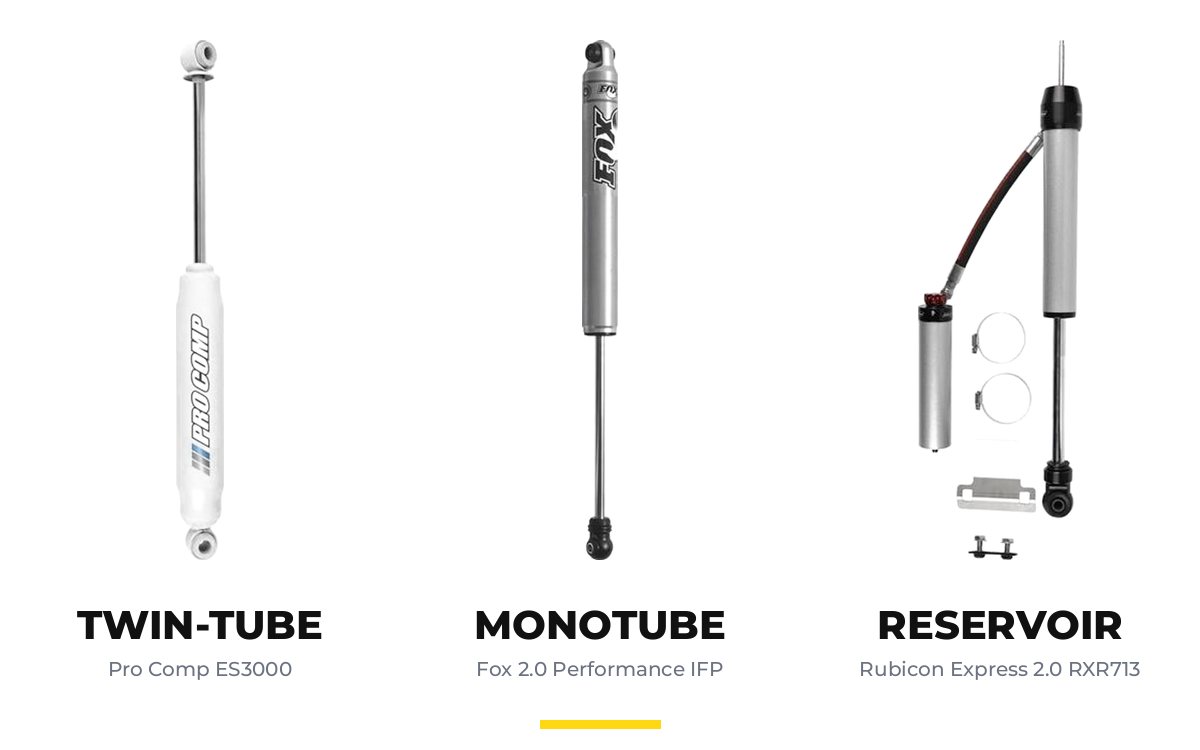
- Twin-tube: a working tube inside a reserve tube. Soft low-speed ride, tolerant of rock hits, more stroke per inch of collapsed length; the oil runs hotter and can foam on long rough runs. Pro Comp ES9000 and ES3000 and Rubicon Express RXT are twin-tubes.
- Monotube: one tube, a floating piston, and nitrogen at high pressure behind it. A bigger piston in the same size body, oil that cannot mix with the gas, and heat that goes straight to the outer wall. The Bilstein 5100 is a 46 mm monotube; the Fox 2.0 is a 2.0-inch one.
- Reservoir: a monotube with extra oil and its gas charge in a separate canister, piggyback or remote. It keeps damping consistent when the truck runs fast over rough ground for a long time, and it is where compression adjusters live.
- Length beats brand: a shock has to cover the distance between its mounts from full droop to full compression. Buy by lift range and by extended and collapsed length, then by design.
What a shock absorber actually does
The name is misleading. A shock absorber does not absorb a bump; the spring does that. The spring compresses over a bump, stores the energy and gives it back; without a damper it would keep overshooting and the truck would bounce down the road. The shock’s job is to slow that motion so the axle settles after one cycle and the tire stays on the ground.
Inside every shock is a piston on a shaft, moving through a tube of oil. The piston has small passages covered by stacks of thin steel discs called shims. When the shaft moves, oil has to squeeze through those passages and bend the shims out of the way. That resistance is damping, and the energy it removes from the suspension ends up as heat in the oil.
Two directions matter:
- Compression (bump): the shaft moves into the body as the wheel rises. It controls how hard the suspension resists a bump and how fast the body dips under braking.
- Rebound: the shaft pulls out as the spring pushes the wheel back down. Rebound damping keeps the spring from throwing the body upward and the tire from skipping on washboard.
- Shaft speed: damping depends on how fast the shaft moves, not on how far. A slow body roll in a corner is a low shaft speed; a square-edged rock at 30 mph is a high one. Valving is tuned for both.
Because a shock turns motion into heat, heat is what limits it. Hot oil thins out and flows through the valves more easily, so the shock gets softer the harder it works. That loss is called fade. How each design handles heat is most of the difference between the three.
Twin-tube shocks: how they are built
A twin-tube shock is, in Bilstein’s words, a tube within a tube. The inner tube is the working tube where the piston moves; the outer tube is the reserve. When the shaft pushes in, it takes up space inside the working tube, so the extra oil has to go somewhere: it flows through a base valve at the bottom into the reserve tube. When the shaft comes out, oil flows back.
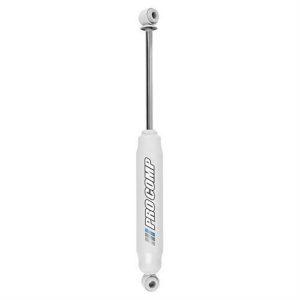
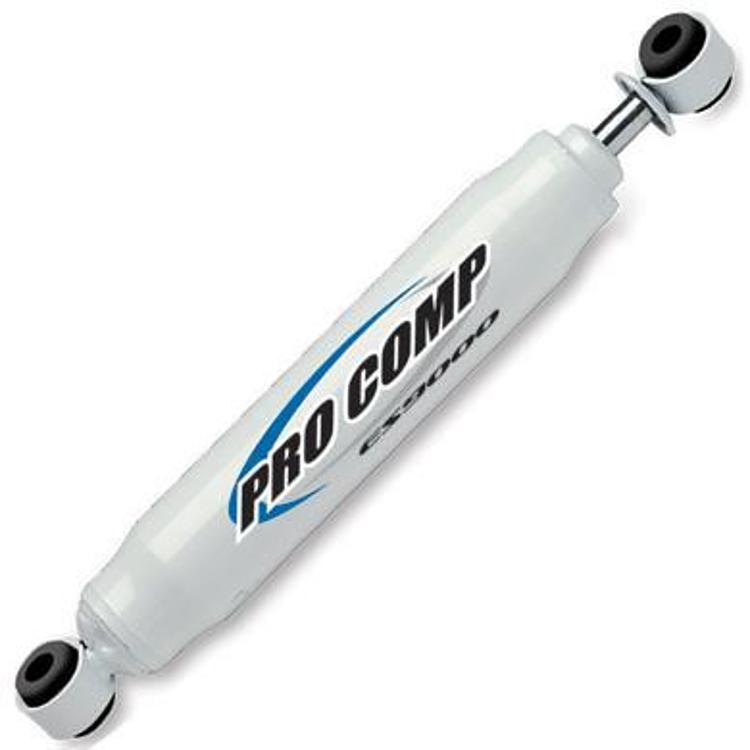
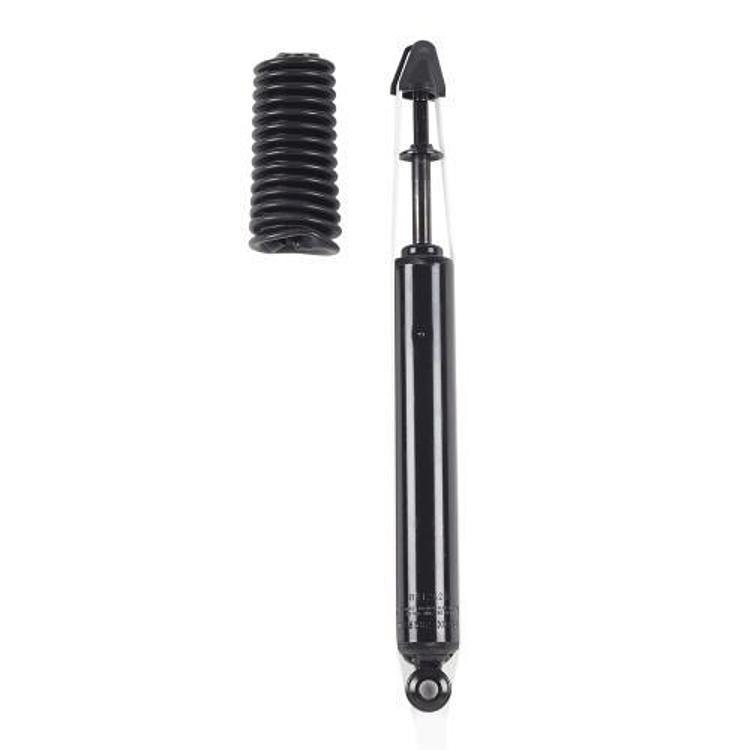
Most off-road twin-tubes are gas charged: the reserve space is filled with nitrogen at low pressure, which pushes on the oil and reduces the bubbles that form when oil is forced through the valves. Some use a sealed bag of gas instead. Pro Comp’s ES3000 is a twin-tube cellular gas shock, where the gas sits inside a closed-cell foam that keeps it apart from the oil. Its bigger brother, the Pro Comp ES9000 (929500 is one of its rear shocks), is a nitrogen-charged twin-tube with 10-stage velocity-sensitive valving and a 1 3/8-inch nylon-banded piston on double-welded mounts. Pro Comp’s PRO-X shocks, sold in its lift kits, are twin-tubes too.
Why people choose twin-tubes
- Comfort at low speed: low gas pressure means little seal friction and little extending force, so the ride on pavement and small bumps is soft.
- Damage tolerance: a rock or a stray tie rod that dents the outer tube usually leaves the working tube inside untouched, so the shock keeps working.
- More stroke per inch: because displaced oil goes to the reserve tube beside the working tube, not into a gas chamber under it, a twin-tube can give more travel for a given collapsed length.
Where twin-tubes run out
The weaknesses all come back to heat and gas. The working tube is surrounded by the reserve tube and its oil, so heat has to pass through two walls before it reaches the air. On a long washboard road or a fast run down a rough canyon, the oil gets hot, and in a twin-tube without a sealed gas cell, oil and gas start to mix into foam. Foam compresses where oil does not, so the shock goes soft. That is aeration, and it shows up as fade that recovers once the shock cools.
The piston is also limited by the inner tube. Rubicon Express answers that with an oversized body on its RXT twin-tubes: the RXT2421B carries a 1.625-inch piston and an 11/16-inch chrome shaft, with 10 inches of stroke between its 14.5-inch collapsed and 24.5-inch extended lengths, and the bigger body holds more oil to soak up heat. Twin-tubes also need to stand roughly shaft-up, because the base valve at the bottom has to stay covered with oil.
Monotube shocks: one tube, high pressure
A monotube puts everything in a single tube. The piston works in oil at one end; at the other end a floating piston with its own seal separates the oil from a chamber of high-pressure nitrogen. When the shaft pushes in, the floating piston moves to make room for the oil the shaft displaces, compressing the gas. Oil and gas never touch, so the oil cannot foam. The design is simple and durable, with room for a larger working piston, and the gas pressure eliminates cavitation in the valving.
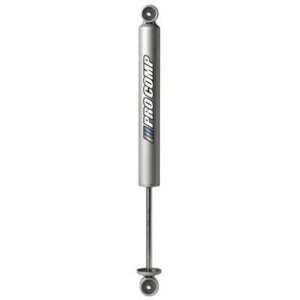
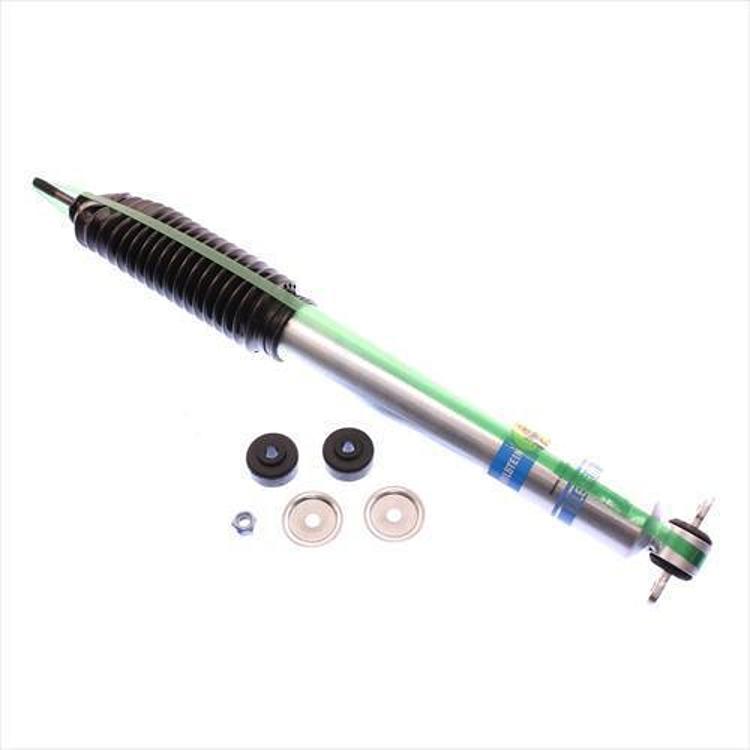
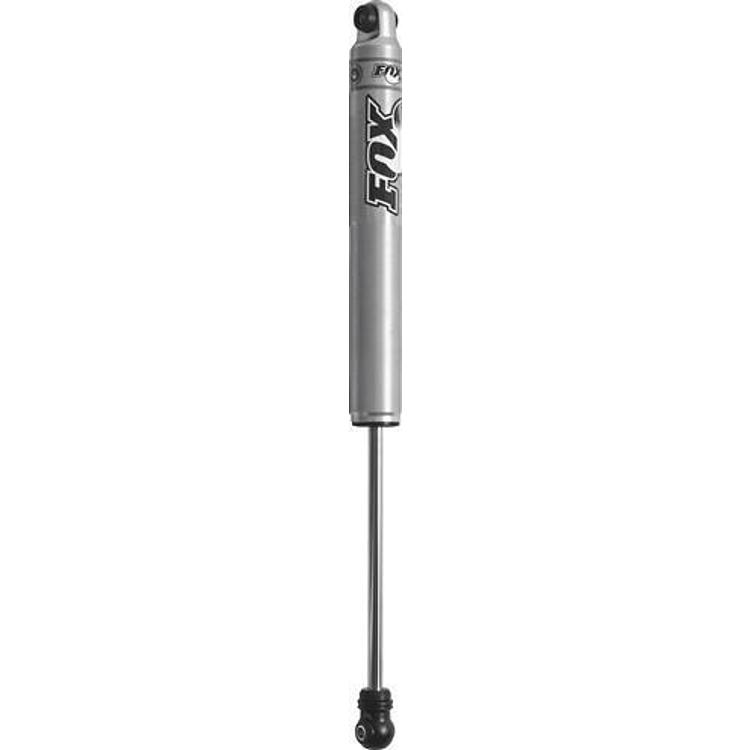
The same design is also known as IFP, for internal floating piston. The Fox 2.0 Performance Series IFP shock is a 2.0-inch body on a 5/8-inch shaft, and the Fox bodies are aluminum, which carries heat away faster than steel. The Bilstein 5100 24-188197 is a 46 mm smooth-body monotube with a 14 mm shaft, self-adjusting deflecting disc valving, a stem top and a bar pin bottom, sized for lifted trucks, Jeeps and prerunners. Pro Comp’s PRO-M PR2001 is a nitrogen-charged monotube with a floating piston, multi-stage disc pack valving and a 14 mm hardened shaft, for GM and Ram pickups with 3 to 6 inches of lift.
What a monotube does better
- Bigger piston: with no inner tube, the piston is nearly as wide as the body. It moves more oil per inch of travel, so the valving can be softer on small bumps and still control big ones.
- Heat leaves faster: the oil touches the outer wall directly, and that wall is in the airstream.
- No foam: the floating piston keeps the nitrogen out of the oil, and the gas pressure keeps the oil from boiling into bubbles behind the piston on hard hits.
- Any angle: because the gas is sealed behind the floating piston, most monotubes can be mounted body-up or body-down.
The trade-offs
The single wall is also the weak point: a dent in a monotube body is a dent in the tube the piston rides in, and the piston can hang up on it. Keep exposed monotubes out of the line of rocks. The gas chamber takes up length inside the body, so a monotube usually needs a longer collapsed length than a twin-tube with the same stroke. And the high gas pressure pushes the shaft out all the time, which makes the ride firmer at low speed and adds a small amount of lift on a light vehicle. On a heavy truck the effect is negligible.
Some lift kits are sold with the choice built in. Rubicon Express offers the same 3.5-inch Super-Flex kit for the 2007-2018 Wrangler JK as the RE7127PT with twin-tube shocks, the RE7127PM with monotube shocks and the RE7127FPR with Fox Performance reservoir shocks, so the shock design is the only thing that changes between them.
Reservoir shocks: more oil, cooler oil
A reservoir shock is a monotube with its gas chamber moved out of the body and into a separate canister. The floating piston goes with it. The body gets more room for oil and stroke, the canister adds oil and surface area, and more oil takes longer to heat up. That is why reservoir shocks are the standard on desert trucks.
Piggyback or remote
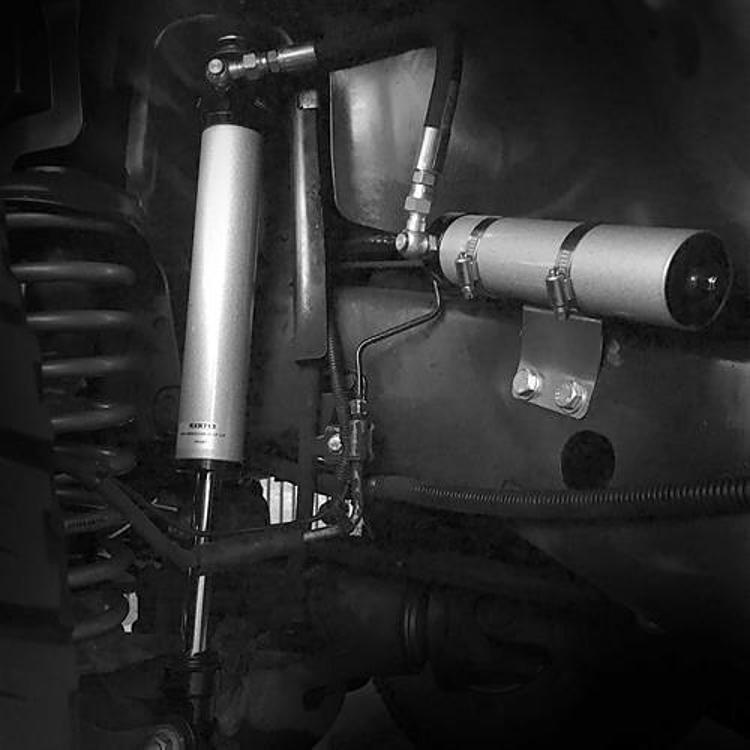
- Piggyback: the reservoir is attached directly to the shock body through a short passage. No hose to route, as long as the canister clears the coil, frame and tire through the travel.
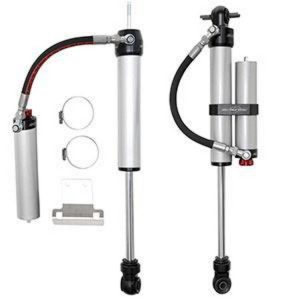
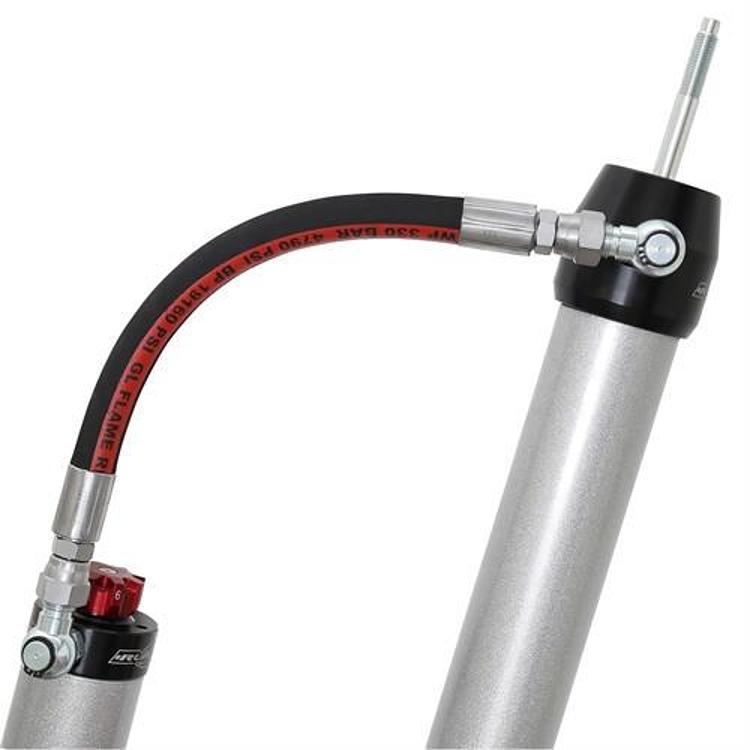
- Remote: the reservoir sits on a bracket elsewhere and connects to the shock with a high-pressure hose. It fits where a piggyback would hit something, but the hose needs slack for full droop and full compression.
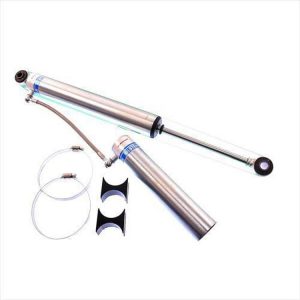
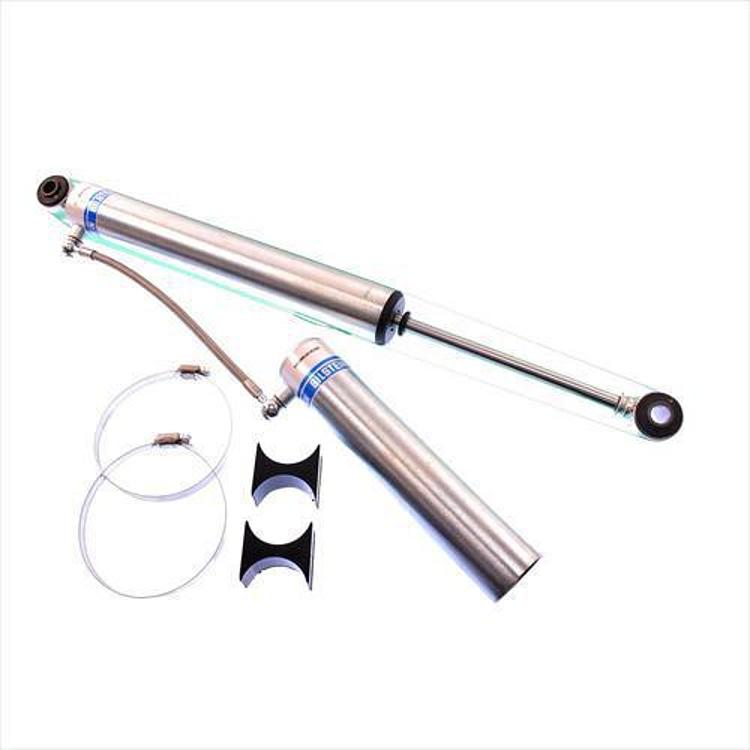
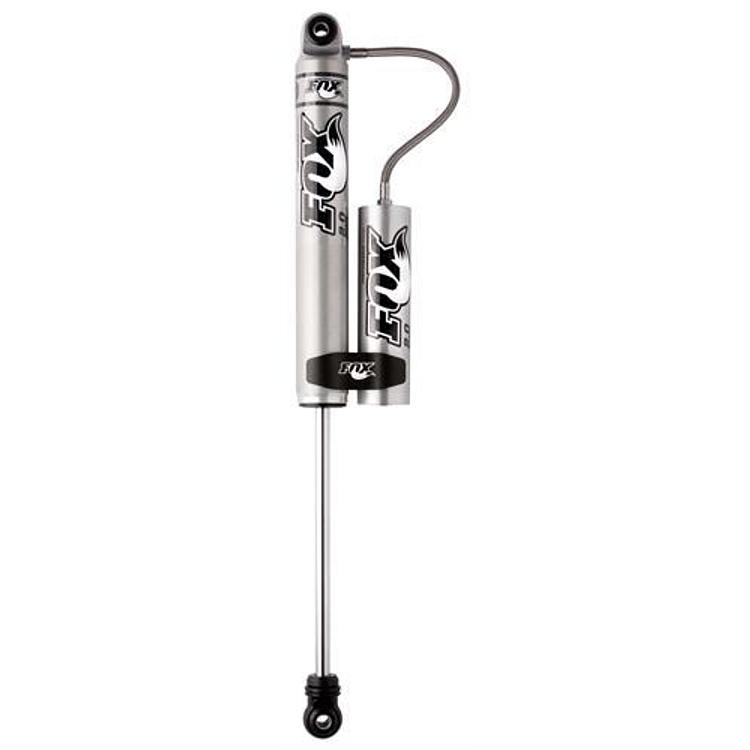
The Bilstein 5160 25-187601 is a remote reservoir rear shock: a 46 mm body with a 14 mm shaft, the floating dividing piston in the reservoir for more wheel travel and shaft movement, digressive valving, and a reservoir mounting kit in the box. It travels 11.55 inches between 16.54 and 28.09 inches and is rated for 0 to 2 inches of lift, so it suits a stock-height or leveled truck. The Fox 2.0 Performance Series reservoir shock 980-24-945 uses an external reservoir with an internal floating piston between the oil and the high-pressure nitrogen, in a metal-impacted aluminum body, with 11.1 inches of travel between 16.35 and 27.45 inches.
Adjusters
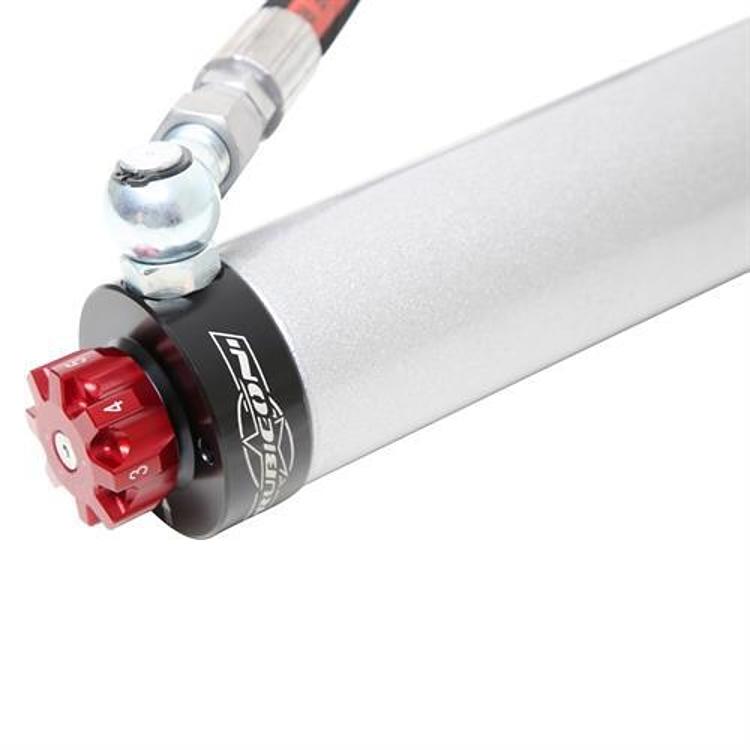
The reservoir is also where most adjustable shocks put their adjuster, in the oil path between body and reservoir. The Rubicon Express 2.0 Adjustable Reservoir RXR713 for the front of the 2007-2018 Wrangler JK with 2.5 to 3.5 inches of lift has eight stages of compression adjustment on a numbered knob, JK-specific valving, a 2-inch alloy body, a 3/4-inch hard chrome shaft, a wiper seal, and a large -6 hose on 360-degree swivel banjos. Fox’s 2.0 Factory Series reservoir shocks come with a CD compression adjuster. Firmer suits a loaded truck; softer suits a light rig on small, fast chatter.
Plan the mount before ordering. A remote reservoir needs a solid spot on the frame or inner fender, clamps and a bracket (remote reservoir mount kits cover the trucks that need their own), and a hose route that is checked with the suspension at full droop and full stuff, steering at both locks.
Emulsion vs separated gas, and why nitrogen
Not every high-performance shock separates the gas from the oil. An emulsion shock lets the nitrogen and oil share the same space with no floating piston, so the oil carries gas bubbles from the start. Emulsion shocks are simple to rebuild and revalve. Fox still builds 2.0 Series emulsion shocks, including versions with a remote reservoir. The catch is consistency: the damping depends on how evenly the gas is mixed in the oil, and under heat the mixture foams more, so the damping drifts as the shock works.
A separated design (IFP monotube, or a reservoir with a floating piston) keeps the oil solid, so the valving sees the same fluid on the first bump and the thousandth.
The gas is nitrogen because it is dry and inert. Shop air carries moisture and oxygen, which corrode the inside of the shock and break down the oil; dry nitrogen does neither, and its pressure changes more predictably with temperature. Sealed shocks are charged once at the factory; rebuildable ones are recharged through a valve. Serviceable shocks take shock rebuild kits with new seals.
Valving basics: what the numbers mean
Valving is the shim stacks on the piston (and, on adjustable shocks, in the reservoir path). Thicker or more shims make the shock stiffer; the arrangement decides how stiffness changes with shaft speed. Three terms come up on spec sheets:
- Velocity-sensitive / multi-stage: the shims open in stages as shaft speed rises. Pro Comp’s 10-stage velocity-sensitive valving on the ES3000 and ES9000 is this idea: soft on slow highway motion, firmer on fast trail hits.
- Digressive: firm at low shaft speed, then the damping force rises more slowly as speed goes up. Bilstein uses digressive valving on the 5100 and 5160.
- Linear or progressive: damping force rises evenly, or faster, with speed.
Vehicle-specific valving matters more than any label. A shock for a 3/4-ton diesel needs far more damping than one for a two-door Wrangler, even at the same length, which is why the same shock series has dozens of part numbers. The Rubicon Express RXR713 is valved for the JK and tuned to Rubicon Express spring rates; Bilstein builds 5100s for specific manufacturer lift kits.
Shock length, travel and lift height
A shock is not sized by the lift, it is sized by the distance between its mounts. Three numbers describe it:
- Extended length: center of the upper mount to center of the lower at full extension. It has to reach the mounts at full droop. If it is too short, the shock becomes the droop limiter.
- Collapsed length: the shortest the shock gets. It has to be shorter than the mount-to-mount distance with the bump stop fully compressed, or the shock bottoms out before the bump stop and bends or blows out.
- Travel (stroke): extended minus collapsed. The Pro Comp ES9000 929500 has 12.51 inches of travel between 17.32 and 29.83 inches for a 6-inch lift; the ES3000 313509 has 4.34 inches between 9.28 and 13.62 for a stock front end on a 1963-1988 GM truck.
Manufacturers translate those numbers into a lift range, which is the easiest place to start: a Bilstein 5160 25-187601 for 0 to 2 inches, a Rubicon Express RXR713 for 2.5 to 3.5, a Pro Comp ES9000 929543 rear shock for 5 to 6 inches on 2002-2016 Ram pickups, a PRO-M PR2001 for 3 to 6 inches. Ride-height adjustable coilover shocks blur the line: the Bilstein 5100 ride height adjustable 24-196499 sets front lift from 0 to 2.5 inches by moving the spring seat to a different snap-ring groove on the body.
To check, measure rather than trust the lift number:
- At ride height: measure mount center to mount center with the truck on its wheels. The shock should sit near the middle of its stroke, a little toward extended.
- At full droop: lift the frame until the tires hang, then measure again. Your new shock’s extended length must be at least this long, or you need limit straps to stop the axle first.
- At full compression: remove the spring or let the axle up onto the bump stop and measure again. The collapsed length must be shorter than this by a margin so the bump stop, not the shock, takes the hit.
If a shock that covers the range will not fit between the stock mounts, shock extensions and relocation brackets move the mount rather than forcing a wrong shock in.
Mounts: eye, stem and bar pin
Length gets the shock between the mounts; the ends have to match the mounts themselves. Shocks come with different ends top and bottom, and the same series is built in several combinations:
- Eye or loop: a ring with a rubber or urethane bushing and a steel sleeve, held by a bolt through the bracket. Both ends of the Pro Comp ES9000 929500 and 929543 are loops.
- Stem: a threaded stud on the end of the shaft or body that passes through a hole in a plate, sandwiched between two bushings and cupped washers and held with a nut. The Rubicon Express RXT shocks and the RXR713 use a stem at one end and an eye at the other; the ES3000 313509 has a stem top and a loop bottom.
- Bar pin: a bushing with a flat bar through it, bolted to the mount with two bolts. The Bilstein 5100 24-188197 has a bar pin at the bottom and a stem at the top.
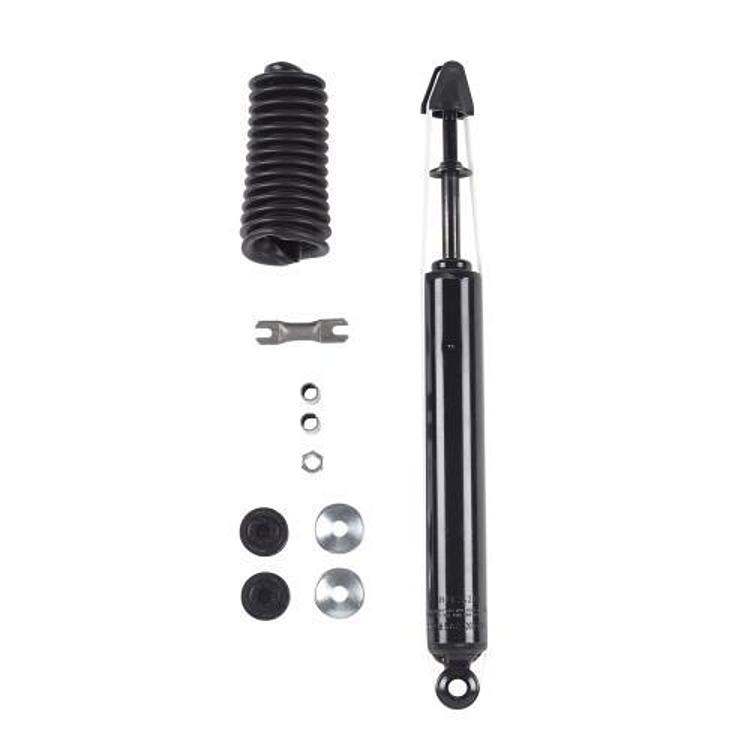
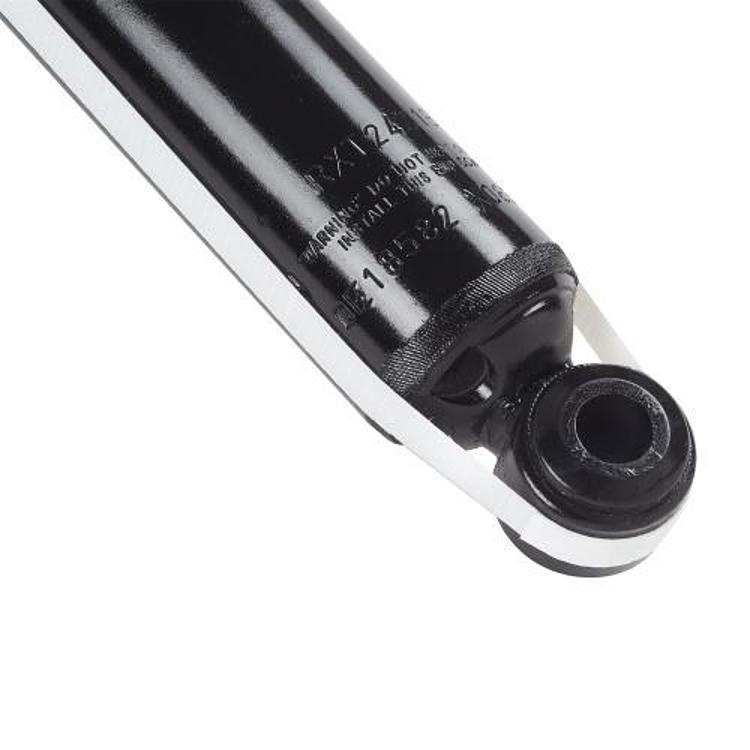
Tighten stem nuts until the bushings just start to bulge, never until they squash flat, and tighten eye bolts with the truck at ride height so the bushing is not preloaded in a twisted position. Bushings wear before the shock does; worn ones clunk and let the shock rattle in its mount. Shock absorber bushings are sold separately for that reason, and swapping them is part of any shock job.
Shock boots: worth the few minutes
The seal where the shaft enters the body is what keeps the oil and gas in, and grit on the shaft wears that seal every stroke. A boot is an accordion-pleated sleeve that covers the exposed shaft. Some shocks come with one: the Bilstein 5100 24-188197, the Pro Comp PRO-M PR2001 (polyurethane) and the Rubicon Express RXT2621B monotube (black urethane) all do. Others, such as the Pro Comp ES9000 929500 and the Bilstein 5160 25-187601, ship without one.
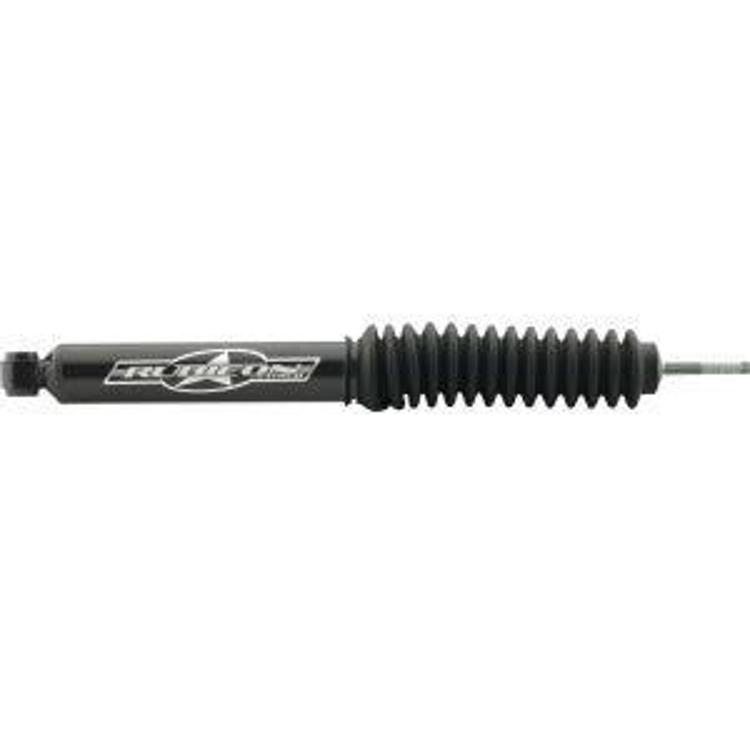
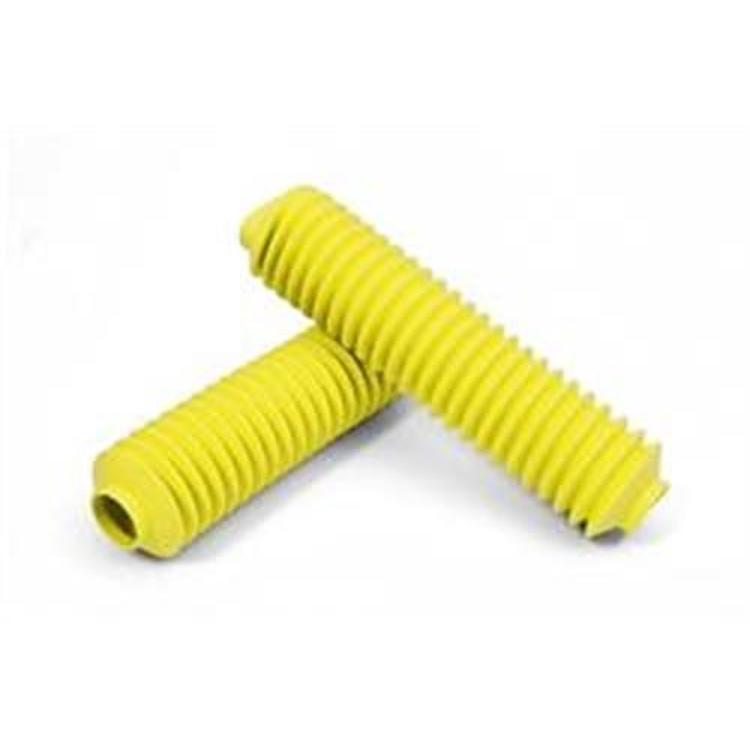
A full size boot such as the Daystar Shock Therapy KU20001YL slides over the shaft and is sized to the shock rather than to the vehicle, so measure the exposed shaft at full extension and the body diameter before you choose one. Too short and it pulls off at droop; too long and it bunches up and rubs at full compression. More sizes and colors are in the shock absorber boot category. Boots matter most on a truck that sees mud, sand and water crossings, and on any shock whose shaft points up into the spray off the tire.
Which design fits how you drive
| Twin-tube | Monotube | Reservoir (piggyback or remote) | |
|---|---|---|---|
| How it is built | Working tube inside a reserve tube, low-pressure gas or gas cell | One tube, floating piston, high-pressure nitrogen | Monotube body plus a separate canister with the floating piston and extra oil |
| Piston size for the body | Smaller (inside the inner tube) | Large, nearly body diameter | Large, and more stroke in the body |
| Heat and fade | Fades first on long rough runs; oil can foam | Sheds heat well; no foaming | Most oil and surface area; holds damping longest |
| Ride on pavement | Softest at low speed | Firmer, more controlled | Firm, often adjustable |
| Damage tolerance | Outer tube protects the working tube | A body dent can stop the piston | Same as monotube, plus a hose or canister to protect |
| Mounting | Roughly shaft-up | Any angle | Needs room and a bracket for the reservoir |
| Examples | Pro Comp ES3000, ES9000, PRO-X; Rubicon Express RXT | Bilstein 5100; Fox 2.0 IFP; Pro Comp PRO-M; RXT monotube | Bilstein 5160; Fox 2.0 reservoir; Rubicon Express RXR713 |
The short version
- Daily driver, stock or leveled: a quality twin-tube or an entry monotube. The truck never gets the shocks hot enough to need more, and a twin-tube gives the softest ride on pavement.
- Towing and hauling: a monotube valved for the truck’s weight. The bigger piston controls a loaded rear axle and a trailer pushing on the hitch better than a twin-tube of the same size, and heat from long grades does not make it fade.
- Trail and rock crawling: a monotube sized to the lift, with a boot. Speeds are low and heat is not the issue; travel, length and body protection are. A twin-tube is a reasonable choice on a budget build if the lengths fit.
- Desert, washboard, fast dirt roads, overland trips with a heavy load: reservoir shocks. This is where the extra oil and the separated gas earn their place, and where a compression adjuster lets you firm up for a loaded truck.
Whichever you pick, pick it as part of the suspension. A complete lift kit with matched springs and shocks takes the length and valving guesswork away, and a shock is easier to get right the first time than after a set of bent mounts.
Signs of a worn shock
Shocks wear gradually, so the truck usually feels normal to the driver until something else breaks or the tires wear out. Check them at every tire rotation:
- Oil on the body: a dusty film near the seal is normal; oil running down the body means the seal has failed and the shock is losing damping.
- Bounce: the truck rises and falls more than once after a dip or speed bump, or keeps porpoising on the highway.
- Dive and squat: the nose dives hard under braking, or the rear squats and the front lifts under acceleration.
- Tire cupping: scalloped wear around the tread, where a tire bounced instead of rolling.
- Clunks: a knock over bumps usually means worn bushings or a loose mount, which wears the shock and the bracket together.
- Body or shaft damage: a dented body, a bent shaft, or a shaft with rust pits or scoring that will cut the seal.
- Lost charge: a gas-charged shock that stays compressed when you push it in by hand, instead of extending on its own, has lost its gas.
Replace shocks in pairs on the same axle, so both sides damp the same. Mixing a new shock with a worn one on the same axle can make the truck pull and lean to one side over bumps.
Frequently asked questions
Is a monotube shock always better than a twin-tube?
No. A monotube holds its damping better under heat and fits a larger piston in the same body, which matters on washboard, long descents and fast desert roads. A twin-tube rides softer at low shaft speeds, tolerates a dented body better because the working tube sits inside an outer tube, and gives more stroke for its collapsed length. For mostly pavement with occasional dirt, a good twin-tube such as the Pro Comp ES9000 or Rubicon Express RXT does the job.
Do I need reservoir shocks for a lifted Jeep or truck?
Only if the shocks get hot. Reservoir shocks add oil and move the gas charge out of the body, so they keep damping when a heavy truck runs miles of washboard, sand or fast whoops. Rock crawling at walking pace and highway driving barely warm a shock, and a well-valved monotube covers both.
What is the difference between a piggyback and a remote reservoir?
A piggyback reservoir is bolted or welded directly to the shock body, so there is no hose to route and the shock installs like a normal one if the body clears everything around it. A remote reservoir sits on a bracket elsewhere and connects to the shock with a hose, which fits tight spaces but needs a hose routed clear of tires and steering through the full travel.
Can I use the same shocks after adding a 2-inch lift?
Usually not. A lift moves the axle farther from the frame at ride height and at full droop, so a stock-length shock tops out early and limits travel, or becomes the droop stop and takes loads it was never built for. That is why shocks are sold by lift range. Measure the shock mounts at full droop and at full compression and pick a shock whose extended and collapsed lengths cover both.
How do I know if my shocks are worn out?
Look for oil wetting the body below the seal, a dent in the body, a scored or pitted shaft, and cracked or missing bushings. On the road: bouncing after dips, nose dive under braking and cupped tires. A gas-charged shock that no longer extends on its own after you compress it by hand has lost its charge. Replace shocks in pairs on the same axle so both sides damp the same.
Start with the length your mounts need, then choose the design for how you drive. The full range of twin-tube, monotube and reservoir shocks from Pro Comp, Rubicon Express, Bilstein, Fox and others is in the shock absorbers category, and the shock absorbers and shock accessories landing page adds the boots, bushings, extensions and reservoir mounts that finish the job.
Sources
- Bilstein, Mono-tube versus Twintube: twin-tube working and reserve tubes, monotube single tube, larger working piston and gas pressure against cavitation.
- Fox, Truck and SUV shocks: the Fox shock range for trucks and SUVs.
- Pro Comp, Suspension: Pro Comp lift kits and suspension components.
- Pro Comp, Installation instructions: Pro Comp installation instructions.
- Wikipedia, Shock absorber: twin-tube and monotube designs and how a damper turns motion into heat.