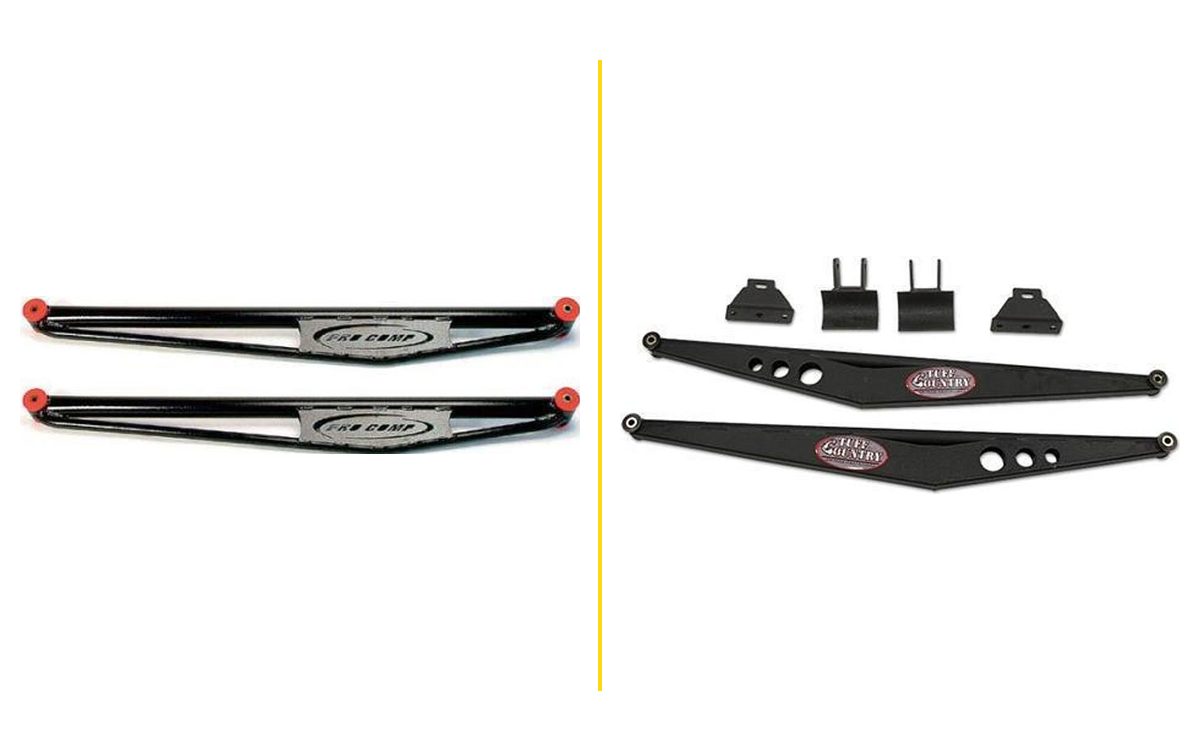
Traction bars and ladder bars both stop axle wrap, the spring windup that makes a lifted leaf-spring truck hop, clunk and break U-joints when the throttle or the trailer load gets heavy. They do it in different ways. A traction bar clamps to the axle at one point and pushes against a floating frame mount, so it resists the axle twisting while letting the suspension move. A ladder bar bolts to the axle at two points and pivots on one, so it locks the pinion angle and the axle’s path together. That difference decides which one belongs on a towing Super Duty, a 35-inch-tire Ram 2500, a Silverado on blocks or a CJ-7 that sees the rocks. Below: what axle wrap is, how each design works, the Pro Comp, Fabtech, Tuff Country, Cognito and M.O.R.E. bars in the traction bar category and the trucks they fit, the alternatives, and what to check before you drill the frame.
Key takeaways
- Axle wrap is a leaf-spring problem: torque twists the housing, the spring’s front half bends into an S, and when it lets go the tire hops. Lift blocks, big tires, diesel torque and trailers all make it worse.
- Traction bar: one axle mount, one floating frame mount (bushing or shackle). It resists twist and leaves most of the travel. It is the right answer for most lifted trucks that tow, haul or see trails.
- Ladder bar: two axle mounts and one front pivot. It holds the pinion angle hardest but fights the spring and limits flex, so it suits launch-heavy street trucks more than rock work.
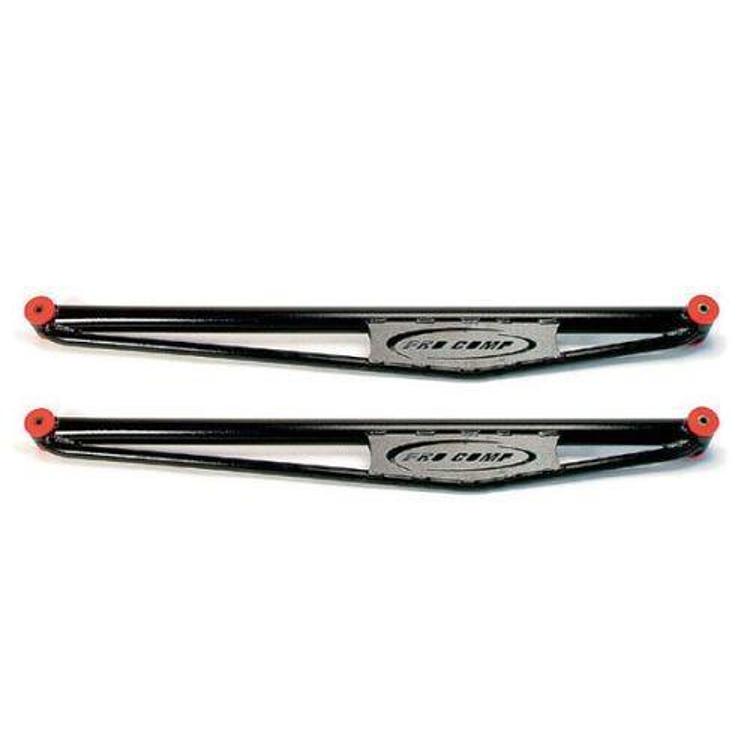
- Pro Comp lateral traction bars come as a pair plus a separate mounting kit matched to the truck: 72501B bars with the 72098B kit for 2003 to 2012 Ram 2500 and 3500, 72400B with 71200B (GM HD) or 72099B (Ford).
- Check clearance before you drill: exhaust, fuel tank, brake lines, the spare and the carrier bearing. Fabtech’s Super Duty kit needs at least 3-inch blocks and will not work with long-travel leaf springs.
What axle wrap is and why lifted leaf-spring trucks get it
Most pickups, the Ford Excursion and older Jeeps carry the rear axle on two leaf springs in what engineers call a Hotchkiss drive: the springs hold the axle up, locate it fore and aft, and also carry the axle’s torque reaction into the frame. When the driveshaft turns the pinion, the ring gear turns the axle shafts, and the housing tries to rotate the opposite way. Under acceleration the pinion nose climbs; under braking it dives. In a stock truck the springs absorb that reaction with little visible movement. The Hotchkiss drive design depends on it.
Leaf springs are flexible on purpose, though, and the front half of the spring, between the axle and the front hanger, is the part that takes the twist. Under enough torque it bends into an S shape. That is spring windup, and the visible result, the housing rotating on the springs, is axle wrap. The spring stores energy as it winds. When the tire can no longer hold, the spring unloads, the axle snaps back, the tire grips again and the cycle repeats several times a second. That chatter is wheel hop.
Four things push a truck past the point where the springs can hold the axle still:
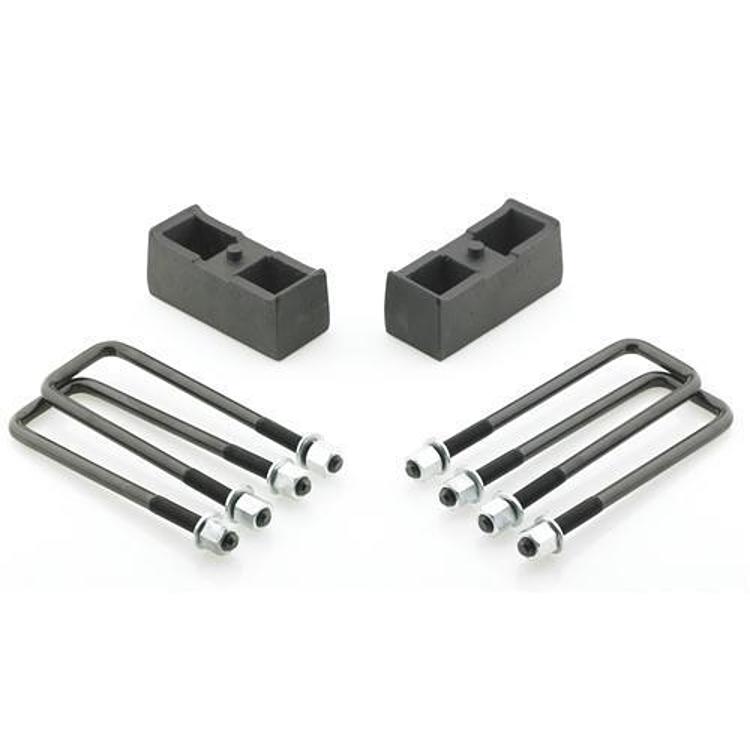
- Lift blocks: a block between the spring and the axle moves the axle away from the spring, so the housing twists the spring through a longer lever. A 3-inch tapered block kit adds 3 inches of lever on top of the lift.
- Bigger tires: a taller tire is a longer lever too, and an aggressive tread grips harder, so more torque reaches the springs before the tire spins.
- Torque: late-model diesels and built gas engines put far more torque into the axle at low speed than the springs on older trucks were sized for.
- Load: a trailer launch from a stop, a loaded bed on a steep grade or a hard stop with a heavy tongue all load the springs in twist exactly when they are already carrying weight.
The symptoms
- Wheel hop on hard launches, on loose gravel, or backing a trailer up a ramp. In reverse the housing rotates the other way, which is why some trucks hop worst backing up.
- A clunk on take-off as the spring winds and the slip yoke shifts, often followed by a second clunk when you lift off the throttle.
- Driveline shudder under load that goes away when you coast, because the pinion angle changes every time the axle wraps and the U-joints run out of phase.
- Broken parts: rear U-joints, pinion yokes, carrier bearings on two-piece shafts, and cracked spring leaves near the front of the pack.
- Spring damage you can see: a leaf pack that has taken a permanent S bend, or leaves that have shifted on the center pin.
If the truck shows none of these, the springs are doing their job and no bar is needed. If it shows them, the fix is to give the axle something stiffer than the front half of a leaf spring to push against.
How a traction bar works
A traction bar is a single arm per side that runs forward from the axle. The rear end clamps rigidly to the housing, usually through a plate under the spring that the U-bolts pass through, so the bar rotates with the axle. When the pinion climbs under power, the front of the bar tries to swing up with it. A frame bracket ahead of the axle stops it, and the twist that would have wound the spring goes into the bar and the frame instead.
The front connection is the clever part. The axle does not move straight up and down on leaf springs; it swings through an arc set by the spring and the shackle. A bar bolted solid at both ends would fight that arc. So traction bars float at the front: a polyurethane bushing, a shackle or a rubber snubber lets the front end slide fore and aft and swing a little while still resisting the up-and-down push that wrap creates. The Mountain Off Road Enterprises TB500 works that way: the shackle lets the axle and bar move fore and aft, but not up and down, which is the motion that causes wrap.
Pro Comp lateral traction bars
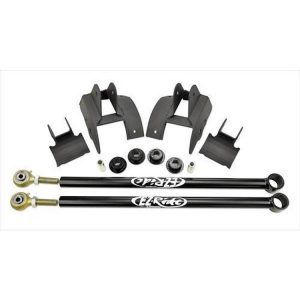
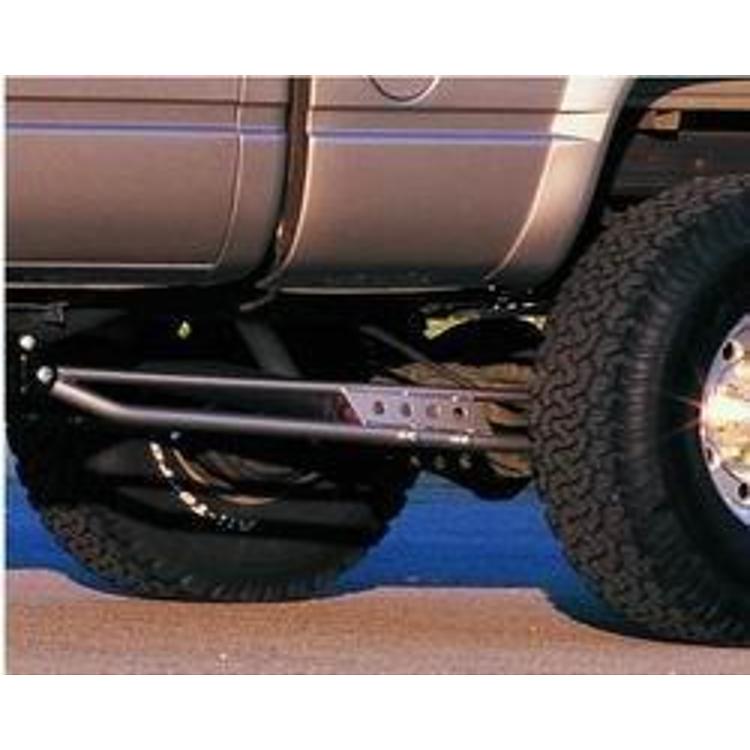
Pro Comp’s bars are the most common bolt-on bars on lifted trucks, sold as a pair in black powder coat. They reduce axle wrap without reducing ground clearance or suspension articulation. Each bar ends in a polyurethane bushing, and the mounting kit is always a separate part, with bushings and sleeves, matched to the truck. Pair them like this:
- Ram: Pro Comp 72501B bars with the 72098B mounting kit for the 2003 to 2010 Dodge Ram 2500 and 3500 and the 2011 to 2012 Ram 2500 and 3500.
- GM HD: Pro Comp 72400B bars with the 71200B mounting kit for the 1999 to 2004 Silverado and Sierra 2500, 2001 to 2010 2500 HD, 2001 to 2006 1500 HD and 3500.
- Ford: the same 72400B bars with the 72099B mounting kit for the 1980 to 1997 F-250 and F-350 and the 1999 to 2010 F-250 and F-350 Super Duty.
- Older GM and Tacoma: 71000B bars for 1988 to 1999 K1500, K2500 and K3500 trucks, the 1999 to 2006 Silverado and Sierra 1500, 1995 to 1999 Tahoe and Yukon and the 1996 to 2004 Tacoma; the 71182B kit covers the 1988 to 1999 K1500 and 1988 to 1998 K2500.
- Newer HDs: 72300B for 2011 to 2017 F-250 and F-350 Super Duty and 2004 to 2011 Titan; 72502B for 2011 to 2013 Silverado and Sierra 3500 HD.
Pro Comp also makes a plate-style bar, the 72301B, with a deep stamped web in place of the tube, which bolts up with the 72101B mounting kit. The complete list of brackets is in the traction bar bracket category.
Floating bars: Fabtech and Cognito
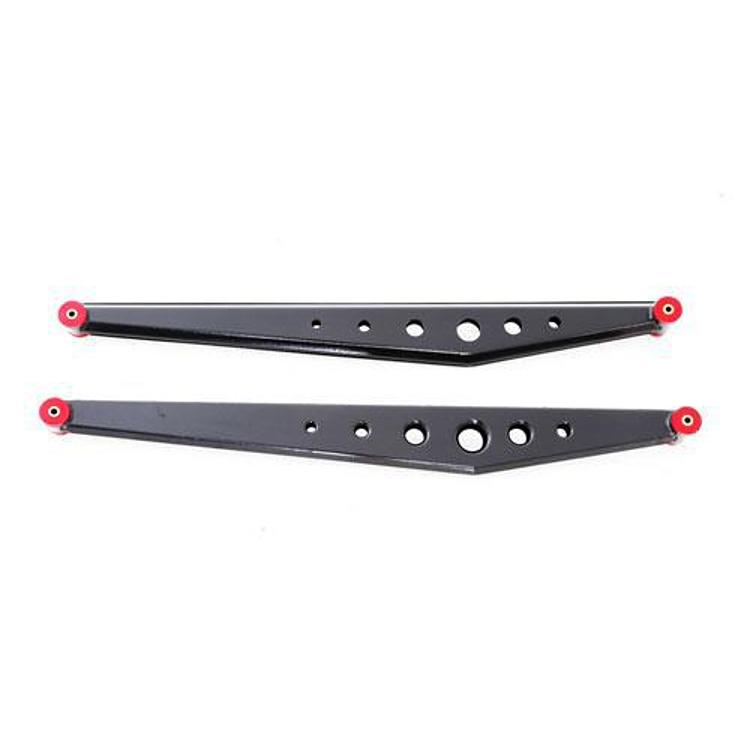
Fabtech’s FTS62003BK floating rear traction bar system for the 1999 to 2008 F-250 and F-350 Super Duty and the 2000 to 2004 Excursion takes the floating idea further. Each bar is two tubes, triangulated at the axle and joined to a single tube at the front. Heim joints thread into both ends, and the front end hangs from a shackle on a frame bracket, so the bar follows the arc of the rear axle instead of fighting it. The system gives a smooth, non-binding highway ride with positive resistance to torque loads. The FTS62006 is the heavy-duty black version for 2011 to 2015 non-dually F-250 and F-350 Super Duty trucks, not for long-bed models.
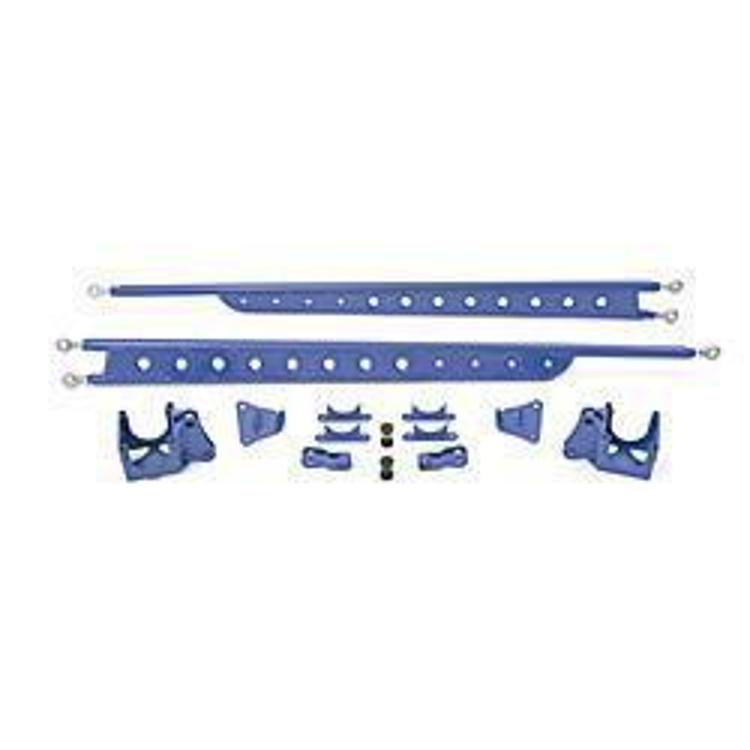
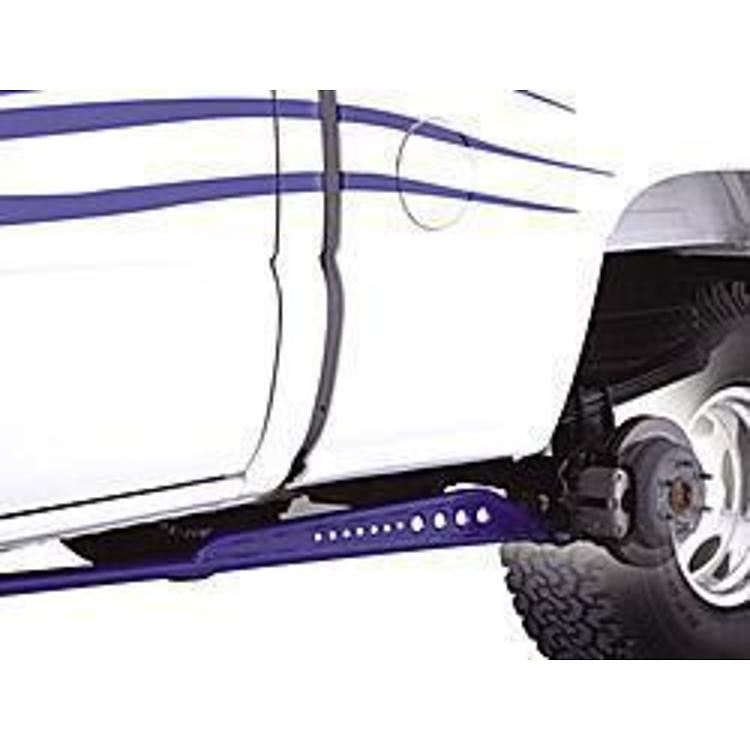
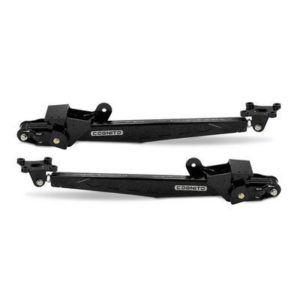
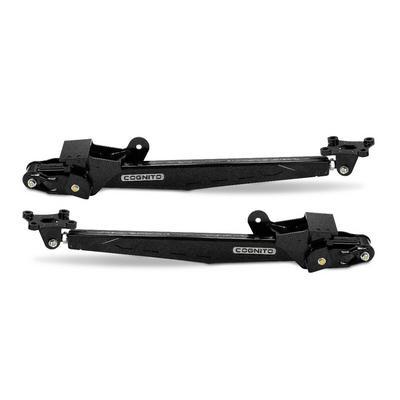
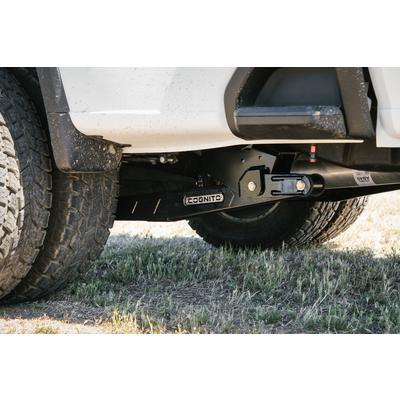
Cognito’s SM Series LDG bars (Limited Dynamic Geometry) are boxed sheet metal rather than tube, and they are adjustable after installation, so you can set them to minimize wrap without restricting suspension travel. The Cognito 110-90901 kit is for 0 to 4 inches of rear lift on the 2020 to 2021 Silverado and Sierra 2500 HD and 3500 HD; Cognito builds other LDG kits by truck and lift height.
Underslung bars: Tuff Country
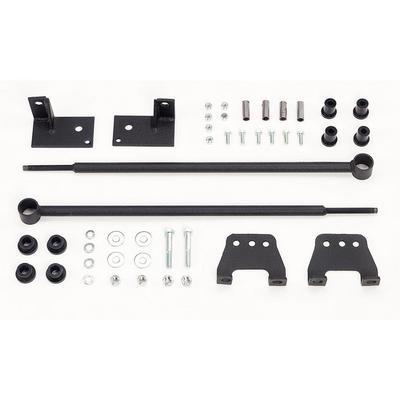
The simplest traction bar mounts under the axle at the U-bolt plate and runs straight forward to a frame bracket. Tuff Country builds them that way and calls them the lighter-duty alternative to its ladder bars. The Tuff Country 10995 for the 1999 to 2006 Silverado and Sierra 1500 and 2007 Sierra 1500 Classic mounts at the U-bolt plate and the frame and bolts on with all hardware included. The Tuff Country 30991 does the same job on the 2003 to 2010 Dodge Ram 2500 and 3500, the 2011 to 2013 Ram 2500 and the 2011 to 2012 Ram 3500. Because the bar hangs below the axle, it gives up some ground clearance under the spring; on a truck that tows and drives on pavement, that rarely matters.
How a ladder bar works
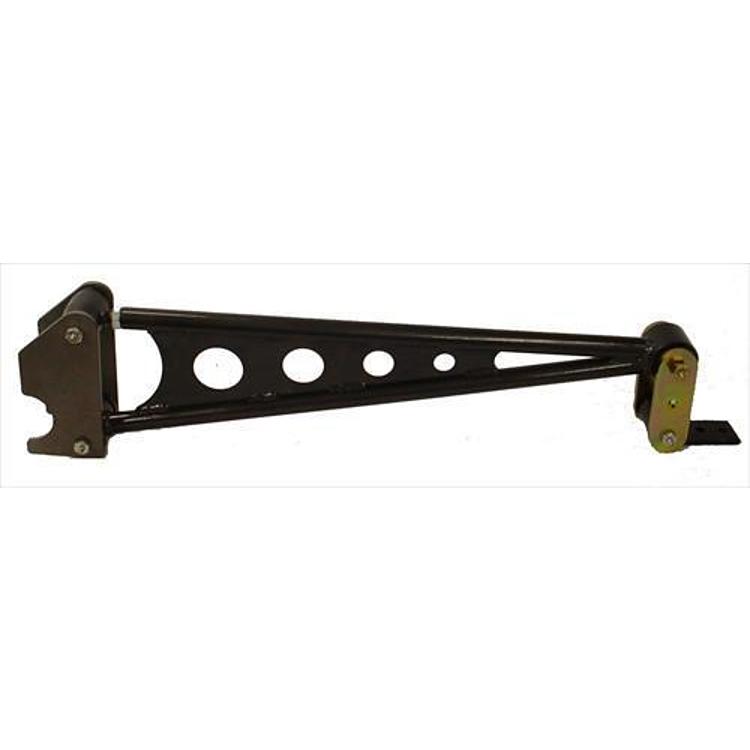
A ladder bar is a triangle. It bolts to the axle at two points stacked vertically, one above the other, and the two arms converge forward to a single pivot on the frame or a crossmember. Because the two axle mounts are fixed relative to each other, the housing cannot rotate on its own at all. The pinion angle is set by the bar, and the axle can only swing up and down in an arc around the front pivot.
That is the strongest anti-wrap geometry there is, which is why ladder bars came out of drag racing. It is also the problem with putting them on leaf springs. The leaf spring wants the axle to follow its own arc, set by the front hanger and the rear shackle. The ladder bar wants the axle to follow a different arc around its front pivot. Where the two arcs disagree, something has to give: the spring bushings, the bar bushings or the spring itself. On a street truck the travel is short and the conflict is small. Off road, at full droop and full stuff, it binds.
Articulation adds a second conflict. When one rear wheel climbs a rock and the other droops, the axle housing rolls. Each ladder bar is fixed rigidly to the housing and wants to pitch it to match its own side’s height, and a solid housing cannot pitch two ways at once. Traction bars with soft front ends tolerate this; two rigid ladder bars resist it like a very stiff sway bar.
Tuff Country ladder bars
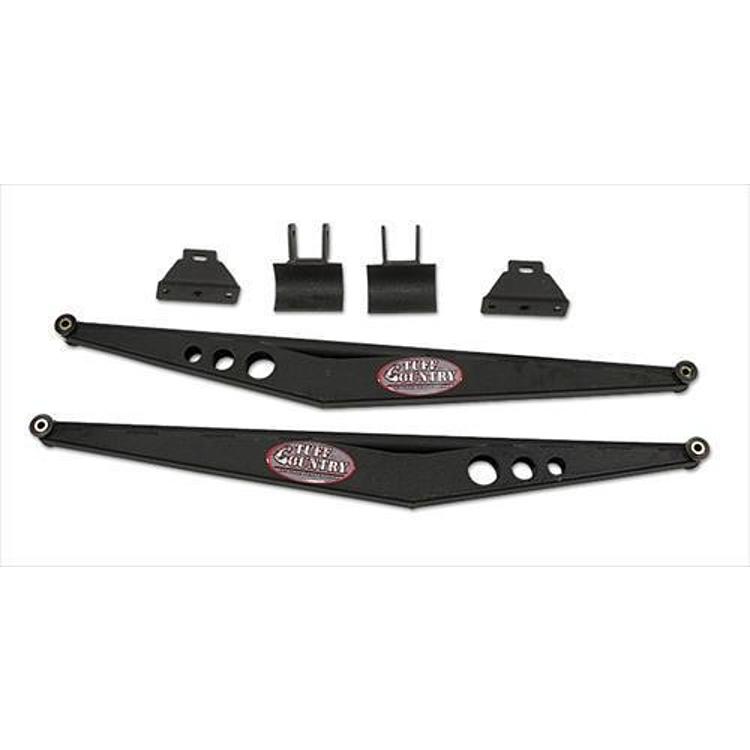
Tuff Country builds bolt-on ladder bars for trucks that launch hard on the street and work on gravel. They are 1.25-inch tubing, powder coated black, direct-fit, with all mounting hardware included:
- GM: Tuff Country 10890 for 1988 to 1998 Chevrolet K1500, K2500 and K3500, GMC K1500 and K3500, and the 1988 to 2000 GMC K2500.
- Dodge: Tuff Country 30995 for the 1994 to 2002 Dodge Ram 2500 and 3500.
A ladder bar changes how the rear axle is located, so check the alignment and driveline angles after installation, and set the pinion angle with the bars bolted in, not before.
Traction bars vs ladder bars vs the alternatives
Every fix for axle wrap works by giving the axle a stiffer path to the frame than the front half of the spring. They differ in how stiff that path is and what it costs in travel and ride.
| Traction bar | Ladder bar | Slapper bar | Stiffer springs or add-a-leaf | |
|---|---|---|---|---|
| Axle mount | One point, usually the U-bolt plate | Two points, stacked vertically | Under the spring at the U-bolts | None |
| Front end | Bushing or shackle on a frame bracket | Single pivot on frame or crossmember | Free; a snubber touches the spring | Spring front hanger |
| How it stops wrap | Bar pushes against the frame mount | Fixes pinion angle to the bar | Snubber bears on the front half of the spring | Spring resists more twist |
| Articulation | Little loss with a floating front | Clear loss; binds at full flex | Little loss | Less flex, stiffer ride |
| Towing and hauling | Strong choice | Strong, with ride trade-off | Light duty | Helps with load and mild wrap |
| Typical install | Bolt-on, frame drilling common | Bolt-on, frame drilling common | Bolt-on at the U-bolts | Spring pack work |
| Best fit | Lifted trucks that tow, haul or trail | Launch-heavy street trucks | Light street trucks on stock height | Sagging or light-duty springs |
Slapper bars
A slapper bar bolts under the spring at the U-bolts and sticks forward under the front half of the spring, with a rubber snubber a short gap below it. When the axle wraps, the front half of the spring comes down onto the snubber and stops. There is no frame mount at all, so slappers give up almost nothing in flex. They also hang low, take repeated impacts and work best at stock or near-stock height. They belong on street trucks with modest tires, not on a lifted rig that drags its belly over rocks.
Stiffer springs, add-a-leafs and clamps
A stiffer spring resists twist better, and the add-a-leaf route is the easiest way to stiffen a pack: a short leaf like the Pro Comp 13120 adds 1.5 to 2.5 inches of rear height and strengthens the existing spring. Extra leaves, a thicker main leaf and tight spring clamps all reduce windup, and a fresh pack from the leaf spring category often cures mild wrap on a light truck. The trade-off is ride and flex. Springs stiff enough to hold a diesel’s torque on 37s ride hard empty and articulate poorly, which is why most heavy trucks use a softer spring and a bar.
Replace worn hardware either way. Loose U-bolts, sagging spring eyes and worn shackle bushings let the axle move on the spring before any bar sees load, and a traction bar bolted to a loose U-bolt plate only moves the clunk somewhere else.
Which trucks and lifts need traction bars
The pattern is simple: a leaf-sprung rear axle, plus at least two of lift blocks, bigger tires, high torque and heavy towing.
- Ford Super Duty and Excursion: leaf rear, heavy diesel torque and frequent block lifts. Fabtech’s FTS62003BK covers the 1999 to 2008 F-250 and F-350 and the 2000 to 2004 Excursion; Pro Comp’s 72400B and 72099B cover F-250 and F-350 trucks back to 1980.
- GM HD: leaf rear on every generation. Pro Comp covers 1999 to 2013 trucks, and Cognito’s LDG kits cover the 2020 and later 2500 HD and 3500 HD.
- Ram 2500 and 3500: leaf rear through 2013 on the 2500 and on every 3500. Pro Comp 72501B and Tuff Country 30991 cover 2003 to 2012 trucks. From 2014 the Ram 2500 uses a coil-sprung link rear that does not wrap the same way.
- Half-tons on blocks: 1999 to 2006 Silverado and Sierra 1500s, older K1500s and the F-150 wrap mainly with tall blocks and big tires. Tuff Country 10995 and Pro Comp 71000B cover the GM trucks.
- Older Jeeps: the CJ-7 and YJ Wrangler ride on leaf springs, and a spring-over-axle conversion moves the axle above the spring and makes wrap worse.
- Mid-size trucks: the Tacoma and Titan carry leaf rears; Pro Comp mounting kits cover the 2005 to 2016 Tacoma and the 2004 to 2012 Titan.
Older Jeeps: one bar in the middle
On a Jeep that crawls, the right bar is a single one on the centerline. The Mountain Off Road Enterprises TB500 for the 1976 to 1986 CJ-7 and 1987 to 1995 Wrangler YJ is a weld-on bar whose axle brackets weld to the housing. Its front hangs from a Johnny Joint mounted shackle on the transfer case crossmember, which turns the axle’s twisting into up-and-down motion at the front of the bar. One bar on the centerline cannot fight the housing in roll, so it stops wrap without limiting articulation. The brackets are weld-on, so have a welder who knows axle housings do the work.
Installation: what to check before you drill
Bolt-on traction bars still change a lot under the truck. Work through these before you mark a hole:
- Exact fit: bars and brackets are built per truck and often per bed length and cab. Fabtech’s FTS62006 is non-dually and not for long-bed models; its FTS62003BK frame bracket sits on the bend of the frame on long beds and on the flat part on short beds.
- Block height and springs: The FTS62003BK needs at least 3-inch blocks and does not work with long-travel rear leaf springs. With Fabtech rear leaf springs or AMP steps it needs bracket kit FTS92025.
- Frame drilling: most bolt-on kits drill the frame for the front bracket. Fabtech’s kit uses 1/2-inch holes and warns to check inside the frame for wiring and hoses before drilling.
- Exhaust: on many trucks the exhaust runs beside a frame rail ahead of the axle, right where a bar goes. Plan to reroute or hang it lower.
- Fuel tank and brake lines: cycle the suspension and check that the bars clear the tank, brake lines and wiring at full droop and full compression. Some kits move the axle brake line tab to the new bracket.
- Spare tire: on trucks with the spare under the bed, check that the spare, its cable and the bar’s axle bracket stay clear of each other at full compression, and that the spare still lowers.
- Driveshaft and carrier bearing: a center bar or a wide bracket can sit close to the driveshaft. On two-piece shafts, the carrier bearing has its own angle limits, and Fabtech bars may not cure carrier bearing vibration on some trucks.
Setup and torque
Set the bar length with the truck on the ground at ride height, unloaded, so the bar is neutral when the axle is at rest; preload pushes the pinion one way all the time. On the Fabtech kit the shackle should hang straight up and down, adjusted with the heim joints, which need at least 1 inch of thread in the bar. Torque the Fabtech kit to 70 ft-lb on the frame bracket bolts, 65 ft-lb on the shackle and axle bracket bolts and 100 ft-lb on the 3/4-inch heim bolts, then a retorque after 50 miles. For other kits, use the maker’s instruction sheet; values differ by fastener size.
After the install, check the pinion angle. Bars hold the pinion where it sits; they do not correct a bad static angle. Tapered axle shims or tapered blocks set it, and the right angle depends on whether the truck runs a single-cardan or a double-cardan shaft. If you are rebuilding the axle at the same time, the Ford 9-inch vs 8.8 and Dana 30, 44 and 60 guides cover what is inside the housing the bars are holding.
Which one to choose
- Lifted truck that tows, hauls or sees trails: a bolt-on traction bar with a floating front, Pro Comp, Fabtech or Cognito, matched to the truck with its mounting kit.
- Street truck that launches hard and rarely leaves pavement: a ladder bar gives the firmest pinion control; accept a stiffer ride and less flex.
- Rock-crawling CJ-7 or YJ: one center-mounted bar on a shackle, such as the M.O.R.E. TB500.
- Light truck at stock height with mild hop: fix the springs and hardware first; a slapper bar or add-a-leaf is often enough.
Pair any bar with good shocks: a shock that has lost its damping lets the axle bounce on the springs, which looks and feels like wheel hop. The Bilstein 5100 vs Fox 2.0 Performance guide covers the common choices for lifted trucks.
Frequently asked questions
Do I need traction bars after a lift?
Not every lifted truck needs them. A leaf-sprung rear axle on a lift block, running bigger tires, with a diesel or a heavy trailer, is the classic case: if it hops on hard launches, clunks when you take off or eats rear U-joints, the springs are winding up and a traction bar is the fix. A stock-height half-ton on stock tires that never shows those symptoms gains nothing from them. A coil-sprung link rear, such as a 2014 and later Ram 2500, already locates the axle with control arms and does not take leaf-spring traction bars.
Are traction bars and ladder bars the same thing?
No. A traction bar bolts to the axle at one point, usually the U-bolt plate under the spring, and reaches a frame mount through a bushing or shackle that lets it move fore and aft. A ladder bar bolts to the axle at two points stacked one above the other and pivots on one point at the front, so it holds the pinion angle rigidly through its travel. Tuff Country sells both and calls its traction bar the lighter-duty alternative to its ladder bar.
What are lateral traction bars?
Lateral traction bars is the name Pro Comp uses for its bolt-on traction bar pairs, such as the 71000B, 72400B and 72501B. Each bar runs lengthwise beside the frame rail from a plate under the axle to a bushed frame bracket, one bar per side. They control axle wrap, not side-to-side axle movement; a track bar or Panhard bar does that job on axles that need it. Every pair needs a separate mounting kit matched to the truck.
Do traction bars reduce articulation off road?
A well-designed bolt-on traction bar takes away little articulation because its front end floats in a shackle or a soft bushing and only resists the axle twisting. A rigid ladder bar on each side takes away more: when one wheel climbs and the other droops, two bars fixed solidly to one housing try to pitch it two different ways, and the bushings, the brackets or the frame take that load. For rock crawling, a single center-mounted bar such as the M.O.R.E. TB500 on a CJ-7 or YJ keeps the most flex.
Will traction bars fix driveline vibration?
They fix the vibration that comes from the pinion angle changing under load, the shudder you feel on a hard launch or while pulling a trailer up a grade. They do not fix a bad static pinion angle, a worn U-joint or a tired carrier bearing. Fabtech floating traction bars may not eliminate carrier bearing vibration on some vehicles, so set the pinion angle with shims and check the carrier bearing before you blame the springs.
Can I run traction bars with lift blocks?
Yes, and lift blocks are one of the main reasons trucks need them, since a taller block lengthens the lever the axle uses to twist the spring. Some kits need a minimum block height to clear the axle bracket: the Fabtech FTS62003BK for the 1999 to 2008 Super Duty needs at least 3-inch blocks and does not work with long-travel rear leaf springs.
Start with the traction bars and ladder bars for your truck, then the matching traction bar mounting kits and the traction bar suspension accessories. If the springs or blocks are part of the problem, the block and U-bolt kits, leaf springs and add-a-leaf kits are the other half of the job.
Sources
- Fabtech, Floating Rear Traction Bar System FTS62003BK: design, shackle system, minimum block height, bracket kit and carrier bearing notes.
- Fabtech, Installation Instructions FTS62003 and FTS62003BK: parts list, frame drilling, shackle setup, torque values, long-travel spring warning.
- Cognito Motorsports, SM Series LDG Traction Bar Kit: Limited Dynamic Geometry design, boxed construction and adjustment.
- Wikipedia, Hotchkiss drive: how leaf springs carry axle torque reaction into the frame under acceleration and braking.
- Wikipedia, Leaf spring: leaf spring construction and how the spring locates the axle.