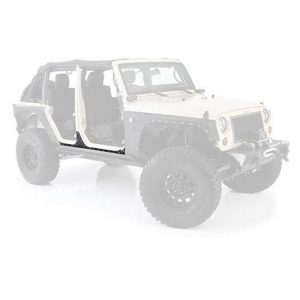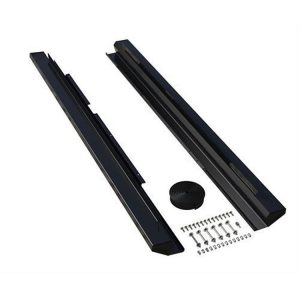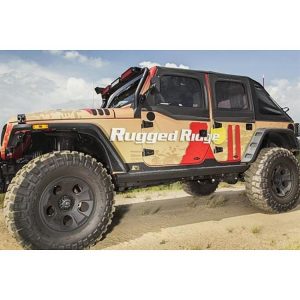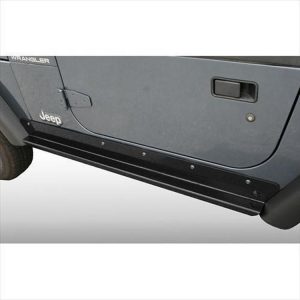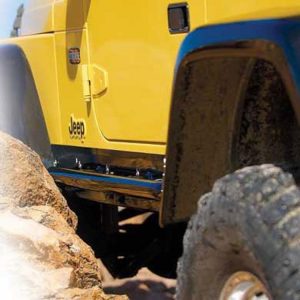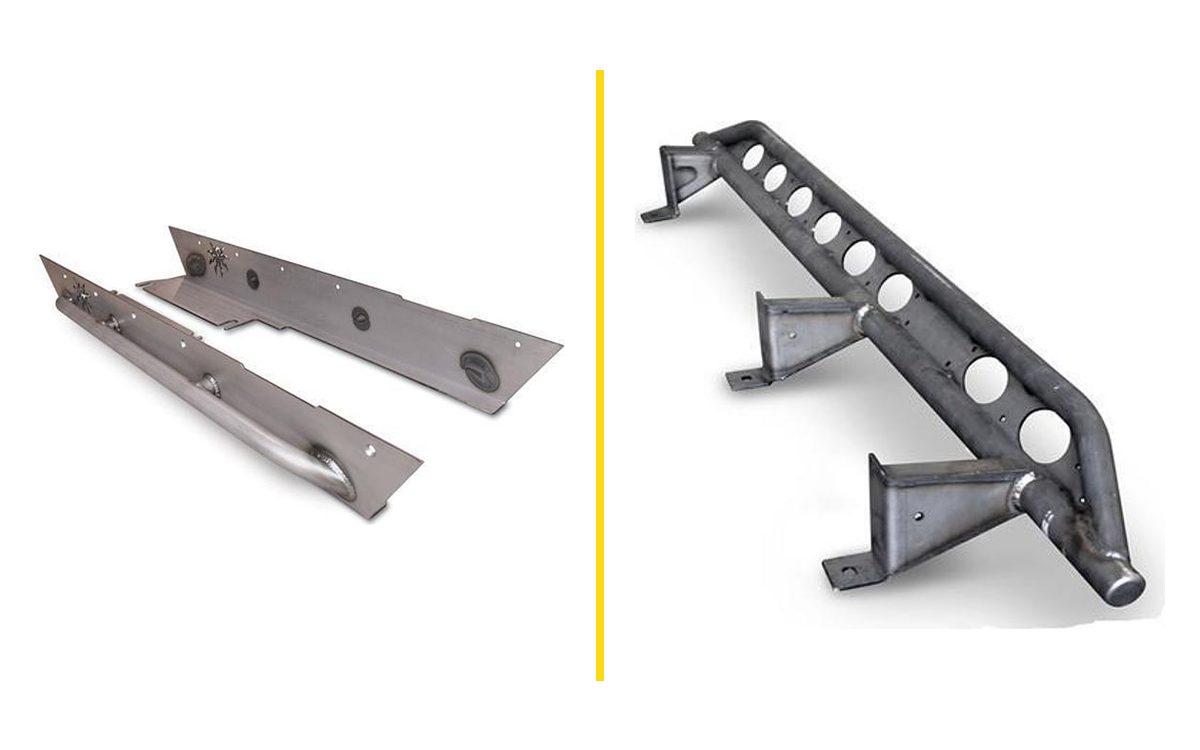
Rocker Knockers vs rock sliders comes down to mounting. Rocker Knockers are Poison Spyder’s formed-plate rocker armor, most of it bolted directly to the Jeep’s body tub. Rock sliders are side rails built to carry the vehicle across a rock, often on frame outriggers. Choose body-mounted armor for a close fit and frame-mounted rails for hard hits.
Key takeaways
- Load path decides the damage: a body-mounted guard sends a hit into the tub and its rubber body mounts, while a frame-mounted rail sends it through outriggers into the frame rail.
- Plate thickness: 3/16-inch plate is about 3.4 times as stiff as 1/8-inch plate of the same steel, and it weighs about 7.7 lb per square foot.
- Cladding is not a slider: Smittybilt XRC Body Cladding is 1/8-inch steel over the body panel. It handles scrapes and is meant to work alongside rock sliders.
- Steps are not armor: a nerf bar is built for a downward load from a boot. A 500 lb step rating says nothing about landing on a ledge.
- Body lift: body-mounted armor rises with the tub. A frame-mounted rail stays behind, and the gap grows by the height of the lift.
Which one suits your Jeep also depends on the generation. The parts below cover the TJ, JK and JL in detail, with the YJ part numbers people search for most.
What does the rocker panel do on a Jeep?
The rocker panel is the steel sill under the doors, running between the front and rear wheel openings, and it is the lowest piece of bodywork on the side of a Jeep. It closes the bottom of the door openings and adds stiffness to the tub, the welded steel body shell that sits on the frame.
Wranglers are body-on-frame vehicles. The frame carries the suspension and drivetrain, and the tub rests on rubber isolators called body mounts. That layout matters here, because anything bolted to the tub is separated from the frame by those rubber mounts.
- It takes the first hit. On a tight obstacle the tire climbs, the body drops or leans, and the sill meets the rock.
- Damage spreads upward. A pushed-in sill can distort the door opening and make the doors hard to close.
- It holds water. The bottom edge carries the pinch seam, the welded flange where the inner and outer panels meet. Mud and salt pack in there, which is why the area under the doors often rusts first.
Factory protection exists, but it depends on the trim. The Rubicon’s rock rails on the 2016 JK are extra-tough body-mounted rails. The 2024 JL has tubular steel rock rails on Willys and Rubicon models. Trims without those rails are the ones that most need rock sliders and rocker guards.
Rocker Knockers vs rock sliders: what is the difference?
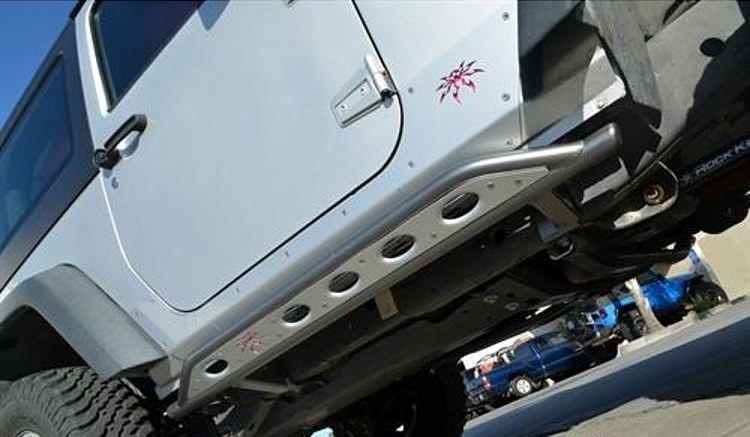
A Rocker Knocker is a specific Poison Spyder product family, while a rock slider is any rail designed to take a rock and let the vehicle slide off it. The two overlap, because Poison Spyder sells Rocker Knockers both with and without a slider tube.
The family has three main forms, and the part number tells you which one you are looking at:
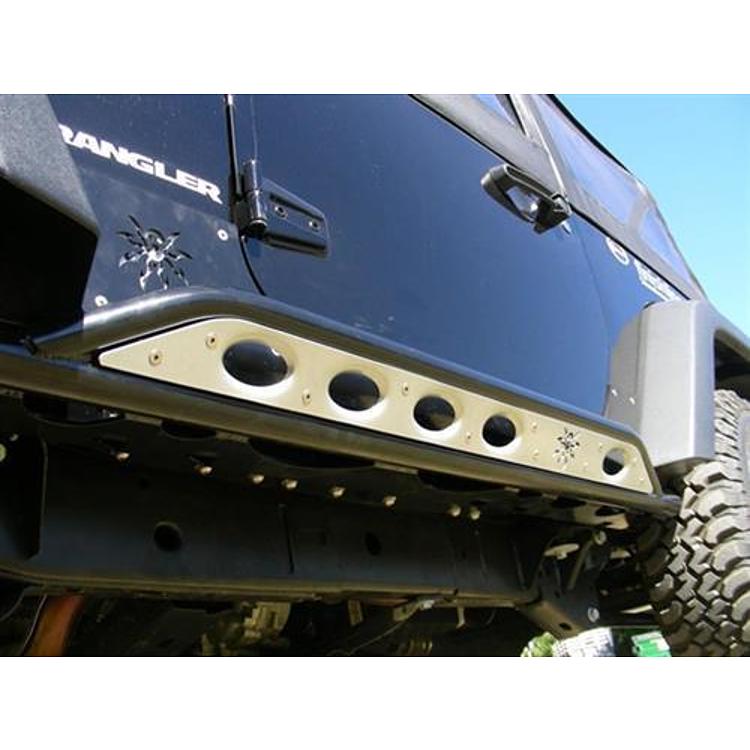
- Plate only: the Rocker Knockers 14-08-050 for the TJ is 3/16-inch high strength plate, CNC laser cut and brake formed to follow the rocker. Countersunk stainless flat-head screws leave a smooth face, and ground clearance barely changes.
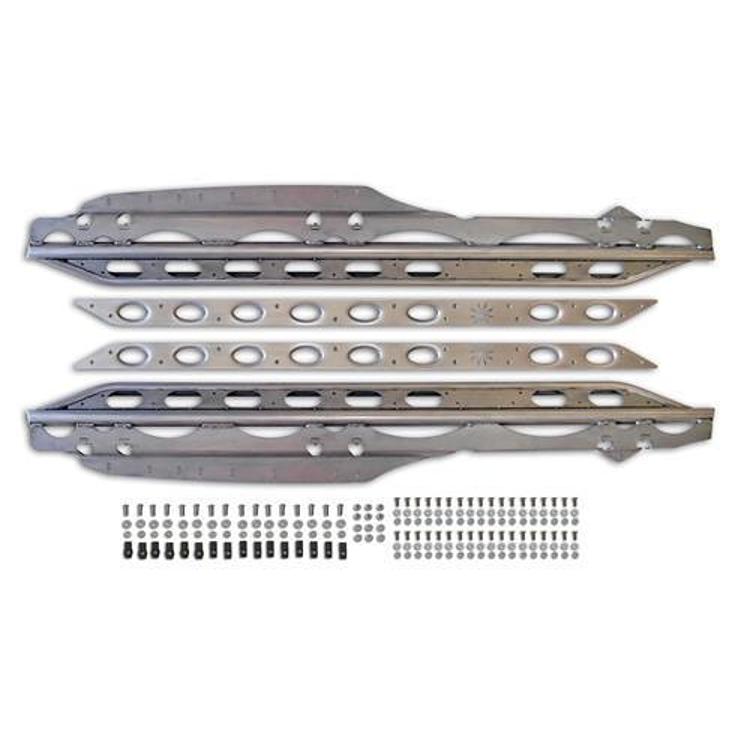
- Plate with slider: the Rocker Knockers with Sliders 14-08-060 adds a DOM tube standing off the plate on DOM spacers. The tube holds the door side away from rocks and can work as a pivot on tight turns.
- Frame mounted: the Frame-Mounted Rocker Knockers 18-08-030 uses the same rail and skid idea, but it hangs from outriggers on the frame.
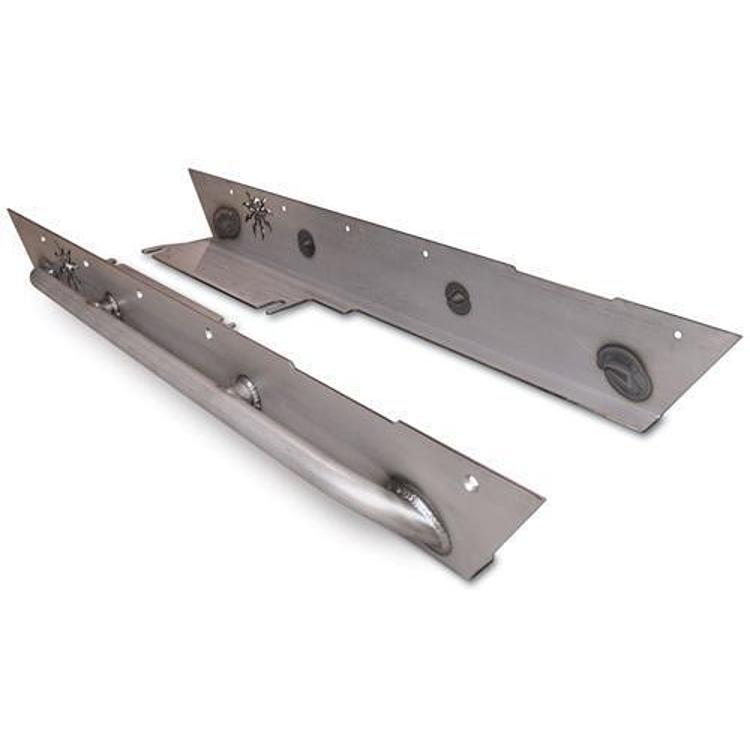
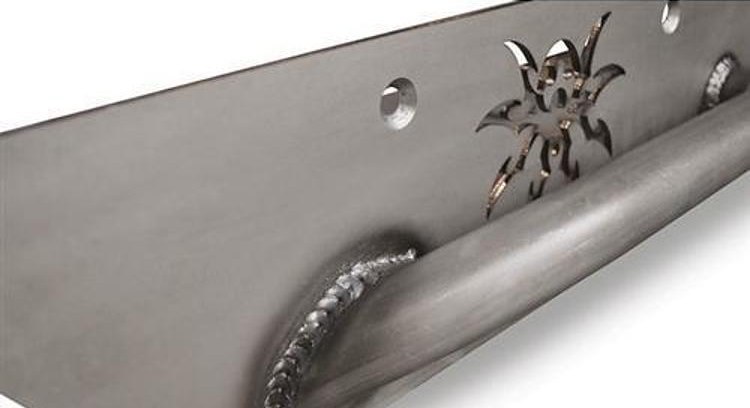
Poison Spyder builds two close relatives. Ricochet Rockers combine the same construction with a dimpled step plate: 5 inches on the 14-50-050 for the TJ, YJ and CJ7, while the JK’s Ricochet Rockers 17-08-040 mount to the frame. The Brawler Rockers 18-08-200 are a two-piece mini-boatside: 3/16-inch plate wraps from the lower sheet metal down and inward, with a rub rail about 3-1/4 inches outboard of the tub. The upper piece fastens to the tub, and the lower piece also picks up the body mounts. A boatside is armor that closes the whole side of the body down toward the frame, so a rock has no sill edge to catch.
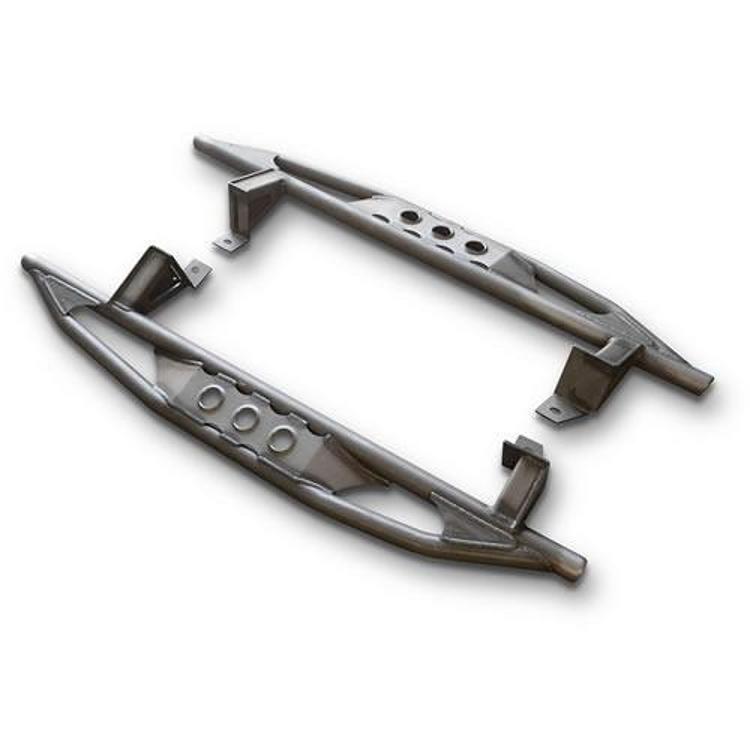
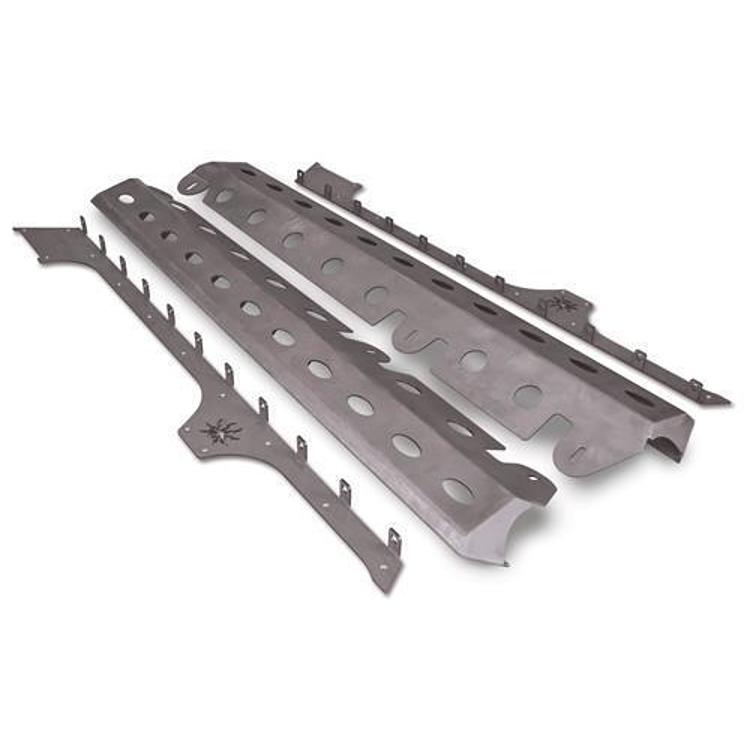
Outside that family, “rock slider” covers everything from the plate-and-tube Smittybilt XRC 76890 for the two-door JK to the plain-tube Trail Gear 120001-1-KIT, a weld-on kit for Toyotas with six legs. “Rock rail” and “rocker guard” usually mean the same class of part, so judge each one by what it bolts to, not by its name.
Body-mounted armor vs frame-mounted sliders: where does the load go?
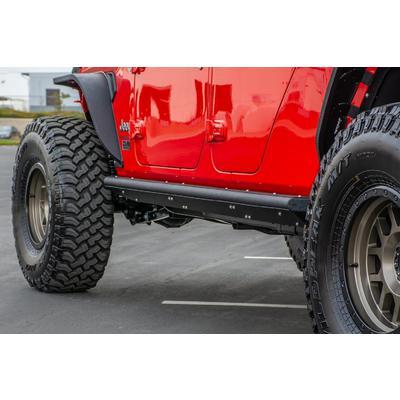
A body-mounted guard feeds an impact into the tub and through the rubber body mounts to the frame, while a frame-mounted slider feeds it straight into the frame rail through steel outriggers. Both protect the rocker from scrapes. They behave differently when the Jeep lands its weight on the rail.
Body-mounted: spread the load across the tub
The body-mounted JK Rocker Knockers 18-08-020 attach to the body tub at 14 bolt locations, with a 3/16-inch mounting plate spreading the load between them. Poison Spyder’s TJ and YJ guards tie into the strengthened parts of the tub, such as the body mounts and ribs. The Fab Fours JK07-G1250-1 use the same idea, tying into the body mounts and 15 places per side on the body.
- Strength: the guard reinforces the sill and keeps the fit tight, with no gap for debris or a tree branch.
- Limit: the tub is still sheet metal on rubber. A hard vertical hit can compress the body mounts and crease the metal above the guard.
- Compatibility: the body-mounted Poison Spyder JK kit moves with a body lift and fits any suspension system, including long-arm kits.
Frame-mounted: skip the rubber
The Frame-Mounted Rocker Knockers 17-08-030 for the 2007-2016 two-door JK and its four-door counterpart hang from outriggers, which are brackets that reach out from the frame rail to carry the rail. On the 18-08-030 there are three outriggers per side. In Poison Spyder’s JK install, the front outrigger uses a factory bolt between the frame rail and the transmission crossmember, the center and rear use spacers and hex-head cap screws, and the adjacent body mount brackets get drilled for extra 3/8-inch hardware. New holes in the frame start with a 3/16-inch pilot and are threaded with a 1/2-inch tap.
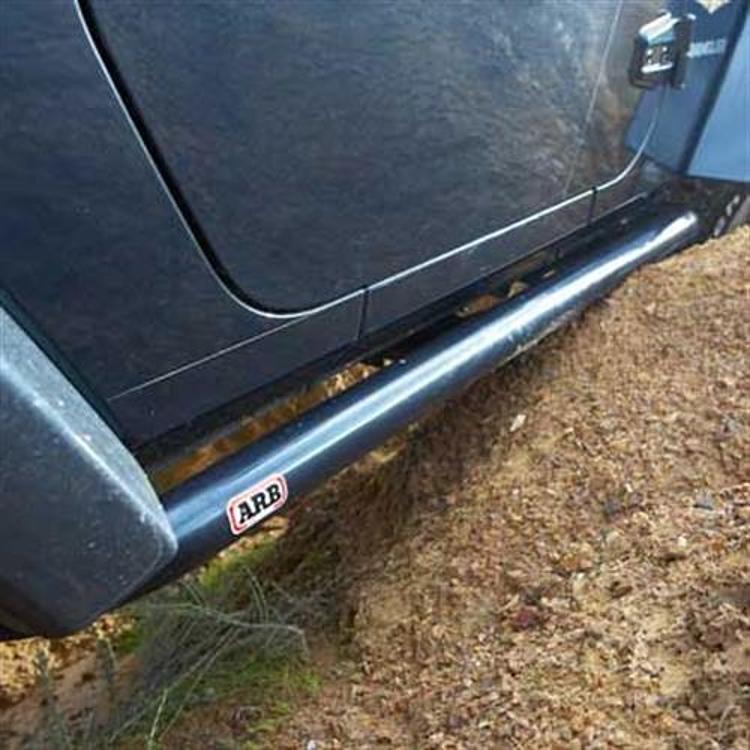
The difference between the two Poison Spyder kits is direct: the frame-mounted kit offers more protection from side and vertical impacts, and the body-mounted kit moves with a body lift. The ARB 4450210 sliders for the four-door JK take the same approach using factory-drilled holes in the chassis and the rear lower control arm hangers.
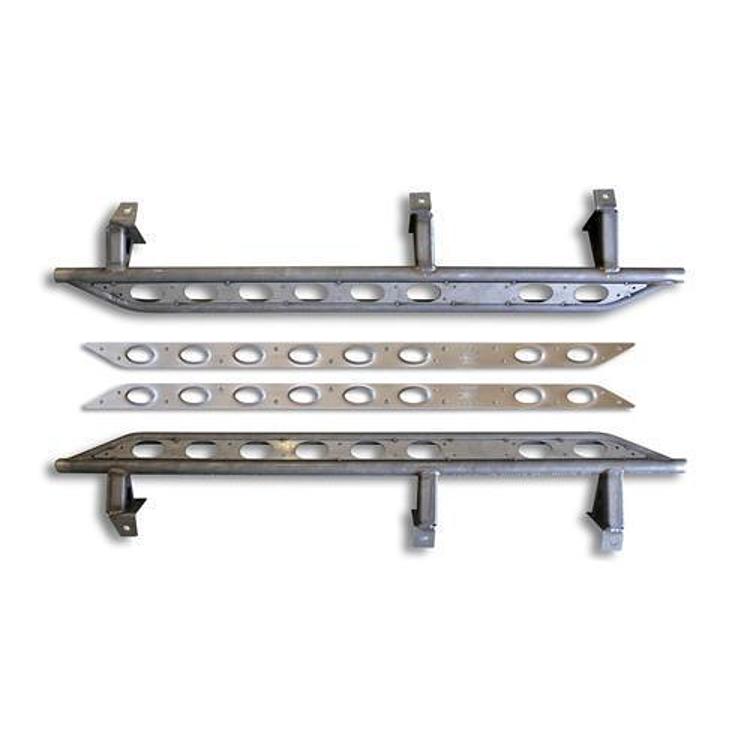
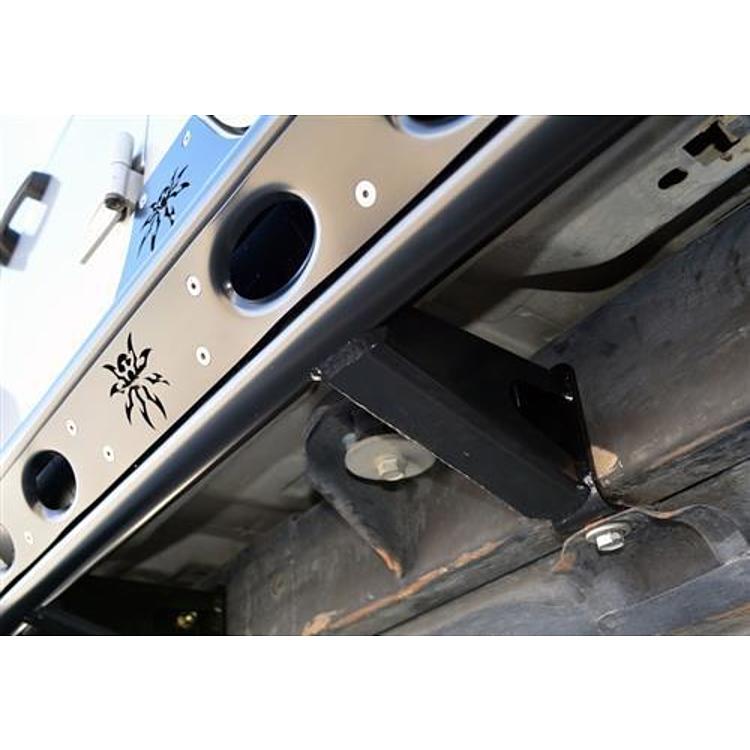
Outriggers have their own limit: leverage. The rail sits outboard of the frame, so a load on it twists each outrigger at its base. Rest half of a 4,000-pound Jeep on a rail 10 inches outboard of the frame, and the outriggers on that side share 20,000 inch-pounds of twist. A hit can also bend an outrigger until the rail touches the body it was meant to protect, so check the gap between rail and tub after a hard run.
Rocker armor compared
| Body-mounted armor | Frame-mounted slider | Body cladding | Nerf bar or side step | |
|---|---|---|---|---|
| Attaches to | Body tub | Frame rail, through outriggers | Body panel | Brackets |
| Load path | Tub, body mounts, frame | Outriggers, frame | Body panel only | Brackets, built for a downward step load |
| Typical material | 3/16 in. plate | 3/16 in. plate plus .120-wall DOM | 1/8 in. cold rolled | Thin-wall tube, such as N-Fab’s .084 and .095 wall |
| Carries vehicle weight | Some, within the tub’s limits | Yes, when built for it | No | No |
| With a body lift | Rises with the tub | Gap grows by the lift height | Rises with the tub | Depends on the bracket |
| Example | Poison Spyder 18-08-020 | Poison Spyder 18-08-030 | Smittybilt 76887 | Rough Country 21003 |
What steel gauge should rock sliders and rocker guards use?
Trail-rated rocker armor is usually 3/16-inch plate, about 7 gauge in thickness, and sliders usually use 1.5-inch to 1.75-inch tube with a .120-inch wall. Thinner steel works for scrape protection, but it is a poor choice for carrying the vehicle.
Gauge numbers run backward: a higher number is thinner steel. Bending stiffness of a flat plate rises with the cube of its thickness and strength with the square, so small changes count for a lot. The table compares common thicknesses, using standard steel gauge values and 1/8-inch plate as the baseline. The ratios assume the same material, so a stainless or higher-strength plate will differ on strength.
| Thickness | Inches | Weight, lb per sq ft | Stiffness vs 1/8 in. | Strength vs 1/8 in. | Example |
|---|---|---|---|---|---|
| 3/16 in. plate | 0.1875 | 7.7 | 3.4× | 2.25× | ARB 4450010, TJ |
| 7 gauge | 0.1793 | 7.3 | 3.0× | 2.1× | General fabrication plate |
| 1/8 in. | 0.125 | 5.1 | 1× | 1× | Smittybilt 76886 cladding |
| 11 gauge | 0.1196 | 4.9 | 0.88× | 0.92× | General fabrication sheet |
| 3 mm | 0.118 | 4.8 | 0.84× | 0.89× | Rugged Ridge 11504.18 |
| 7/64 in. | 0.109 | 4.5 | 0.67× | 0.77× | Kentrol 30413 stainless, CJ5 |
| 12 gauge | 0.1046 | 4.3 | 0.59× | 0.70× | General fabrication sheet |
Tube works differently, because diameter matters more than wall thickness for bending, while the wall ratio decides how easily it dents. A bigger number below means stiffer in bending, and a lower diameter-to-wall ratio means better dent resistance.
| Tube | Used on | Moment of inertia, in⁴ | Diameter ÷ wall |
|---|---|---|---|
| 1.5 in. × .120 DOM | Rocker Knocker slider rail | 0.125 | 12.5 |
| 1.66 in. × .140 (1.25 in. schedule 40 pipe) | ARB 4450010 | 0.195 | 11.9 |
| 1.75 in. × .120 DOM | Trail Gear 300145-KIT | 0.205 | 14.6 |
| 3 in. × .084 steel | N-Fab nerf bars, 3-inch tube | 0.819 | 35.7 |
| 2.4 in. × .25 mild steel | ARB 4450210 | 0.989 | 9.6 |
The N-Fab row explains why a large step tube can feel solid underfoot and still crumple on a ledge. The 3-inch nerf tube resists bending well, but its thin wall dents far more easily than a .120-wall rail.
DOM stands for drawn over mandrel: welded tube cold drawn through a die and over a mandrel, which gives a uniform wall and works the weld seam into the surrounding steel. Trail Gear builds its sliders from 1035 DOM and says HREW tube, hot rolled electric welded, can split down the seam under heavy stress.
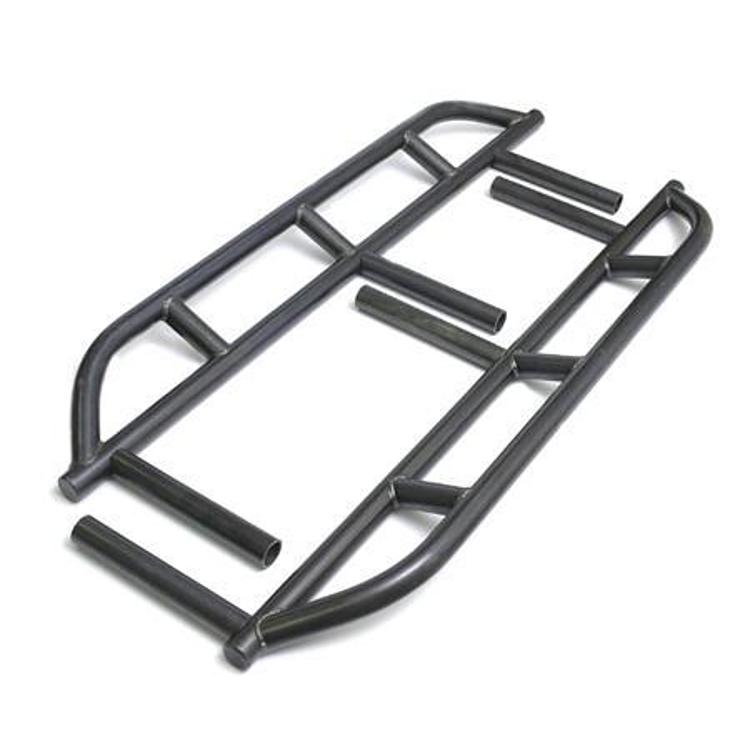
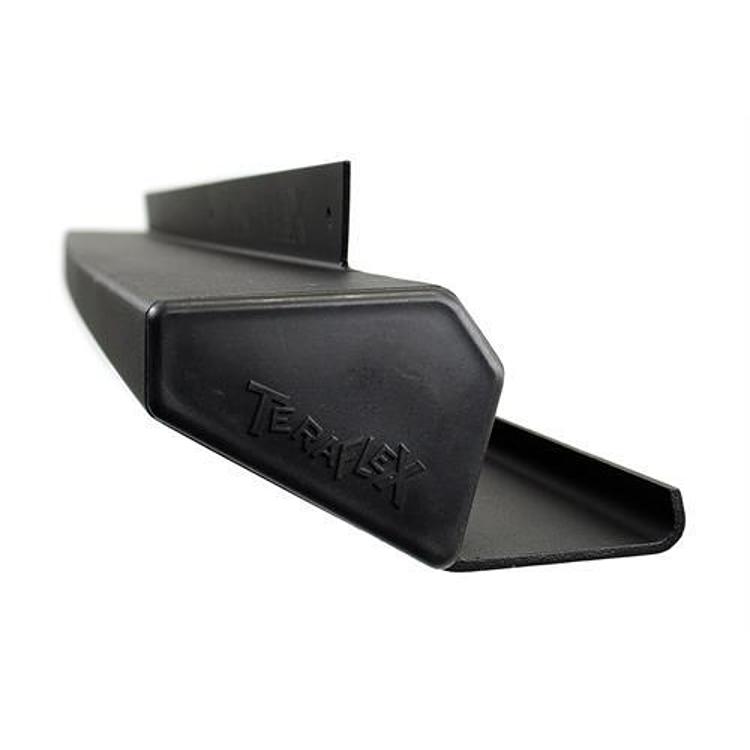
Aluminum is the other route. TeraFlex RockGuard sliders are extruded 6063-T5, up to 1/4 inch thick in critical areas. The TeraFlex 4637310 kit for the four-door JK is aluminum, which cannot rust the way steel does and weighs about a third as much per unit of volume. It is also roughly a third as stiff per unit of section, so an aluminum part needs the extra thickness to compete. It suits a Jeep that takes rock rash and rarely lands hard.
Is XRC body cladding a rock slider?
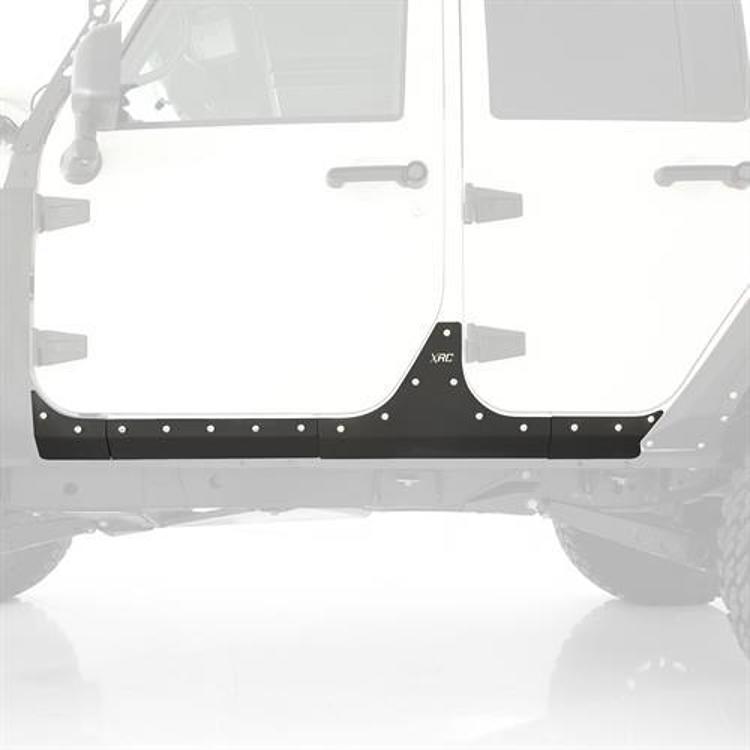
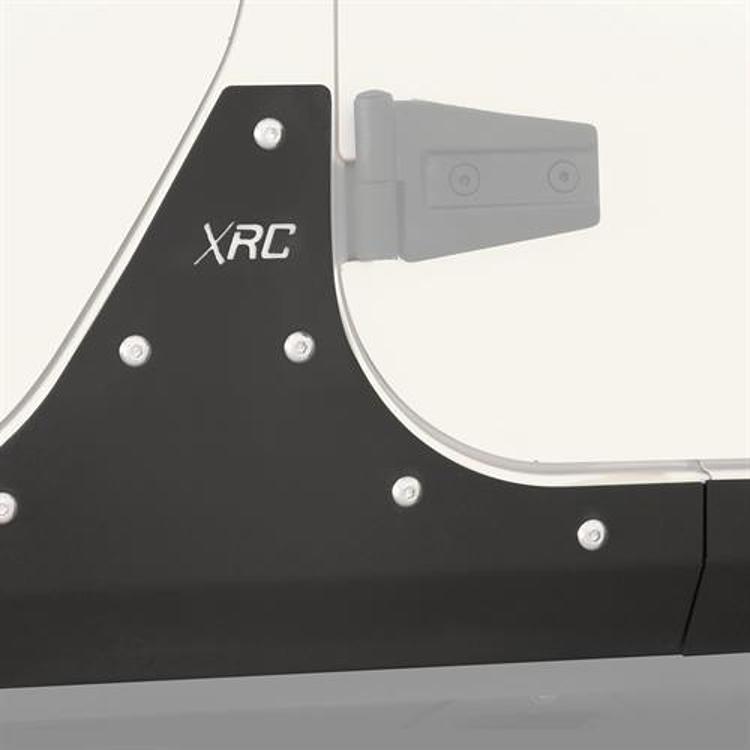
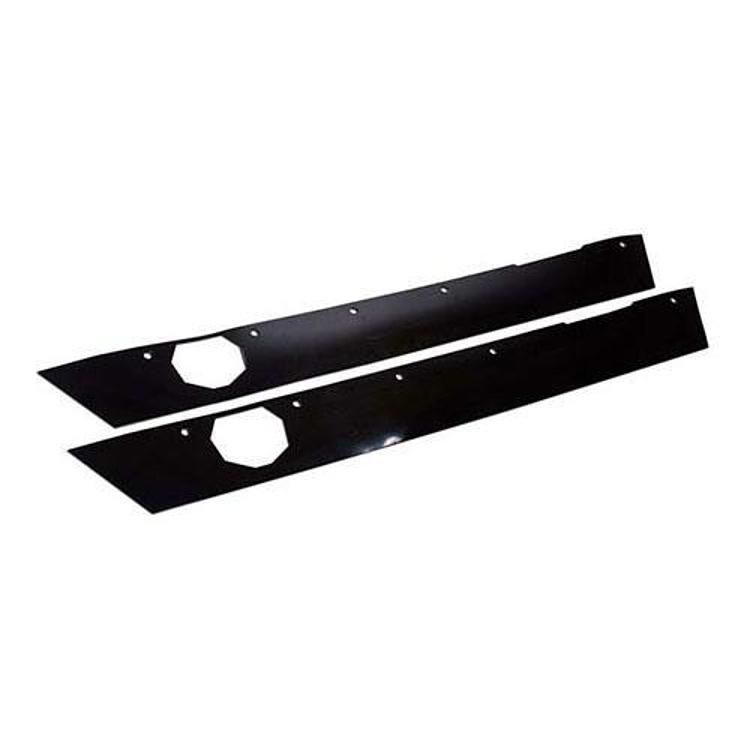
No. Smittybilt XRC Body Cladding is 1/8-inch cold rolled steel fastened over the lower body panel, and it stops scrapes and gravel, not the weight of a Jeep on a rock. Think of it as a wear surface.
The XRC Body Cladding 76886 is the set for two-door models, and the XRC Body Cladding 76887 is the panel for the four-door JK. Each follows the body contour and uses 304 marine grade stainless button-head hardware over a two-stage textured powder coat. Smittybilt designs the cladding to complete lower quarter panel protection when used with XRC rock sliders, and it works with factory and aftermarket flares. On the 76887, each button head threads into a rivet nut set in a deburred 17/32-inch hole drilled through the body.
For a real slider underneath, the natural partners on the JK are the XRC 76890 for two-door models and the XRC 76895 for four-doors, both 3/16-inch solid plate with a 1.75-inch over-rider tube. Add body corner guards to carry the protection around the rear of the tub. If you want no holes at all, look at plastic:
- Rugged Ridge Rocker Guard Kit 11651.11: impact-resistant polycarbonate for the two-door JK, mounted with automotive 3M acrylic tape, which also hides the pinch seam.
- Bushwacker Trail Armor 14012: Dura-Flex 2000 TPO for four-door models, with no drilling and no rust.
Are nerf bars the same as rock sliders?
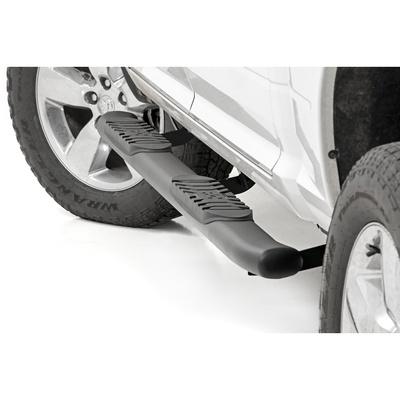
No. Nerf bars are steps, built to carry a person climbing in, while rock sliders are armor, built to take a rock from the side and from below. Some parts do both, but a step that happens to look like a rail is not trail armor.
Look at the Rough Country 21003. It is a cab-length oval step for Ram trucks with a 4.5-inch stepping area and a rating of up to 500 lb per step, which is a sensible number for a boot and says nothing about a ledge. N-Fab’s D2086MC-TX nerf bars use the same logic, with .084-wall steel on 3-inch tube and .095-wall on 2-inch tube: a large, light tube makes a good step. Ends and brackets also hang below the sill, which reduces the clearance you were trying to protect.
Three approaches give you a step and protection together:
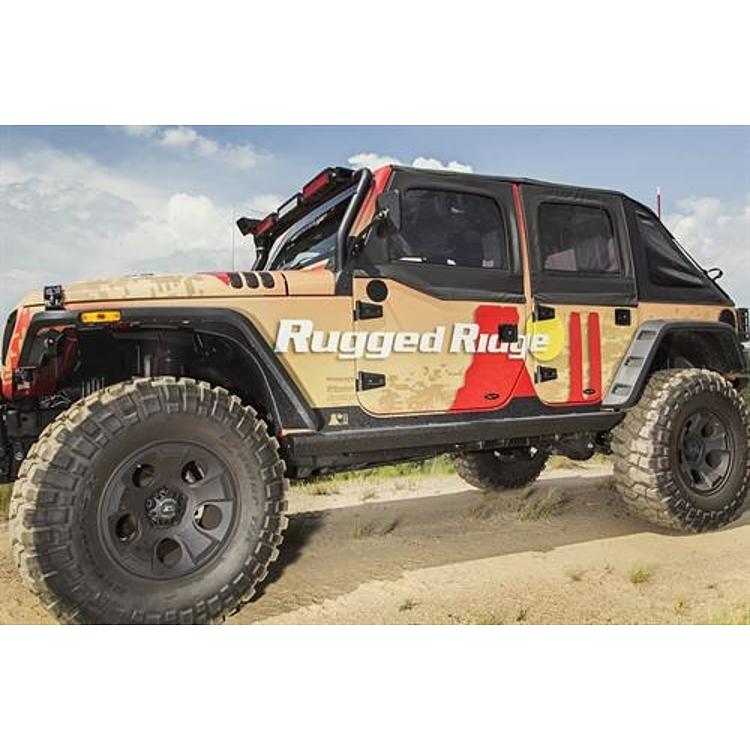
- Step built into the slider: the Rugged Ridge XHD 11504.18 has an integrated 4-inch step, and the Ricochet Rockers 14-50-050 use a 5-inch dimpled plate that also reinforces the slider.
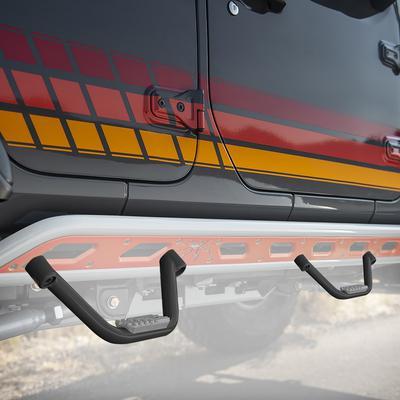
- Removable steps: the Rocker Knocker Step Kit 19-08-050P1 for the four-door JL and the Gladiator adds two 1-inch by .120-wall DOM drop steps that come off before a trail.
- A flat top: the DV8 SRGL-02 for the Gladiator bolts to all factory locations, in 3/16-inch steel with .160-wall tube and a small flat area on top for your foot.
Truck owners who never leave gravel are well served by the nerf bars and steps range or the wider side steps and running boards section. Jeep owners who wheel should buy the armor first and add a step that does not compromise it. The Kargo Master Rocker Walk 56000 is a 2007-2016 four-door JK option that stays on the armor side, bolting directly to the frame with heavy duty brackets.
Which rocker guards fit the TJ, JK and JL?
Poison Spyder’s YJ and TJ armor is body mounted, the JK gets body-mounted and frame-mounted versions of the same design, and the JL rail mounts to the frame. Most of these parts are specific to one generation, so match the part number to your Jeep and door count.
| Jeep | Rocker armor | Mounting | Also consider |
|---|---|---|---|
| YJ, 1987–1995 | 13-08-010, 13-08-020, 13-08-050 | Body | Rubber liners for YJ and CJ7 |
| TJ, 1997–2006 | 14-08-050, 14-08-060, ARB 4450010 | Body | Ricochet 14-50-050 |
| LJ, 2004–2006 | 15-08-050, 15-08-060 | Body | Rugged Ridge 11504.16, 2-inch step |
| JK, 2007–2018 | 17-08-020 (2-door, 2007–2016), 18-08-020 (4-door), Fab Fours JK07-G1250-1 (4-door) | Body | Brawler 18-08-200 |
| JK, 2007–2018 | 17-08-030 (2-door, 2007–2016), 18-08-030 (4-door), ARB 4450210 (4-door) | Frame | Kargo Master 56000 (4-door, 2007–2016) |
| JL, 2018–2026 | 20-08-030P1 (4-door) | Frame | Step kit 19-08-050P1 (4-door), Rampage 26410030 (2-door), Body Armor JL-4121 (4-door, 2018–2021) |
| Gladiator JT, 2020–2026 | 22-08-030P1C, DV8 SRGL-02 | No cutting or drilling | Step kit 19-08-050P1 |
TJ and LJ: body-mounted armor
The ARB 4450010 is a good example of the era: 3/16-inch steel with a 1.25-inch schedule 40 pipe (a standard pipe wall, .140 inch at this size) angled up 30 degrees, plus internal supports and drain holes. It mounts to the body and works with all body lifts and most aftermarket flares. On the longer LJ, the Rugged Ridge 11504.16 adds a 2-inch step and cutouts for an off-road jack. Stretched builds have their own part: the Rocker Knockers 15-08-040 is built for an LJ with a 4-inch rear wheelbase stretch and allows up to a 40-inch tire.
Poison Spyder 13-08-050 on the YJ
The Rocker Knocker with Sliders 13-08-050 is built for the 1987–1995 Wrangler YJ when it runs TJ fender flares. Its plate-only sibling for TJ flares is the 13-08-040. The plate-only 13-08-010 is cut to fit around factory YJ flares, and the 13-08-020 is the other YJ version with a slider. All four are 3/16-inch high strength plate with countersunk hardware, and the two slider versions add a DOM tube on DOM spacers.
Poison Spyder 17-08-030 on the JK
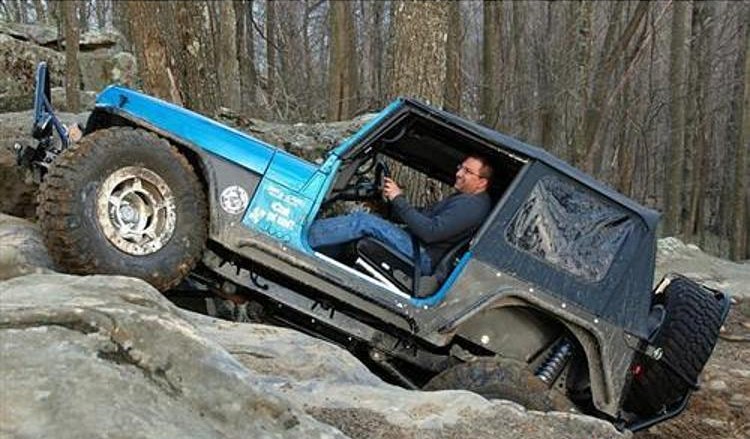
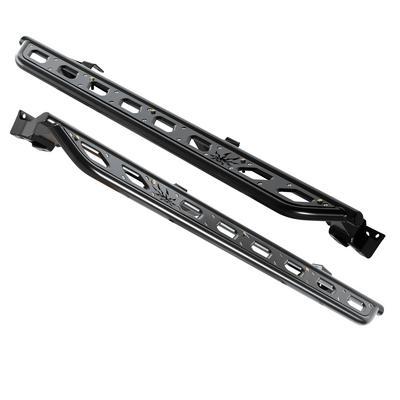
The JK is where the choice is sharpest, since Poison Spyder sells the same design both ways. The 17-08-030 for 2007-2016 two-door models and the 18-08-030 for four-door models are the frame-mounted pair. The 17-08-020 and the 18-08-020 bolt to the tub. The JK’s curved lower body also pushes makers toward shaped plates: the Fab Fours guard, for example, uses a vertical plate that follows the radius of the JK body. If a lift is part of the same build, the JK lift height comparison covers what each height asks of the rest of the Jeep.
JL and Gladiator: frame mounts and factory rails
Poison Spyder’s JL Rocker Knockers mount to the frame, with no cutting or trimming, and they are designed to work with suspension kits and body lifts. The 20-08-030P1 for the four-door JL uses a 1.75-inch by .120-wall DOM rocker rail, a 1.5-inch slider rail and a 3/16-inch laser-cut base plate, and the 22-08-030P1C is the same recipe for the Gladiator. Four-door JL owners also have the JcrOffroad JLSL-CL-4D-PC, cut from 2x2x3/16 box tube and not compatible with body lifts, and the two-door Rampage 26410030. A Rubicon or Willys already has factory rails, which are a reasonable starting point for mild trails. The Wrangler vs Bronco vs 4Runner comparison sets the JL’s hardware against its two closest rivals.
Do rock sliders need drilling, and how do you stop rust?
Many guards need new holes in the tub or at the frame, kits built around factory holes do not, and every new hole or trapped gap is a place rust can start. Read the kit’s instructions before you buy it.
- Drilling required: most Poison Spyder bare-steel kits, TeraFlex 4637310 and Body Armor JL-4121.
- Factory holes: XRC 76890, ARB 4450210 and DV8 SRGL-02.
- Welding required: Trail Gear 120001-1-KIT and the DIY Short Ricochet Rockers, a kit of tube rub rails, steps and gussets. The 17-08-030 can be bolted or welded.
Follow this order on any steel guard:
- Trial fit. Hold the guard in place, then check for brake lines, fuel lines, wiring and exhaust before you drill. Frame-mounted kits need clean, straight rail at each outrigger.
- Treat every hole. Deburr it and prime the bare edge. A drill cuts through the factory coating, so an untreated hole starts rusting from the inside.
- Coat bare steel. Take the guard back off and paint or powder coat it, including the back face you will never see again. Degrease anything that ships oiled. Coating last keeps a trial fit from scarring the finish.
- Separate the metals. Fit a liner or gasket between guard and paint. Poison Spyder’s Rubber Rocker Liners 14-08-310 sit between the body and the guard, the Rugged Ridge guards use rubber gaskets, and TeraFlex includes rubber beading.
- Keep drains open. The JK Rocker Knockers have drain reliefs in the mounting plate, the ARB TJ sliders have drain holes, and the Brawler’s oval holes let you hose out mud.
- Check again. Inspect bolts and welds after the first few trail runs, and again after any hard hit.
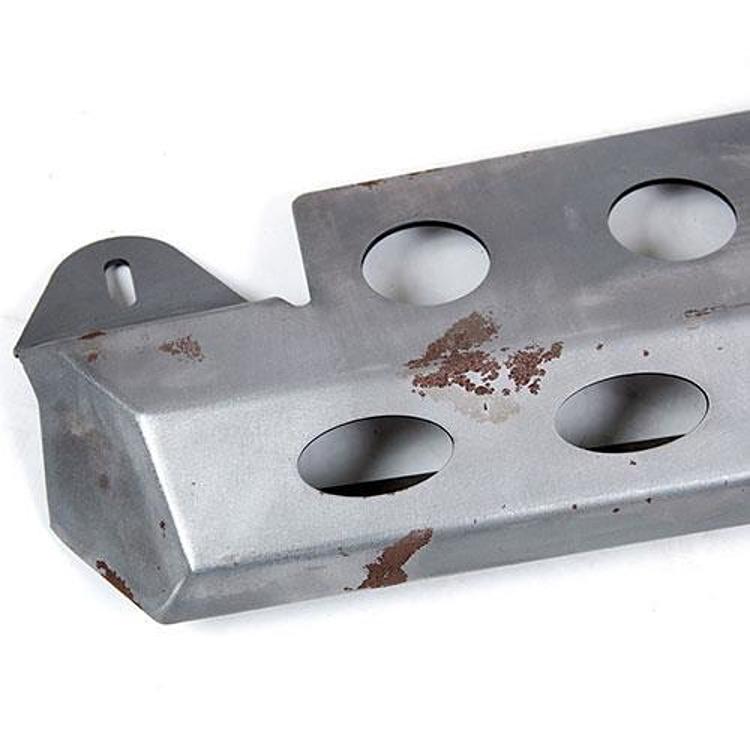
Stainless hardware is not the rust problem it is sometimes made out to be. A stainless bolt in a large carbon steel plate in a rain-shedding application is generally not a concern, because the small stainless area has little effect on the large steel area. The risk grows where salty mud sits against the joint and stays wet, so wash the rails from behind after winter roads and muddy trails.
Look inside the sill before fitting body-mounted plate. If it already has rust, fix that first, since armor bolted over it will hide the problem and give it a damp place to grow. Bolted armor on a rusted rocker also has less to hold on to. On an overlanding build that sees wet seasons, plan an annual look behind the guard.
Rocker Knockers or rock sliders: which should you buy?
Buy frame-mounted sliders if the Jeep will land on them, and body-mounted armor if a tight fit and a body lift matter more. Cladding and steps add to that choice but do not replace it.
- Hard rock use, no body lift: frame-mounted. Poison Spyder 17-08-030 or 18-08-030 on a JK, 20-08-030P1 on a four-door JL.
- Body lift, or a tight fit and clearance first: body-mounted plate with a slider. Poison Spyder 14-08-060 on a TJ, 18-08-020 on a four-door JK.
- Mild trails and daily use: factory-hole plate-and-tube sliders such as the Smittybilt XRC 76890, or the factory rails on a Rubicon or Willys.
- Brush and gravel only: XRC cladding or a plastic guard.
- Getting in and out is the whole issue: a nerf bar on a truck, or a removable step on a slider if the Jeep also wheels.
Frequently asked questions
Are Rocker Knockers the same as rock sliders?
Not exactly. Rocker Knocker is Poison Spyder’s product name for its rocker armor, and rock slider is the general term for any side rail built to take a rock and let the Jeep slide off it. A plain Rocker Knocker is a formed plate with no slider tube. The versions with sliders, and the frame-mounted JK and JL versions, are rock sliders by function.
What Jeep does the Poison Spyder 17-08-030 fit?
The Poison Spyder 17-08-030 is the frame-mounted Rocker Knocker for the two-door Jeep Wrangler JK. It is built from 3/16-inch plate with a 1.5-inch by .120-wall DOM slider rail and comes in bare steel. The 17-08-030 is listed for 2007-2016 models. Its four-door counterpart is the 18-08-030, which uses three outriggers per side. Plan on drilling during the install.
What Jeep does the Poison Spyder 13-08-050 fit?
The Poison Spyder 13-08-050 is a Rocker Knocker with a tubular slider for the 1987–1995 Jeep Wrangler YJ running TJ fender flares. It is 3/16-inch high strength plate, body mounted with countersunk stainless flat-head hardware, and it comes in bare steel, so plan on paint or powder coat after the trial fit.
Can you put a Hi-Lift jack on rock sliders?
On a slider built for it, yes. The Poison Spyder JL Rocker Knockers and JK Brawler Rockers work as lifting points for a Hi-Lift jack, and Trail Gear designs its DOM sliders to carry the weight of the truck with the jack anywhere along the tube. Do not jack on steel cladding, plastic rocker guards or a nerf bar, because none of them is built to carry the vehicle. Set the jack on firm, level ground and keep your head and hands clear of the handle.
Is XRC body cladding enough protection on its own?
For brush, gravel and light scrapes, yes. For rocks, no. Smittybilt XRC Body Cladding is 1/8-inch cold rolled steel fastened over the body panel, and Smittybilt designs it to complete lower quarter panel protection when used with XRC rock sliders. It has no standoff and no direct path to the frame, so a hard hit still reaches the sheet metal behind it.
Do frame-mounted sliders work with a body lift?
They bolt up, but the lift changes the fit. A frame-mounted rail stays with the frame while the body rises, so the gap between the rail and the tub grows by the height of the lift. A body-mounted guard moves up with the tub and keeps its fit. Some designs, including the Brawler Rocker and JcrOffroad JLSL-CL-4D-PC, are not compatible with body lifts at all.
Compare the full range of rock sliders and guards, the sliders built as side steps and the body protection parts by your Jeep’s generation and door count, starting from your vehicle page: CJ7, CJ5, YJ, TJ, JK or JL.
Sources
- Poison Spyder: JLU Rocker Knockers
- Poison Spyder: JKU Brawler Rockers
- Off-Road Xtreme: Poison Spyder tech series, frame-mounted JK Rocker Knockers
- Stellantis: 2024 Jeep Wrangler press kit
- Jeep: 2016 Wrangler brochure
- TeraFlex: JK four-door RockGuard aluminum rock slider kit
- International Molybdenum Association: Galvanic corrosion
- Makerverse: Sheet metal thickness gauge charts