





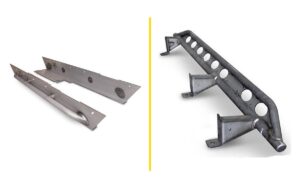
Rocker Knockers vs rock sliders: body-mounted armor, frame-mounted rails, load paths, steel gauge, XRC cladding, nerf bars and TJ, JK and JL fitment.
Nerf Bars & Steps
Nerf bars and steps give you a solid place to put your foot when climbing into a lifted truck, Jeep or SUV, and they protect the rocker panels from trail debris. This category covers cab-length and wheel-to-wheel bars, oval and round tube styles, bed and hitch steps, and brackets from N-Fab, Smittybilt, Lund, Go Rhino and Aries.Browse the product pages for finish, length and part numbers, then compare the products below.

A lift and bigger tires raise the door sill well above a comfortable step. Nerf bars and side steps give you and your passengers a solid foothold, take rock and gravel strikes off the rocker panels, and add a grab point for reaching a roof rack or bed.
Side steps run along the cab, either cab length or wheel to wheel, in round tube, oval tube or flat step designs. Bed and bumper steps get you into the cargo box from the side or the tailgate, and they come fixed, folding or retractable. Hitch steps slide into a receiver. Mounting kits and replacement parts cover brackets for bars you already own or a new truck model.
389Parts listed
22Brands
5Part types
3" / 6"Round / oval tube sizes
1-1/4" / 2"Hitch step receivers
8-pointSure Step frame mount
Shop nerf bars and steps by type
Popular nerf bars and steps
-
-
Nerf Steps
4 Wheel Parts Factory Bronco Side Steps (2-Door) – 61669W
- 4 Wheel Parts factory Bronco side steps for the 2-door, part number 4WP61669W
- Hybrid design in textured matte black steel, cab length
- Mounting hardware included and no drilling required
- Fits 2021–2026 Ford Bronco models
SKU: 4WP61669W -
-
Bed and Bumper Steps
Kentrol Side Step Kit (Stainless) – 30518
- Fits 1997–2006 Jeep Wrangler TJ and 2004–2006 Jeep Wrangler LJ models
- Part number KEN30518, stainless steel construction
- No drilling required for installation
- Stainless steel hardware included with the kit
- Step only, fixed operation
SKU: KEN30518 -
Bed and Bumper Steps
Kentrol Side Steps (Polished) – 30432
- Fits 1976–1983 Jeep CJ5, 1976–1986 Jeep CJ7, 1981–1985 Jeep Scrambler and 1987–1995 Jeep Wrangler YJ
- Part number KEN30432, polished stainless steel
- 304 surgical stainless steel with stainless hardware included
- Mounts to floor braces welded to the body floor pan
- Some drilling required, fiberglass bodies need spacers and longer hardware
SKU: KEN30432 -
Bed and Bumper Steps
Bestop TrekStep Rear Mounted Step (Black) – 75305-15
- Gloss black folding TrekStep rear mount step, part number BST75305-15
- Die cast aluminum alloy with a high-grip step pad rated for 300 lb
- Mounts to either rear frame corner, usable with tailgate up or down
- Fits the 2007–2018 Toyota Tundra in all trims
SKU: BST75305-15 -
-
Mounting Kits
Aries Offroad AeroTread Mounting Brackets – 2051132
- Vehicle-specific brackets for AeroTread running boards, fits 2014–2017 and 2018–2020 Jeep Cherokee plus one 2016 XL Overland
- No-drill installation through the AeroTread track mounting system
- High-strength steel with black powder coat and co-cured finish
- Limited lifetime warranty: three-year finish, one-year parts
- Brackets and hardware included; running boards not included
- Part number ARS2051132
SKU: ARS2051132
Step and nerf bar reference
How the main step styles compare, and the specs listed on products in this section. Lengths and brackets are specific to cab and door count, so confirm both on the product page.
Side step styles
| Step surface | Typical use | |
|---|---|---|
| 3" round tube | Narrow, curved tube with pads | Jeeps and compact SUVs |
| 6" oval tube | Wider flat top with tread | Full-size and midsize trucks |
| Flat or composite step | Broad flat board-style step | Easy entry for passengers |
| Slider-style step bar | Heavy tube or plate at the rocker | Trail use with rock contact |
Specs from listed products
| Smittybilt Sure Step JN460-S2T | 3" tube, wheel to wheel, TJ |
|---|---|
| Smittybilt Sure Step mounting | No-drill, 8-point frame mount |
| Smittybilt J1866 | Wheel to wheel, JL 2-door and 4-door |
| 4 Wheel Parts Bronco steps | Steel, cab length, 2- or 4-door kit |
| Lund 24386007 | 6" oval straight tube, cab length |
| Curt 32002 hitch step | 2" receiver, 6" drop |
| Go Rhino 310PS hitch step | 1.25" receiver |
| Carr Hoop II 104502 | Cast aluminum, 10" wide step pad |
Upkeep
- Recheck bracket bolts after the first few hundred miles
- Rinse road salt and mud out of brackets and tube ends
- Touch up chipped powder coat before rust spreads
- Replace worn step pads before metal shows through
- Clean and lubricate folding and retractable step pivots
Bed, bumper and hitch steps
| Operation | Examples here | |
|---|---|---|
| Hoop steps | Fixed | Carr Super Hoop, Hoop II |
| Tailgate area steps | Folding | Bestop TrekStep, AMP flip-down |
| Bumper and box-side steps | Retractable | AMP BedStep, BedStep2 |
| Hitch steps | Slides into receiver | Curt Grip Step, Go Rhino 310PS |
Check before ordering
- Cab style and door count: 2-door and 4-door kits differ
- Whether brackets come with the bar or are a separate kit (Aries, Dee Zee)
- Dually or heavy-duty trucks may need a specific bracket kit (AMP BedStep2)
- Receiver size on your hitch before choosing a hitch step
- Clearance to the rocker pinch weld, exhaust and fuel tank
- Fixed, folding or retractable: how often the step will drag on the trail
Steps are built for foot traffic, not for jacking or recovery. Use a rated jack point unless the product page says the bar is designed to carry the vehicle.
All Nerf Bars & Steps 389 parts
-
Nerf Steps
SmittyBilt Wheel-to-Wheel Nerf Steps (Light Textured) – J1980T
- Fits the 2020–2026 Jeep Gladiator in its listed versions, including Mojave, Overland, Rubicon and Willys
- Apollo side steps built from 1-1/2 inch tubing with a one-piece welded design
- Light textured matte black finish with customizable accent plates
- Wheel-to-wheel coverage with bolt-on installation
SKU: S/BJ1980T -
-
Nerf Steps
Smittybilt Wheel-to-Wheel Nerf Steps (Black) – T0786CC-TX
- Fits the 2020 Toyota Tundra in its 1794 Edition, Limited, Platinum and SR5 versions
- Black wheel-to-wheel nerf steps on a 3-inch main tube
- Four or six step drop-down design with cleated step plates
- One-piece bolt-on unit, rated for up to 445 pounds
SKU: S/BT0786CC-TX -
Nerf Steps
Smittybilt Wheel to Wheel Nerf Steps with Cleated Steps (Textured Black) – J0764
- Fits the 2007–2018 four-door Jeep Wrangler Unlimited JK in its 70th Anniversary, 75th Anniversary, Rubicon, Sahara, Sport, Sport S and X versions
- Textured matte black wheel-to-wheel nerf steps on a 3-inch main tube
- Cleated step plate design, custom-made for each application
- Described with 304 marine grade stainless construction and a limited lifetime warranty
SKU: S/BJ0764 -
Nerf Steps
Smittybilt Wheel to Wheel Nerf Steps with Cleated Steps (Textured Black) – C1489CC-SS
- Fits the 2014–2018 Chevrolet Silverado 1500 and GMC Sierra 1500 in the versions covered
- Textured matte black wheel-to-wheel nerf steps with cleated plates
- Four or six step drop-down design on a 3-inch main tube
- One-piece bolt-on frame mount, rated for up to 445 pounds
SKU: S/BC1489CC-SS -
Nerf Steps
Smittybilt Wheel to Wheel Nerf Steps with Cleated Steps (Stainless) – T0678CC-SS
- Fits the 2005–2015 Toyota Tacoma in its Base, Pre Runner, TRD Pro and X-Runner versions
- Polished stainless wheel-to-wheel nerf steps on a 3-inch main tube
- Four or six step drop-down design with cleated plates
- One-piece frame-bolt unit rated for up to 445 pounds
SKU: S/BT0678CC-SS -
Nerf Steps
Smittybilt Wheel to Wheel Nerf Steps with Cleated Steps (Stainless) – N0482CC-SS
- Fits the 2004–2011 and 2013–2015 Nissan Titan in its LE, PRO-4X, S, SE, SL, SV and XE versions
- Polished stainless wheel-to-wheel nerf steps with cleated plates
- Four or six step drop-down design on a 3-inch main tube
- One-piece bolt-on frame mount
SKU: S/BN0482CC-SS -
Nerf Steps
Smittybilt Wheel to Wheel Nerf Steps with Cleated Steps (Stainless) – J1246-SS
- Fits the 2012–2018 two-door Jeep Wrangler JK in its 75th Anniversary, Rubicon, Sahara, Sport and Sport S versions
- Polished stainless wheel-to-wheel nerf steps
- Drop-down design with cleated plates on a one-piece bolt-on frame mount
- Rated for loads of up to 445 pounds
SKU: S/BJ1246-SS -
Nerf Steps
Smittybilt Wheel to Wheel Nerf Steps with Cleated Steps (Stainless) – J0746-SS
- Fits the 2007–2018 two-door Jeep Wrangler JK in its 70th Anniversary, 75th Anniversary, Rubicon, Sahara, Sport, Sport S and X versions
- Polished stainless wheel-to-wheel nerf steps with cleated plates
- Three-inch main tube with a drop-down step design
- One-piece frame-bolt unit, rated for up to 445 pounds
SKU: S/BJ0746-SS -
Nerf Steps
Smittybilt Wheel to Wheel Nerf Steps with Cleated Steps (Stainless) – F99100CC-SS
- Fits the 1999–2016 Ford F-250 and 1999–2015 F-350 Super Duty in their listed versions
- Polished stainless wheel-to-wheel nerf steps with cleated plates
- Four or six step drop-down design on a 3-inch main tube
- One-piece bolt-on unit rated for up to 445 pounds
SKU: S/BF99100CC-SS -
Nerf Steps
Smittybilt Wheel to Wheel Nerf Steps with Cleated Steps (Stainless) – F0486SC-SS
- Fits the 2004–2008 Ford F-150 in its FX2, FX4, King Ranch, Lariat, 60th Anniversary, XL and XLT versions
- Polished stainless wheel-to-wheel nerf steps with cleated plates
- Four or six step drop-down on a 3-inch main tube
- One-piece frame-bolt design
SKU: S/BF0486SC-SS -
Nerf Steps
Smittybilt Wheel to Wheel Nerf Steps with Cleated Steps (Stainless) – D1098CC-SS
- Fits the 2010 and 2011–2016 Dodge Ram 2500 and 3500 in the trims covered for each model year
- Polished stainless wheel-to-wheel nerf steps with cleated plates
- Four or six step drop-down on a 3-inch main tube
- Bolt-on frame mount with a 445-pound load rating
SKU: S/BD1098CC-SS
Nerf bars versus other step types
Nerf bars are tubular or oval side rails mounted below the doors. Running boards are flatter and wider, and drop-down or power steps retract. Tubular bars are lighter, shed mud easily and are the usual choice on trucks and SUVs that see dirt. Sample listings here include 3 inch round bars, 6 inch oval bars, and wheel-to-wheel steps with cleated pads.
Subcategories cover bed and bumper steps, hitch steps, mounting kits and replacement parts, which is helpful if you need only a bracket set or step pad.
Choosing length and style
Length is the first decision:
- Cab length bars cover the door area only and leave the lower body mostly visible.
- Wheel-to-wheel bars run from the front wheel well to the rear and add protection along the whole rocker, which crew cab trucks often prefer.
- Step-pad spacing varies; some bars include individual pads at each door while others have a continuous tread.
Check the listing for the cab or door configuration, since regular, extended and crew cab trucks need different lengths.
Materials and finish
Steel is common because it is strong and holds up to being stepped on. Look for a powder coat, textured black or gloss black finish. Textured finishes hide scratches better than gloss. Stainless and polished options resist corrosion but show scuffs. Non-slip step pads help in wet or snowy conditions, and pads that sit in a recess keep metal from exposing as they wear.
Weight ratings differ by product and are not always stated, so use the manufacturer's rating if you plan to carry heavy loads or step on the bar often.
Fitment and installation
Most bars are vehicle-specific direct-fit kits. Many advertise no-drill installation using existing frame or body holes, but some trucks still need drilling. Confirm fitment for your year, make, model and cab style, and compare against the manufacturer's specifications.
Tighten brackets to the specified torque, check them periodically for loosening, and consider thread locker on hardware. A bar that sits too low can reduce ground clearance and take hits on trails, so choose a mounting height that matches how you drive. Lift height and tire size can change the ideal bracket setup.
Measuring, cleaning and common mistakes
Before choosing, measure the distance between the front and rear wheel wells on your truck and compare it with the length stated on the product page, then check how far below the door sill you want the step to sit. Most people find a step that sits a few inches under the door opening easiest to use.
- Rinse mud and road salt from the brackets and the underside of the tube, since trapped grit is what starts rust under a coating.
- Touch up chips in powder coat with a paint made for the finish.
- Do not use a nerf bar as a jacking point or tie-down-cargo-management unless the manufacturer says it is rated for that.
- Check that a bar does not block the factory jack points or the rocker pinch weld you rely on for lifting.
Related guides
- Rocker Knockers vs Rock Sliders: Guarding a Jeep’s Rockers
Popular Nerf Bars & Steps brands
- N-Fab (121)
- Smittybilt (97)
- Go Rhino (36)
- Lund (34)
- Aries Offroad (24)
- AMP-Research (16)
- Carr (10)
- Dee-Zee (10)
- Rampage (8)
- Bestop (7)
- Westin (5)
- Rough Country (5)
Nerf Bars & Steps FAQ
Are nerf bars the same as running boards?
Not quite. Nerf bars are tubular rails, while running boards are flat, wider platforms. Both help you step into the vehicle. Tubular bars shed mud and weigh less, while running boards give a larger standing surface.
Can I install nerf bars myself?
Often, yes. Many are bolt-on kits that use factory holes, which a mechanically inclined owner can do with basic hand tools. Confirm whether your kit needs drilling, and tighten hardware to the manufacturer's torque specification.
Will nerf bars fit a lifted truck?
They can, but a lift changes the best bracket height. Some kits use adjustable mounts. Check the manufacturer's notes for your lift and make sure the step still sits at a practical height.
What does direct fit mean on nerf bars?
It means the bar and brackets are made for a specific vehicle application and match its mounting points. Confirm the year, make, model and cab style, since similar trucks can have different mounting locations.