Wheel spacers and adapters change how far a wheel sits from the hub, and adapters also change the bolt pattern. This category lists aluminum spacers and bolt-pattern adapters from Spidertrax Offroad, Rugged Ridge, G2 Axle and Gear, Alloy USA and RT Off-Road, for Jeeps, Toyotas and other 4x4s.Compare thickness, bolt pattern and stud details on each product page, then compare the products below.
Wheel Spacers and Adapters
Showing 1–12 of 54 resultsSorted by popularity
-
Wheel Spacers and Adapters
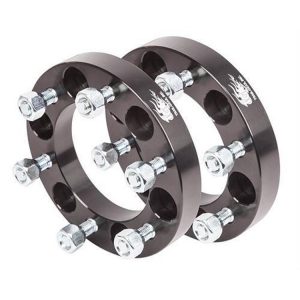
Spidertrax Offroad Wheel Spacers (Black) – WHS007K
- 1.25 inch thick 6 on 5.5 hub centric spacers in black anodized 6061T6 aluminum
- Intended for front and rear late model Toyota axles with hub centric wheels
- Includes 12 pre-installed M12x1.5 studs and 12 lug nuts
- Sold as a pair, with Loctite included
SKU: SPIWHS007K -
Wheel Spacers and Adapters
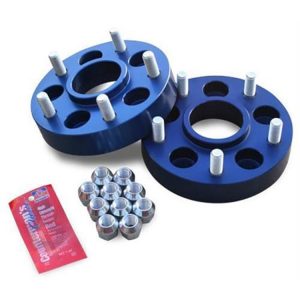
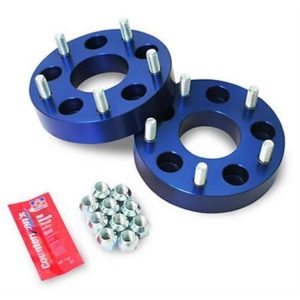
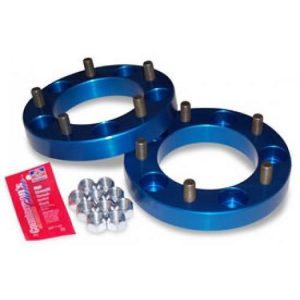
Spidertrax Offroad Wheel Spacers (Anodized Blue) – WHS025
- Pair of 1.5 in thick, 6 on 4.5 wheel spacers in anodized blue 6061T6 aluminum
- Named for 2005-Up Xterra, 2005-Up Frontier and 2005-2012 Pathfinder axles running OE wheels
- 12 M12x1.25 studs pre-installed, with 12 lug nuts and thread locker
- Part number WHS025 from Spidertrax Offroad
SKU: SPIWHS025 -
-
Wheel Spacers and Adapters
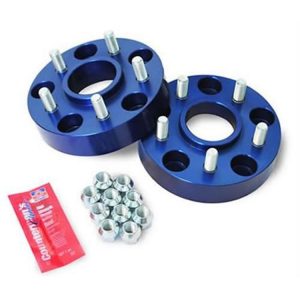
Spidertrax Offroad Conversion Wheel Adapters (Anodized Blue) – WHS013
- Adapter kit for 5 on 5″ Jeep JK wheels on XJ, YJ, TJ, ZJ and Liberty
- Two 1.25 inch thick aluminum adapters in anodized blue
- Studs pre-installed, with lug nuts and thread locker
- Made in-house in Colorado, USA
SKU: SPIWHS013 -
Wheel Spacers and Adapters
Spidertrax Offroad Conversion Wheel Adapters (Anodized Blue) – WHS011
- Spidertrax Offroad WHS011 conversion wheel adapter, not a plain spacer
- 1.375 inch thick, bolt pattern changes from 5 on 5 to 5 on 4.5
- Fits 2007-Present Jeep Wrangler JK axles
- Kit includes two adapters, 10 pre-installed studs, 10 lug nuts and Loctite
SKU: SPIWHS011 -
Wheel Spacers and Adapters
Spidertrax Offroad Conversion Wheel Adapters (Anodized Blue) – WHS004
- Converts a 5 on 4.5″ bolt pattern to 5 on 5.5″
- Pair of 1.25″ thick 6061T6 aluminum adapters
- Includes 10 pre-installed studs, 10 lug nuts and thread locker
- Universal Fit label; no specific vehicle is listed
SKU: SPIWHS004 -
Wheel Spacers and Adapters
Spidertrax Offroad Wheel Spacers (Anodized Blue) – WHS001
- Spidertrax Offroad WHS001 anodized blue spacers, 1 inch thick
- 5 on 5.5 bolt pattern with 6061T6 aluminum
- Pair of spacers with 10 pre-installed Suzuki Samurai OEM metric wheel studs
- Includes 10 metric lugnuts and Loctite
- Some Suzuki models are named, but only two carry model years
SKU: SPIWHS001 -
-
Wheel Spacers and Adapters
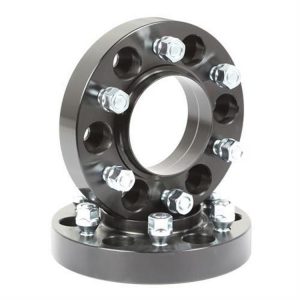
Rugged Ridge Wheel Spacers (Black) – 15201.19
- Rugged Ridge part 15201.19, black hub-centric spacer
- 1 inch (25 mm) thick with 120 mm bolt pattern and 64 mm center bore
- Double anodized 6061-T6 aluminum with grade-8 hardware
- Vehicle fitment not listed; confirm the bolt pattern and bore first
SKU: RUG15201.19 -
Wheel Spacers and Adapters
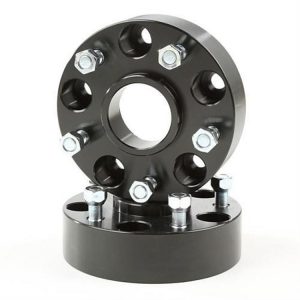
Rugged Ridge Wheel Spacers (Black) – 15201.18
- Rugged Ridge part 15201.18, black hub-centric spacer
- 1.25 inch thick with 6 x 139.7 mm bolt pattern and 93 mm center bore
- Double-anodized 6061-T6 aluminum with grade-8 hardware
- Vehicle fitment not listed by model; check bolt pattern and bore before ordering
SKU: RUG15201.18 -
-
Wheel Spacers and Adapters
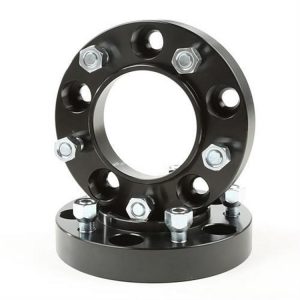
Rugged Ridge Wheel Spacers (Black) – 15201.16
- Rugged Ridge 15201.16 black aluminum spacers, 1.25 inch thick
- Bolt pattern given as 5 on 150
- Extra thick 6061T6 aluminum with double anodized black finish
- Hardware is grade-8
- No vehicle, year or chassis code is named
SKU: RUG15201.16




Spacers and adapters explained
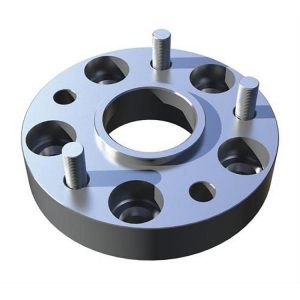
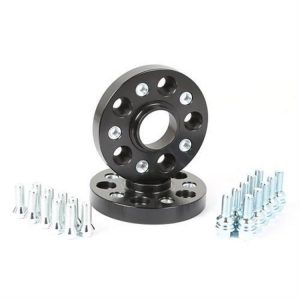
A spacer moves a wheel outward to widen the track, clear brakes or suspension parts, or fit a wheel with more backspacing. An adapter does the same and also converts the bolt pattern, for example from 5x4.5 inch to 5x5.5 inch, so wheels from another vehicle can be mounted.
Wider track improves stability a little, but the extra leverage on the bearings and studs is real, so use quality parts and keep the spacer thickness modest.
Key specifications
The sample listings show the details to compare:
- Bolt pattern, such as 5 on 5, 5 on 5.5, 5 on 150mm or 6 on 5.5. It must match both the hub and the wheel, unless you use an adapter.
- Thickness, from about 1 inch to 2 inches in these listings.
- Centerbore, which should match the hub for a hub-centric fit.
- Studs and nuts, such as 14x1.5 studs. Some kits come with pre-installed studs, lug nuts and thread locker, while others require longer studs separately.
- Material, commonly 6061-T6 aluminum, usually anodized.
Bolt-on versus slip-on
Slip-on spacers sit between the wheel and hub using the factory studs, which must be long enough for full nut engagement. Bolt-on adapters use their own studs and bolt to the hub first. Thicker spacers generally need longer studs or the bolt-on style. Full thread engagement is a safety issue, so do not guess.
Installation and compatibility
Clean the hub and spacer faces, make sure the spacer is seated flat, and tighten lug nuts to the specified torque in a star pattern. Retorque after a short drive. Because wheels and tires are safety critical, professional installation is wise if you are unsure.
Spacers change offset, so check for tire rub on fenders and suspension at full lock and full flex, and for clearance with brake calipers. Confirm fitment for your exact year, make, model and axle, and check the manufacturer's specifications. Rules on tires extending past the fenders vary by state.
Also think about the wheels themselves. Some aftermarket wheels already have plenty of backspacing, and a spacer on top can push the tire out farther than expected. Measure the existing offset and the gap behind the tire before choosing a thickness.
Measuring offset and avoiding mistakes
To choose a spacer thickness, measure the clearance you want to gain. For brake or suspension clearance, check the gap with the wheel off and add a small margin. For widening the stance, remember that a spacer moves the wheel outward by its full thickness, so a 1.5 inch spacer adds 1.5 inches per side.
- Check the hub pilot length. A thick spacer on a short hub may not support the wheel unless it has its own pilot.
- Confirm that wheel nuts engage the full length of the thread; as a rule of thumb, aim for at least as many turns of thread as the stud diameter in millimeters.
- Do not stack two spacers to get a thickness you want; buy the right single piece.
- Re-torque after the first drive and again periodically, and look for dust marks that suggest loosening.
Popular Wheel Spacers and Adapters brands
- Spidertrax Offroad (17)
- Rugged Ridge (15)
- G2 Axle and Gear (11)
- Alloy USA (6)
- RT Off-Road (6)
- Gorilla Automotive (4)
- Trail Gear (1)
- TeraFlex (1)
Wheel Spacers and Adapters FAQ
What is the difference between a wheel spacer and an adapter?
A spacer only moves the wheel outward and keeps the same bolt pattern. An adapter also changes the bolt pattern so you can run wheels made for a different pattern.
Are wheel spacers safe?
Quality spacers installed correctly can be safe. They need hub-centric fit, full thread engagement, proper torque and a retorque after driving. Poor fitment or too much thickness raises stress on bearings and studs.
Do I need longer studs?
With slip-on spacers, often yes, because the factory studs must still fully engage the lug nuts. Bolt-on adapters come with their own studs. Always confirm thread engagement.
How thick a spacer should I choose?
Choose the thickness needed to clear the part or reach the desired offset, and no more. Thinner spacers put less leverage on bearings. Check the vehicle's clearance and the kit's specifications.