




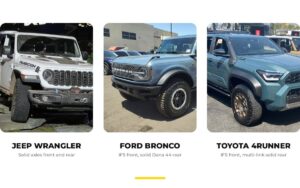
Wrangler, Bronco and 4Runner compared on frames, axles, transfer cases, crawl ratios, lockers, travel and angles, using each maker's own spec sheets.
Lift Kits, Suspension & Shocks
Showing 3649–3660 of 3681 resultsSorted by popularity
-
-
Control Arms
Rubicon Express Control Arm Rear Adjustable Upper Extreme-Duty/ Pair – RE4040
- Rubicon Express adjustable rear upper control arms, pair, part RE4040
- Super-Flex joints for more axle articulation
- 1.5 in by 1/4 in wall 4130 chromoly, gray powder coat
- Made for the Jeep Wrangler TJ and Grand Cherokee ZJ
SKU: R/ERE4040 -
Control Arms
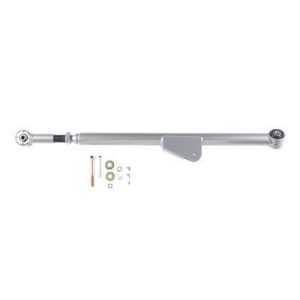
Rubicon Express Control Arm Front Adjustable Lower Right Extreme-Duty/ Single – RE4010
- Passenger side front lower long arm, adjustable, sold as a single
- 2 x 1/4-inch wall 4130 chromoly with Super-Flex joints
- Gray powder coat finish
- Used with Rubicon Express RE4020 arms to convert a four link to a radius arm design
SKU: R/ERE4010 -
Control Arms
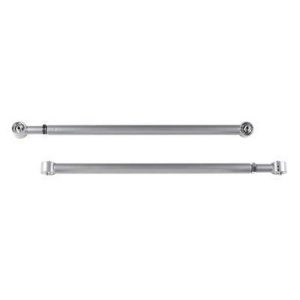
Rubicon Express Control Arm Rear Adjustable Upper Super-Flex TJ/LJ/ZJ/ Pair – RE3783
- Rubicon Express RE3783 rear upper adjustable control arms, sold as a pair
- Fits 1997–2006 Jeep Wrangler TJ, 2004–2006 Wrangler LJ and 1993–1998 Grand Cherokee ZJ
- Adjusts rear pinion angle; a threaded steel insert sets bearing preload
- Rebuildable, greasable spherical bearing in a gray powder coat finish
SKU: R/ERE3783 -
Control Arms

Rubicon Express Control Arm Front/Rear Adjustable Lower Super-Flex TJ/LJ/XJ/MJ/ZJ/ Pair – RE3715
 Control Arms
Rubicon Express Control Arm Front/Rear Adjustable Lower Super-Flex TJ/LJ/XJ/MJ/ZJ/ Pair – RE3715
- Rubicon Express adjustable lower control arms, pair, part RE3715
- Super-Flex joints with a rebuildable spherical bearing
- Greaseable and quiet, with non-metallic races
- Fits TJ, LJ, XJ, MJ and ZJ vehicles
SKU: R/ERE3715 -
Control Arms
Complete Adjustable Control Arm Kit
- Complete 8-arm adjustable control arm kit for TJ Wrangler and ZJ Grand Cherokee
- Adjustable super-flex upper arms and adjustable super-ride lower arms
- Upper arms adjust from factory length to +1 inch
- PT MEG bushings, greasable Zerk fittings and power coat finish
SKU: R/ERE3803 -
Control Arms
Rubicon Express Control Arm Front Adjustable Upper Super-Flex TJ/LJ/XJ/MJ/ZJ/ Pair – RE3780
 Control Arms
Rubicon Express Control Arm Front Adjustable Upper Super-Flex TJ/LJ/XJ/MJ/ZJ/ Pair – RE3780
- Adjustable front upper control arms, driver and passenger side, sold as a pair
- Adjusts pinion angle and caster, with an adjustable range of 15.25 to 16 1/8 inches
- Super-Flex joint with a rebuildable, greasable spherical bearing
- Covers TJ and LJ Wranglers, XJ Cherokee, MJ Comanche and ZJ Grand Cherokee, 1984 to 2006
SKU: R/ERE3780
Start with the goal for the truck
Suspension work is a chain of decisions, and the first one is what the vehicle will do most. A daily driver that sees weekend trails needs a different setup than a dedicated rock crawler or a desert runner. Write down the tire size you want, how much lift you can live with, and whether you tow or carry heavy loads. Those three answers narrow the field quickly.
The catalog is broken into several families that serve different goals:
- Complete lift kits bundle springs, shocks, brackets and hardware sized to one lift height.
- Leveling kits raise the front a modest amount to remove factory rake.
- Body lifts add spacers between body and frame without changing suspension geometry.
- Shocks, stabilizers and bushings refresh or tune an existing setup.
Lift kit versus component upgrade
A complete kit is convenient because the pieces are designed to work together, and many list the lift height range, shock series and rear lift method (add-a-leaf, blocks or springs) right in the title. Buying components separately gives more control but puts the burden of matching spring rates, shock lengths and travel on you. Taller lifts often need extra parts such as drop brackets, longer brake lines, track bars, control arms or driveshaft changes, so read the kit contents carefully for what is and is not included.
Key things to compare
- Lift height range and whether it is measured at the front, rear or both.
- Shock type: twin-tube, monotube or reservoir, and whether shocks are included.
- Spring type and rate, particularly if you carry a winch, bumper or camper.
- Rear lift method, such as blocks, add-a-leaf or new springs.
- Fitment: confirm the exact year, make, model, cab style and drivetrain.
Installation and alignment
Lifting a vehicle changes ride height, driveline angles, brake line length and steering geometry. Professional installation is recommended for most buyers, and every lift should be followed by a wheel alignment. Torque suspension fasteners to the manufacturer's specification, ideally with the vehicle at ride height so bushings are not preloaded. Recheck torque after the first few hundred miles. Bigger tires may also call for re-gearing and a speedometer recalibration.
Compatibility and local rules
Always verify fitment for your exact vehicle and review the manufacturer's specifications before choosing. Height limits for bumpers, headlights and bodies vary by state, so check local regulations before committing to a tall lift.
Common pairings and mistakes
Lift kits rarely work alone. Larger tires often call for wheel offset changes, a steering stabilizer, and sometimes re-gearing. Matching shocks to the actual lift height is important, because a shock that is too short limits travel and one that is too long can hit its internal stops.
- Do not mix a tall lift with stock brake lines or limiting straps.
- Do not skip bushing and ball joint inspection before adding new parts to an old front end.
- Do not assume a leveling kit and a lift kit can be stacked without checking the maker's limits.
Inspection and upkeep
After installation, recheck fasteners after the first 100 miles or so, then at each oil change. Look for torn boots, leaking shock bodies, cracked bushings and loose U-bolts. Suspension that has been lifted needs more regular attention than a stock setup, particularly when used off-road.
Related guides
- Wrangler vs Bronco vs 4Runner: The Engineering Compared
- Bilstein 5100 vs Fox 2.0 Performance: Which Shock for Your Lifted Truck or Jeep
Bilstein 5100 vs Fox 2.0 Performance: body, shaft, reservoir, travel and lift ratings from 417 catalog listings, which trucks and Jeeps both fit, how…
Popular Lift Kits, Suspension & Shocks brands
- Pro Comp Suspension (682)
- Rubicon Express (250)
- Rough Country (242)
- ARB 4x4 Accessories (242)
- Skyjacker (242)
- Fabtech (208)
- Bilstein (179)
- ICON Vehicle Dynamics (149)
- Energy Suspension (145)
- Daystar (145)
- TeraFlex (132)
- ReadyLift (113)
Shop Lift Kits, Suspension & Shocks by type
- Shock Absorbers & Shock Accessories (933)
- Complete Suspension Systems and Lift Kits (687)
- Suspension Accessories (1,460)
- Leveling Kits (175)
- Body Lifts & Bushings (258)
- Steering Stabilizers (79)
- Air Ride Suspensions (76)
- Lowering & Sport Suspensions (13)
Lift Kits, Suspension & Shocks FAQ
How much lift do I need for 35-inch tires?
It depends on the vehicle and wheel offset. Many trucks need roughly 4 to 6 inches of lift, or a smaller lift paired with trimming, to clear 35s. Check the kit maker's tire-size guidance for your exact vehicle.
Is a leveling kit the same as a lift kit?
No. A leveling kit usually raises only the front to match the rear, giving a small gain. A lift kit raises both ends and often changes shocks and other components. Leveling kits are simpler but give less clearance.
Do I need new shocks with a lift?
Usually yes. Taller ride height needs longer shocks to keep full travel and avoid overextending brake lines and limiting straps. Many complete kits include shocks matched to the lift height; confirm this in the listing.
Do I need an alignment after installing a lift?
Yes. Changing ride height alters alignment angles such as caster and toe. An alignment after installation protects tires and keeps steering predictable. Some larger lifts also need adjustable control arms or track bars to bring angles back in range.