Replacement axle shafts for Jeeps, trucks and SUVs, sold as inner and outer shafts, CV axle sets and complete shaft assemblies. They are for drivers dealing with a broken, twisted or clicking shaft, and for anyone upgrading to stronger material before adding larger tires. Brands include G2 Axle and Gear, Crown Automotive, Alloy USA, Dana Spicer and Omix-Ada. See each product page for part numbers, then compare the products below.
Replacement Axle Shafts
Showing 1–12 of 249 resultsSorted by popularity
-
-
Replacement Axle Shafts

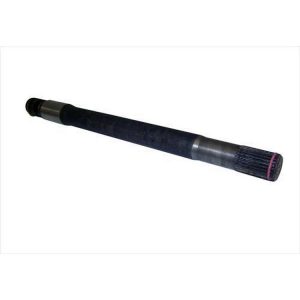
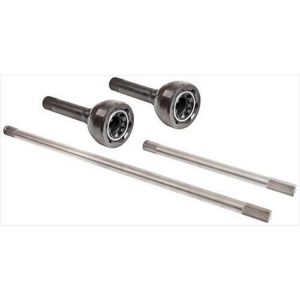
G2 Toyota Birfield CV Style Big Spline Chromoly Inner Axle Shaft – 97-2044-004
 Replacement Axle Shafts
G2 Toyota Birfield CV Style Big Spline Chromoly Inner Axle Shaft – 97-2044-004
- Big Spline driver-side long inner axle shaft, 30 splines
- 28.937 in overall length, Toyota 9.5 inch front axle
- Requires an aftermarket CV joint
- Fits the 1975–1984 Toyota Land Cruiser (FJ40)
SKU: G/297-2044-004 -
Dana 44 Axle Shafts, Replacement Axle Shafts
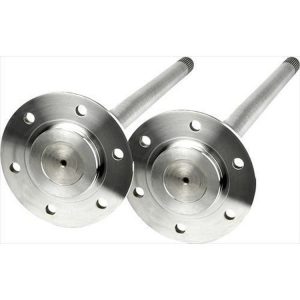
G2 Dana 44 Replacement Axle Shaft – 95-2033-2-331
- Driver side rear axle shaft for Dana 44, 33 splines
- For 1997–2006 Jeep Wrangler TJ with the Dana 44 option
- Forged high-grade alloy steel, heat treated
- Designed for extended service life and high-torque use
- G2 Axle and Gear part 95-2033-2-331
SKU: G/295-2033-2-331 -
-
-
-





What an axle shaft does
An axle shaft carries torque from the differential to the wheel hub. On a solid axle, it slides through the axle tube and splines into the differential's side gear. On a front 4x4 axle, the shaft is usually split into an inner and outer section joined by a universal joint or a constant-velocity joint, so it can turn with the steering. Shafts see heavy loads when tires are large, traction is high and throttle is applied abruptly.
Common reasons to replace them
- A shaft has snapped, often at the spline or just inside the hub.
- A CV joint is clicking, binding or leaking grease from a torn boot.
- Wheel splines are worn or stripped.
- Larger tires, lockers or higher power are raising the load beyond what stock shafts handle.
Matching the shaft to the axle
Axle shafts are specific. The listing titles in this category name the axle, such as a Dana 44, a Chrysler 8.25 or a GM 8.5 inch 10-bolt, and details such as the spline count, shaft length, left or right side, and front or rear position all matter. Spline count must match the differential and the hub. Vehicle details such as ABS tone rings or disconnect systems can also change which shaft fits, so verify against your vehicle's axle tag or build data.
Material and design
Stock shafts are usually forged steel. Upgraded shafts commonly use chromoly steel, which is stronger for a given diameter, and some are made with larger diameters or more splines. Keep in mind that the strongest part of a drivetrain is the part you have not yet broken; upgrading shafts alone may move the weak point to the differential, U-joints or gears. Heavier shafts are not always the right answer for a mostly street-driven vehicle.
Installation notes
Replacing a shaft means removing the wheel, brake components and often the hub or knuckle assembly. Bearings, seals and U-joints are easy to damage and are smart to inspect while the axle is open. Use new seals, repack bearings with the correct grease, and torque the axle nut and caliper bolts to the manufacturer's specification. Professional installation is recommended if you are not comfortable with axle service.
Compatibility
Confirm fitment for your exact year, make, model and axle, and check the manufacturer's specifications for spline count and length before choosing.
Measuring and confirming what you have
Before ordering, identify the axle by its tag, the cover shape, the ring gear bolt count or a VIN-based build sheet. For an old shaft, measure the overall length, the spline count at the differential end and at the wheel end, and the diameter just behind the flange. Note whether your vehicle has ABS, since some axles use a tone ring on the shaft.
Inspection and mistakes to avoid
Inspect the differential, U-joints, bearings and seals whenever a shaft is out. A broken shaft often follows shock loading from spinning tires that suddenly grip, so adding tire size and lockers without upgrading the shafts invites a repeat failure. Do not reuse damaged splines or seals, and keep grease clean when packing joints. Always compare left and right side parts, since shaft lengths often differ between the two sides.
Popular Replacement Axle Shafts brands
- G2 Axle and Gear (153)
- Crown Automotive (28)
- Alloy USA (28)
- Dana Spicer (19)
- Omix-Ada (11)
- Trail Gear (8)
- Ten Factory (6)
- RCV Axles (4)
- Dorman (2)
- Genuine Packages (1)
Replacement Axle Shafts FAQ
How do I know which axle shaft I need?
Identify the axle model, spline count, shaft length and side. An axle tag, build sheet or measurement of the old shaft helps. Confirm against the manufacturer's specifications for your year, make and model before choosing.
Are chromoly axle shafts always stronger?
Chromoly steel is generally stronger than stock steel at the same diameter, but design and heat treatment matter too. Stronger shafts can shift the failure point to other drivetrain parts, so consider the whole system.
What are the signs of a failing CV axle?
Clicking while turning, vibration under acceleration and grease flung from a torn boot are common signs. Catching a torn boot early may save the joint, but a worn joint generally needs replacement.
Do I have to replace both shafts at once?
Not always. A single failure can be fixed with one shaft, but many people replace both sides when upgrading for strength so that left and right match. Follow the manufacturer's guidance for your setup.