Driving lights are auxiliary lamps that add long-range illumination beyond your headlights for night trail driving and desert runs. This category covers round and rectangular LED and halogen driving and fog lamps from Rigid Industries, ARB 4×4 Accessories, KC HiLites, Hella and Baja Designs, in flood, spot and combo patterns. Compare sizes and beam patterns on each product page, then compare the listings below.
Driving Lights
Showing 1–12 of 37 resultsSorted by popularity
-
Driving Lights, Lighting & Lighting Accessories, Offroad Racing Fog & Driving Lights

Rugged Ridge Halogen Single Slim Light – 15207.10
 Driving Lights, Lighting & Lighting Accessories, Offroad Racing Fog & Driving Lights
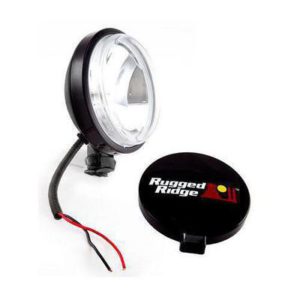
Rugged Ridge Halogen Single Slim Light – 15207.10
- Single halogen slim light, 12V 100 watt
- Heavy-duty stamped steel housing, crystal glass lens
- Narrow profile, 2 13/16 inch thick, stem mount
- Universal fit
SKU: RUG15207.10 -
Driving Lights, Lighting & Lighting Accessories, Offroad Racing Fog & Driving Lights

Rough Country 4″ LED Round Lights – 70804
 Driving Lights, Lighting & Lighting Accessories, Offroad Racing Fog & Driving Lights
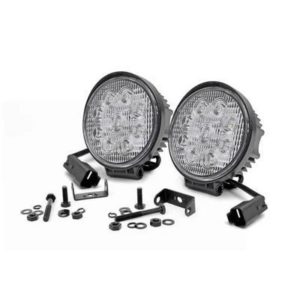
Rough Country 4″ LED Round Lights – 70804
- Universal fit: two 4 inch round LED lights, part number R/C70804
- 54 W and 4320 lumens total for the pair
- IP67 waterproof die-cast aluminum housing
- Stud mount design
- Rough Country 3-year limited warranty
SKU: R/C70804 -
Driving Lights, Lighting & Lighting Accessories, Offroad Racing Fog & Driving Lights

Rigid Industries R-Series 46 Hyperspot Light (Black Retrofit) – 633423
 Driving Lights, Lighting & Lighting Accessories, Offroad Racing Fog & Driving Lights
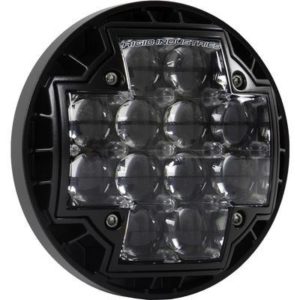
Rigid Industries R-Series 46 Hyperspot Light (Black Retrofit) – 633423
- Universal fit: a round Rigid Industries R-Series 46 light, black retrofit finish
- Part number RIG633423
- Curved lens and housing with an advanced heat sink
- Available in spot, hyperspot, flood, combo, driving and wide patterns
SKU: RIG633423 -
Driving Lights, Lighting & Lighting Accessories, Offroad Racing Fog & Driving Lights
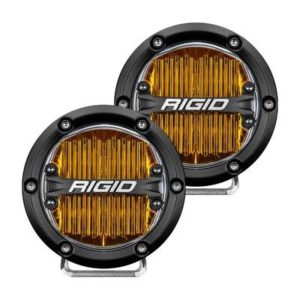
Rigid Industries 360-Series PRO SAE Fog Light Kit (Yellow) – 36121
 Driving Lights, Lighting & Lighting Accessories, Offroad Racing Fog & Driving Lights
Rigid Industries 360-Series PRO SAE Fog Light Kit (Yellow) – 36121
- Rigid Industries 360-Series PRO SAE fog light kit, selective yellow, part number 36121
- SAE/DOT compliant for street use
- Yellow light for dust and low-visibility conditions
- Draws 2 amps, up to 50,000 useful hours
SKU: RIG36121 -
Driving Lights, Lighting & Lighting Accessories, Offroad Racing Fog & Driving Lights
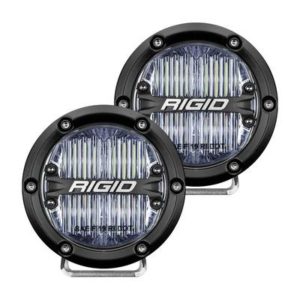
Rigid Industries 360-Series PRO SAE Fog Light Kit (White) – 36120
 Driving Lights, Lighting & Lighting Accessories, Offroad Racing Fog & Driving Lights
Rigid Industries 360-Series PRO SAE Fog Light Kit (White) – 36120
- Rigid Industries 360-Series PRO SAE fog light kit, white, part number 36120
- 3100 lumens, 2.14 amps, 50,000 hour LED life
- SAE J583 compliant for street use
- Universal fit
SKU: RIG36120 -
Driving Lights, Lighting & Lighting Accessories, Offroad Racing Fog & Driving Lights
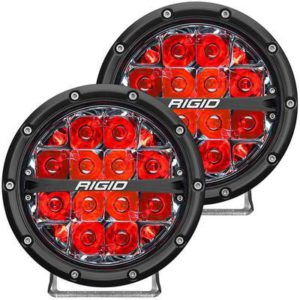
Rigid Industries 360-Series 6″ Spot LED Lights (Red) – 36203
 Driving Lights, Lighting & Lighting Accessories, Offroad Racing Fog & Driving Lights
Rigid Industries 360-Series 6″ Spot LED Lights (Red) – 36203
- Rigid 360-Series 6 inch spot light with red backlight
- 8670 raw lumens and 72 watts per light
- 18.7 degree horizontal beam angle, sold as a set of two
- Aluminum housing with blacked-out circuit board
- Limited lifetime warranty
SKU: RIG36203 -
Driving Lights, Lighting & Lighting Accessories, Offroad Racing Fog & Driving Lights
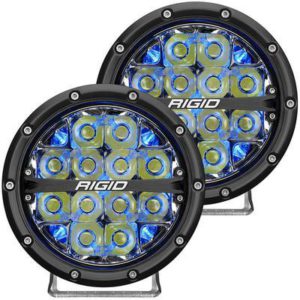
Rigid Industries 360-Series 6″ Spot LED Lights (Blue) – 36202
 Driving Lights, Lighting & Lighting Accessories, Offroad Racing Fog & Driving Lights
Rigid Industries 360-Series 6″ Spot LED Lights (Blue) – 36202
- Rigid 360-Series 6 inch spot light with blue backlight
- 8670 raw lumens and 72 watts per light
- 18.7 degree horizontal beam angle, sold as a set of two
- Aluminum housing with blacked-out circuit board
- Limited lifetime warranty
SKU: RIG36202 -
Driving Lights, Lighting & Lighting Accessories, Offroad Racing Fog & Driving Lights
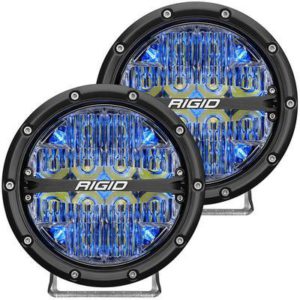
Rigid Industries 360-Series 6″ Driving LED Lights (Blue) – 36207
 Driving Lights, Lighting & Lighting Accessories, Offroad Racing Fog & Driving Lights
Rigid Industries 360-Series 6″ Driving LED Lights (Blue) – 36207
- Rigid 360-Series 6 inch driving light with blue backlight
- 8670 raw lumens and 72 watts per light
- 57 degree horizontal beam angle, sold as a set of two
- Aluminum housing with blacked-out circuit board
- Limited lifetime warranty
SKU: RIG36207 -
Driving Lights, Lighting & Lighting Accessories, Offroad Racing Fog & Driving Lights
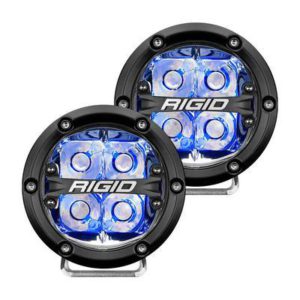
Rigid Industries 360-Series 4″ Spot LED Lights (Blue) – 36115
 Driving Lights, Lighting & Lighting Accessories, Offroad Racing Fog & Driving Lights
Rigid Industries 360-Series 4″ Spot LED Lights (Blue) – 36115
- Rigid 360-Series 4 inch spot light with blue backlight
- 3060 raw lumens and 28 watts per light
- 16.5 degree horizontal beam angle, sold as a set of two
- Aluminum housing with blacked-out circuit board
- Limited lifetime warranty
SKU: RIG36115 -
Driving Lights, Lighting & Lighting Accessories, Offroad Racing Fog & Driving Lights
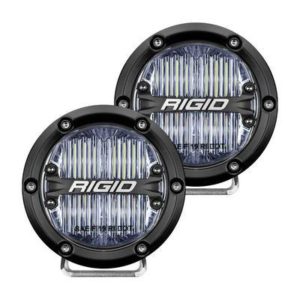
Rigid Industries 360-Series 4″ SAE LED Fog Lights (White) – 36110
 Driving Lights, Lighting & Lighting Accessories, Offroad Racing Fog & Driving Lights
Rigid Industries 360-Series 4″ SAE LED Fog Lights (White) – 36110
- Rigid Industries 360-Series 4-inch SAE LED fog lights, part number 36110
- Set of two, white backlight, SAE fog pattern
- Up to 8,600 raw lumens with aluminum housing
- Limited lifetime warranty, harness sold separately
SKU: RIG36110 -
Driving Lights, Lighting & Lighting Accessories, Offroad Racing Fog & Driving Lights
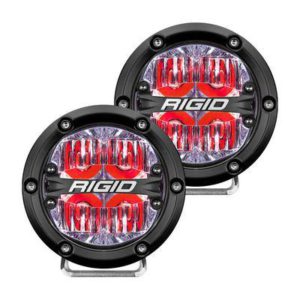
Rigid Industries 360-Series 4″ Driving LED Lights (Red) – 36116
 Driving Lights, Lighting & Lighting Accessories, Offroad Racing Fog & Driving Lights
Rigid Industries 360-Series 4″ Driving LED Lights (Red) – 36116
- Rigid 360-Series 4 inch driving LED light with red backlight
- 3060 raw lumens and 28 watts per light
- 44 degree horizontal beam angle, sold as a set of two
- Aluminum housing with blacked-out circuit board
- Limited lifetime warranty
SKU: RIG36116 -
Driving Lights, Lighting & Lighting Accessories, Offroad Racing Fog & Driving Lights
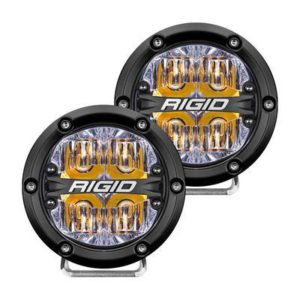
Rigid Industries 360-Series 4″ Driving LED Lights (Amber) – 36118
 Driving Lights, Lighting & Lighting Accessories, Offroad Racing Fog & Driving Lights
Rigid Industries 360-Series 4″ Driving LED Lights (Amber) – 36118
- Rigid 360-Series 4 inch driving light with amber backlight
- 3060 raw lumens and 28 watts per light
- 44 degree horizontal beam angle, sold as a set of two
- Aluminum housing with blacked-out circuit board
- Limited lifetime warranty
SKU: RIG36118
What driving lights do
Headlights are designed for the road, with a pattern that avoids glare for oncoming traffic. Driving lights are auxiliary lamps that throw a focused beam farther down the trail or road, or a wide beam that lights the sides. They are intended for off-road use or places where the law allows. They differ from fog lights, which sit low and cast a wide, flat beam under mist, and several lamps in this category are used in both roles.
Beam patterns
- Spot: a tight beam that reaches far, good for high-speed desert driving.
- Flood: a wide, even spread for the area close to the vehicle, useful for technical trails.
- Driving or combo: blends distance and width, a practical choice when a vehicle carries just one pair of lights.
- Pencil beam: a very narrow pattern used by some rally lights for maximum reach.
Choosing a lamp
Consider the size and shape, such as 4-inch, 6-inch or slim formats, and where it will mount (bumper, grille guard, hood or roof). LEDs draw less current and last longer than halogen, while halogen lamps are simple and easy to replace. Look at the lumen output, but remember that the beam pattern and reflector design affect real-world seeing distance. Amber or selective-yellow lenses reduce glare in dust, fog and snow, which some drivers prefer.
Wiring and installation
A driving light needs a relay and a fuse sized to the lamp's current draw, and a switch inside the cab. Use gauge wire rated for the load and protect the connections from water. A wiring harness designed for the lamp makes the install simpler, and many lights are ready with a connector. Aim the lamps so they do not blind other drivers. Where required, wire lights so they only operate with the high beams on.
Rules and compatibility
Laws about auxiliary lamps, including covers, mounting height and use on public roads, vary by state, so check local regulations. Confirm that the mounting location and bracket suit your vehicle, and compare the lamp specifications with the manufacturer's data.
Mounting position affects how useful a light really is. Lights mounted high, such as on the roof or windshield frame, reduce glare from dust and fog and send light farther down the road, while low bumper mounts light the ground and sides but reflect more back from airborne dust. Many drivers combine both, using a spot on top and flood at the bumper. Keep the lamps aimed slightly below the horizon, and recheck the aim after any suspension change or after bracket bolts loosen.
Durability counts on the trail. Look for a rated water and dust resistance, a rugged housing, a lens made of impact-resistant material and a bracket that holds the lamp steady over washboard roads. Vibration breaks cheap brackets and loosens fasteners, so use thread locker where the manufacturer recommends it. Consider heat as well, since halogen lamps run hot and LED lamps depend on their housings to shed heat, which means the lamp should not be buried where air cannot reach it. Cover or switch off the lights in traffic, and clean lenses regularly for full output.
Popular Driving Lights brands
- Rigid Industries (10)
- ARB 4x4 Accessories (9)
- KC HiLites (6)
- Hella (4)
- Piaa Lighting (3)
- Baja Designs (3)
- Pro Comp Suspension (2)
- Rugged Ridge (1)
- Anzo (1)
- Rough Country (1)
Driving Lights FAQ
What is the difference between driving lights and fog lights?
Driving lights project a longer beam for distance, while fog lights give a wide, low beam for poor visibility. Some lamps are used in either role. Beam pattern and mounting height decide which suits you.
Should I choose spot or flood?
Spot reaches farther and suits fast open terrain, flood lights the near surroundings for slow trails. A combo mixes both. Many drivers use a spot at the front and flood for the sides.
Do I need a relay for driving lights?
Generally yes. A relay protects the vehicle switch and lets the lamps draw current directly from the battery, with a fuse sized to the load. Most lights are supplied with or recommend a harness.
Are off-road driving lights legal on the street?
It depends on state rules, which often limit use or require the lights to be covered or off on public roads. Check your local regulations before you drive with them on.