
Axle U-Bolt Kit
Showing 37–48 of 54 resultsSorted by popularity



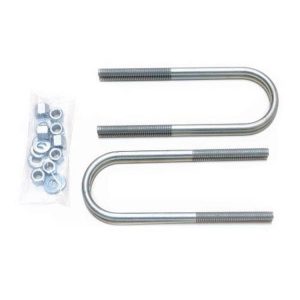

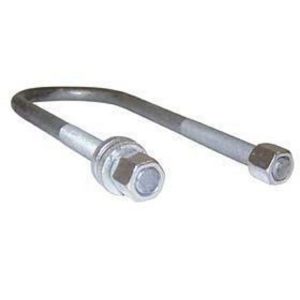

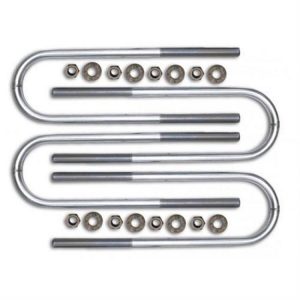
Why U-bolts are one-time hardware
U-bolts hold the leaf spring, spring plate and axle together under every load the suspension sees. When they are torqued, the threads stretch into their elastic range to maintain clamp force; once loosened, they do not reliably return to the same tension, and the threads have usually been deformed by the nuts. That is why spring makers and axle shops treat U-bolts as replace-every-time parts. Any time you install a lift block, an add-a-leaf, new springs or just pull the axle for a gear change, new U-bolts belong on the list.
Measuring for the right kit
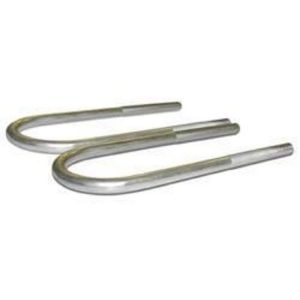
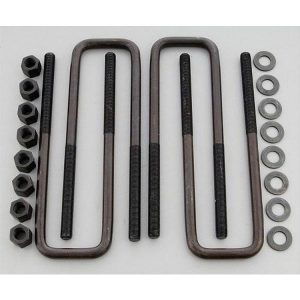
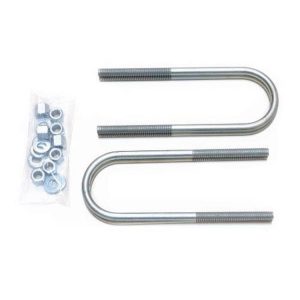
A U-bolt is specified by three numbers: diameter of the bolt stock, inside width between the legs, and leg length from the inside of the bend to the end of the threads. Kits here are named that way, for example 9/16 inch by 2.5 by 11.5 inches for a square bend or 9/16 by 3.25 by 11.50 for a round bend.
- Diameter: 9/16 inch is common on half-ton trucks and Jeeps, 5/8 inch on three-quarter and one-ton axles. Match the holes in your spring plate.
- Bend shape: round bend fits a round axle tube; square bend fits a square or flat-topped tube or a cast axle pad. Using the wrong bend leaves a gap and lets the axle shift.
- Inside width: should equal the axle tube or pad width. Too narrow and it will not go on; too wide and the legs bend inward when tightened.
- Leg length: measure from the top of the axle pad through the spring pack, any lift block and the spring plate, then add room for the nut and a few threads showing. A thicker pack from an add-a-leaf or a lift block means longer legs.
Lift blocks and block kits
Rear lift blocks sit between the spring and the axle pad to raise the rear of the truck without changing the spring. They are rear only; blocks on a front axle are unsafe because the steering and braking loads work to rotate the block out. Tapered blocks correct pinion angle, non-tapered ones replace a factory block at a different height. Kits from Tuff Country and Skyjacker pair the blocks with the correct longer U-bolts, which is the easiest way to get the length right. Keep block height modest, and never stack blocks.
Installation and torque
Clean the axle pad and the spring plate, and make sure the spring center pin is seated in the pad or block hole. Install the U-bolts with the washers and the Nylock or deformed-thread nuts supplied, then tighten in a cross pattern in two or three stages. Final torque depends on diameter: 9/16 inch bolts are commonly in the 90 to 110 foot-pound range and 5/8 inch bolts higher, but use the figure from the spring or U-bolt maker. Do not use an impact gun for the final pass. Recheck torque after about 100 miles and again after 500, because the leaves settle and clamp force drops. Cut excess thread flush with a few threads showing, then coat the cut end.
Axle-specific kits
A few kits here are made for one axle, like the Rancho set for the Chrysler 8.25 in 1984 to 1997 Cherokee XJ and Grand Cherokee ZJ, with four U-bolts, eight washers and eight nuts. These remove the guesswork, but still verify that your spring pack is stock thickness or allow for the extra leaf. If you run a shop or a fleet, a U-bolt that matches your axle in a universal kit is worth keeping on the shelf, since a stripped U-bolt is a trip-ending failure.
Popular Axle U-Bolt Kit brands
- Pro Comp Suspension (13)
- Fabtech (8)
- California Super Trucks (8)
- Skyjacker (7)
- Rubicon Express (4)
- Rough Country (3)
- Trail Gear (3)
- Rancho (3)
- Tuff Country (2)
- Icon Suspension (2)
- Crown Automotive (1)
Axle U-Bolt Kit FAQ
Can I reuse my old U-bolts after a lift?
No. U-bolts stretch when torqued and the threads deform under the nuts, so reused bolts cannot be trusted to hold the same clamp force. Replace them whenever the spring plate comes off, including for lift blocks, add-a-leafs or new springs.
How do I measure for new U-bolts?
Take three measurements: the bolt diameter at the spring plate holes, the inside width across the axle tube or pad, and the leg length from the top of the axle through the spring pack, block and plate with room for the nut. Match the bend shape to the axle, round or square.
What torque do U-bolts need?
It depends on diameter and the maker's spec. 9/16 inch U-bolts often fall around 90 to 110 foot-pounds, and 5/8 inch bolts higher. Tighten in stages in a cross pattern, avoid an impact gun for the final pass, and recheck after 100 and 500 miles.
Are lift blocks safe on the front axle?
No. Blocks belong on the rear only. On a front axle, braking and steering forces try to rotate the block out from between the spring and the axle. Rear blocks should be modest in height and never stacked, and always paired with the correct longer U-bolts.