Brake rotor and caliper kits for trucks, SUVs and Jeeps, including vented rotors, matched pad and rotor sets and upgraded front brake kits. Power Stop supplies most listings, alongside TeraFlex, Trail Gear and Baer Brakes. Check whether a kit is OE-style or an upgrade, front or rear, and compare fitment details. Open a product page for full details.
Disc Brake Calipers, Pads and Rotor Kits
Showing 1–12 of 44 resultsSorted by popularity
-
Brakes & Steering, Disc Brake Calipers, Pads and Rotor Kits, Disc Brake Kits & Components

Trail Gear Fully Loaded Front Brake Kit – 300563-KIT
 Brakes & Steering, Disc Brake Calipers, Pads and Rotor Kits, Disc Brake Kits & Components
Trail Gear Fully Loaded Front Brake Kit – 300563-KIT
- Trail Gear 300563-KIT fully loaded front brake kit, part number 300563-KIT
- Complete front brake kit designed to go with the Rock Assault 9 Front Axle Housing
- Universal fit tag; match it to your axle housing before ordering
SKU: TGI300563-KIT -
Brakes & Steering, Disc Brake Calipers, Pads and Rotor Kits, Disc Brake Kits & Components

TeraFlex High-Modulus Brake Caliper Kit with Pads (Rear) – 4403402
 Brakes & Steering, Disc Brake Calipers, Pads and Rotor Kits, Disc Brake Kits & Components
TeraFlex High-Modulus Brake Caliper Kit with Pads (Rear) – 4403402
- Rear opposed 4-piston brake caliper kit with pads for the TeraFlex Delta Brake System
- Fits 2007-2018 Wrangler JK, 2018-2022 Wrangler JL and 2020-2022 Gladiator JT
- Bridges are heat-treated 4140 cast steel; piston housings are 6061-T6 forged aluminum
- Low-profile bridge clears 14″ rotors behind 17″ wheels
- Calipers and pads only; disc brakes are not included
SKU: TER4403402 -
Brakes & Steering, Disc Brake Calipers, Pads and Rotor Kits, Disc Brake Kits & Components
TeraFlex Delta Front and Rear Brake Kit (5×5 Bolt Pattern) – 4403450
 Brakes & Steering, Disc Brake Calipers, Pads and Rotor Kits, Disc Brake Kits & Components
TeraFlex Delta Front and Rear Brake Kit (5×5 Bolt Pattern) – 4403450
- Front and rear Delta big brake kit, 5×5 bolt pattern
- For 2007-2018 Wrangler JK, 2018-2021 Wrangler JL and 2020-2021 Gladiator JT
- Vented and slotted rotors, high-modulus calipers
SKU: TER4403450 -
Brakes & Steering, Disc Brake Calipers, Pads and Rotor Kits, Disc Brake Kits & Components

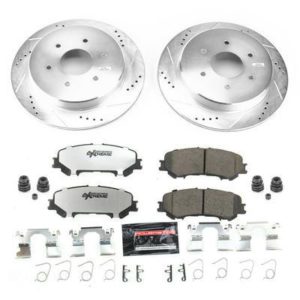
Power Stop Z36 Truck and Tow Rear Brake Kit – K7874-36
 Brakes & Steering, Disc Brake Calipers, Pads and Rotor Kits, Disc Brake Kits & Components
Power Stop Z36 Truck and Tow Rear Brake Kit – K7874-36
- Rear brake kit for the 2017-2021 Nissan Titan
- Ceramic carbon-fiber pads with drilled, slotted, zinc-plated rotors
- Stainless steel hardware included
SKU: PSTK7874-36 -
Brakes & Steering, Disc Brake Calipers, Pads and Rotor Kits, Disc Brake Kits & Components
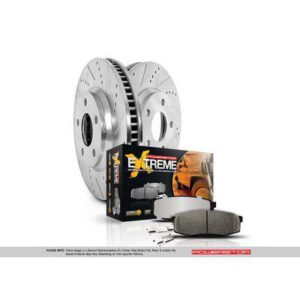
Power Stop Z36 Truck and Tow Front and Rear Brake Kit – K15461DK-36
 Brakes & Steering, Disc Brake Calipers, Pads and Rotor Kits, Disc Brake Kits & Components
Power Stop Z36 Truck and Tow Front and Rear Brake Kit – K15461DK-36
- Front and rear brake kit for the 1994-1996 Ford Bronco
- Ceramic carbon-fiber pads, drilled, slotted, zinc-plated rotors
- Stainless steel hardware included
SKU: PSTK15461DK-36 -
Brakes & Steering, Disc Brake Calipers, Pads and Rotor Kits, Disc Brake Kits & Components
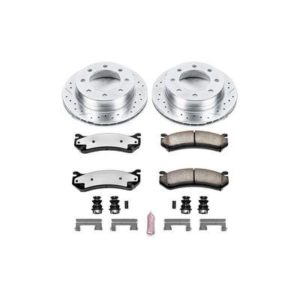
Power Stop Z36 Truck & Tow Rear Brake Kit – K5190-36
 Brakes & Steering, Disc Brake Calipers, Pads and Rotor Kits, Disc Brake Kits & Components
Power Stop Z36 Truck & Tow Rear Brake Kit – K5190-36
- Rear brake kit for 2003-2005 Chevrolet Silverado HD, Suburban 2500, GMC Sierra HD and Yukon XL 2500
- Slotted and cross-drilled cast iron rotors, 8 lugs
- Ceramic pads, 2-wheel set
SKU: PSTK5190-36 -
Brakes & Steering, Disc Brake Calipers, Pads and Rotor Kits, Disc Brake Kits & Components
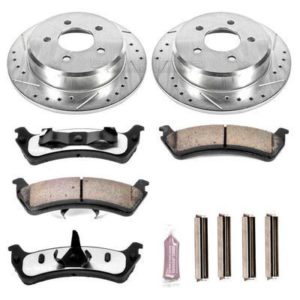
Power Stop Z36 Truck & Tow Rear Brake Kit – K1858-36
 Brakes & Steering, Disc Brake Calipers, Pads and Rotor Kits, Disc Brake Kits & Components
Power Stop Z36 Truck & Tow Rear Brake Kit – K1858-36
- Rear brake kit for 1995-2002 Ford Explorer, 1998-2002 Ranger EV and 1997-2001 Mercury Mountaineer
- Slotted and cross-drilled cast iron rotors, zinc plated
- Ceramic pads and stainless steel hardware, 2-wheel set
SKU: PSTK1858-36 -
Brakes & Steering, Disc Brake Calipers, Pads and Rotor Kits, Disc Brake Kits & Components
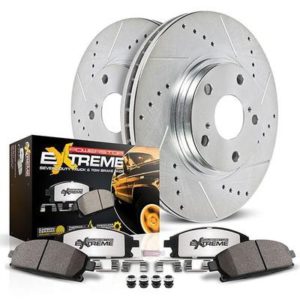
Power Stop Z36 Truck & Tow Performance Front and Rear Brake Upgrade Kit – K15095DK-36
 Brakes & Steering, Disc Brake Calipers, Pads and Rotor Kits, Disc Brake Kits & Components
Power Stop Z36 Truck & Tow Performance Front and Rear Brake Upgrade Kit – K15095DK-36
- Front and rear brake kit for the 1995-2000 Toyota 4Runner
- Ceramic carbon-fiber pads with drilled, slotted, zinc-plated rotors
- Stainless steel hardware included
SKU: PSTK15095DK-36 -
Brakes & Steering, Disc Brake Calipers, Pads and Rotor Kits, Disc Brake Kits & Components
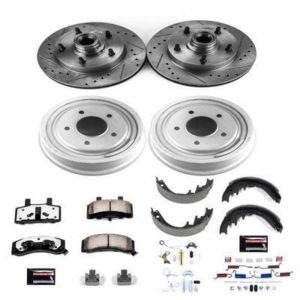
Power Stop Z36 Truck & Tow Performance Front and Rear Brake Upgrade Kit – K15089DK-36
 Brakes & Steering, Disc Brake Calipers, Pads and Rotor Kits, Disc Brake Kits & Components
Power Stop Z36 Truck & Tow Performance Front and Rear Brake Upgrade Kit – K15089DK-36
- Front and rear kit for 1990-1993 Ford E-150 and F-150, including the 1993 Lightning
- Ceramic pads with carbon fibers and drilled, slotted, zinc-plated rotors
- Stainless steel hardware included, bolt-on installation
SKU: PSTK15089DK-36 -
Brakes & Steering, Disc Brake Calipers, Pads and Rotor Kits, Disc Brake Kits & Components
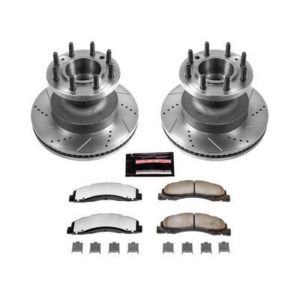
Power Stop Z36 Truck & Tow Front Brake Kit – K4717-36
 Brakes & Steering, Disc Brake Calipers, Pads and Rotor Kits, Disc Brake Kits & Components
Power Stop Z36 Truck & Tow Front Brake Kit – K4717-36
- Front brake kit for the 2008-2019 and 2021 Ford E-350 Super Duty
- Drilled and slotted rotors with Z36 Extreme Truck & Tow pads
- Direct-fit design for towing, hauling and off-road use
SKU: PSTK4717-36 -
Brakes & Steering, Disc Brake Calipers, Pads and Rotor Kits, Disc Brake Kits & Components
Power Stop Z36 Truck & Tow Front Brake Kit – K1990-36
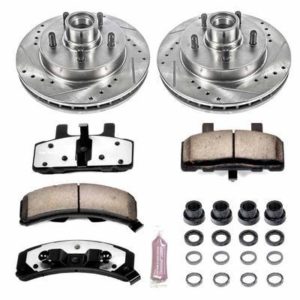 Brakes & Steering, Disc Brake Calipers, Pads and Rotor Kits, Disc Brake Kits & Components
Power Stop Z36 Truck & Tow Front Brake Kit – K1990-36
- Front kit for 1992–2002 Chevrolet and GMC trucks, vans and SUVs
- Matched drilled and slotted rotors and pads
- Direct fit
- Built for tow and haul heat
SKU: PSTK1990-36

Kits versus individual parts
A brake kit combines components that are meant to work together, such as rotors and pads, or calipers, rotors and pads. Kits save time compared with matching parts one at a time and help ensure compatible sizes. Single rotors, as in several sample listings, suit owners who only need to replace worn discs. Check the product page for exactly which parts are included and whether the pieces cover one axle or one wheel.
Rotor types
- Smooth vented rotors are the common OE-style design. They are quiet and need little break-in.
- Drilled rotors have holes that vent gas and water, and can be prone to cracking under hard use.
- Slotted rotors have grooves that clear debris and gas from the pad surface.
- Coated rotors resist rust on the non-contact surfaces, which helps in wet or salty regions.
When a kit is an upgrade
Bigger tires add rotating mass and leverage on the brake system, so many owners of lifted vehicles look at upgraded brakes. A big brake kit with larger rotors and multi-piston calipers increases clamping force and heat capacity. Check whether the kit requires specific wheel diameter clearance, because larger calipers may not fit inside a stock wheel. Universal-fit listings, such as some Trail Gear kits, should be checked carefully against axle and hub type.
Compatibility checklist
- Year, make, model, front or rear axle and brake package.
- Rotor diameter and thickness, bolt pattern and hat design.
- Whether calipers are loaded with pads and hardware, or need brake lines and brackets.
- Wheel clearance and brake line routing.
Installation notes
Brakes are a safety-critical system. Professional installation is advisable unless you have experience. Replace pads and rotors together, clean hub faces of rust, torque caliper brackets and wheel nuts to specification and bleed the system when any hydraulic line is opened. Follow the maker's bedding procedure for new pads and rotors, and test the pedal feel at low speed before driving normally.
Inspection and mistakes to avoid
Check rotor thickness with a micrometer and compare it to the minimum thickness stamped on the rotor. Look for deep grooves, blue heat marks, cracks around holes or slots and lip wear at the edge. Rotors with a runout problem, usually felt as pedal pulsation, may be warped, or the hub face may have rust or debris under the rotor.
- Do not reuse worn hardware such as caliper bolts that call for replacement, or stretched clips.
- Do not use an impact gun to tighten wheel nuts. Uneven torque can distort rotors and cause pulsation.
- Do not mix unmatched pads and rotors from different brake systems, since friction materials work best with the rotor type they were designed for.
- Do not skip bleeding when a hydraulic connection is opened.
For tow rigs and heavily loaded trucks, check that the whole system keeps up: hoses, fluid and the master cylinder. A big upgrade at the wheels does not help if the pedal feel is spongy because of old fluid. Flush brake fluid on the schedule in your owner's manual.
Popular Disc Brake Calipers, Pads and Rotor Kits brands
Disc Brake Calipers, Pads and Rotor Kits FAQ
Should I replace rotors and pads together?
Usually yes. New pads on worn or grooved rotors do not seat well and can wear unevenly. Replacing both restores full contact and consistent braking. Rotors must be above minimum thickness, which is stamped on the rotor.
Are drilled or slotted rotors better for a truck?
Not necessarily. Slotted rotors help clear debris and are often chosen for towing or off-road use. Drilled rotors can crack under heavy stress. Smooth OE-style rotors work well for most daily driving.
Do larger tires affect my brakes?
Yes. Bigger, heavier tires and wheels raise the effort needed to stop. Many lifted-vehicle owners upgrade pads, rotors or calipers. Have the brake system inspected after changing tire size.
Do I need to bleed the brakes when changing rotors?
Not if the hydraulic system stays closed. Replacing calipers or lines opens the system and requires bleeding. When in doubt, a technician can check pedal feel and fluid condition.