Rear bumpers replace the factory piece with a heavier steel or aluminum design that adds recovery points, hitch options and better departure angle. This branch of the Bumpers tree includes direct-fit bumpers for Wranglers, Broncos, Gladiators and trucks from Fab Fours, Addictive Desert Designs, Smittybilt, DV8 Offroad and Body Armor 4×4.Each product page lists finish, hitch and tire carrier details with part numbers, so you can compare the products below.
Rear Bumpers
Showing 1–12 of 76 resultsSorted by popularity
-
Bumpers, Bumpers, Tire Carriers & Winch Mounts, Rear Bumpers

Smittybilt Tubular Jeep Rear Bumper (Stainless Steel) – JB48-RHS
 Bumpers, Bumpers, Tire Carriers & Winch Mounts, Rear Bumpers
Smittybilt Tubular Jeep Rear Bumper (Stainless Steel) – JB48-RHS
- Fits 2007–2018 Jeep Wrangler JK 2-door and Unlimited 4-door models
- One-piece stainless steel tubular rear bumper
- Receiver hitch included
- Robotically welded with pre-cut vertical uprights
- Part number S/BJB48-RHS
SKU: S/BJB48-RHS -
Bumpers, Bumpers, Tire Carriers & Winch Mounts, Rear Bumpers
Smittybilt Stryker Rear Bumper – 77732
- Fits 2018–2022 Jeep Wrangler JL 2-door and Unlimited 4-door models
- Rear bumper that matches the modular Stryker front bumper
- Receiver hitch and 7/8 inch D-ring mounts included
- Stubby design press-formed from 3mm cold rolled steel
- Part number S/B77732
SKU: S/B77732 -
Bumpers, Bumpers, Tire Carriers & Winch Mounts, Rear Bumpers
Smittybilt Stryker Modular Rear Bumper – 76732
 Bumpers, Bumpers, Tire Carriers & Winch Mounts, Rear Bumpers
Smittybilt Stryker Modular Rear Bumper – 76732
- Fits 2007–2018 Jeep Wrangler JK 2-door and Unlimited 4-door models
- Stubby modular rear bumper press-formed from 3mm cold rolled steel
- Integrated lift points and 7/8 inch D-ring mounts
- Optional Stryker Side Wings sold separately for side protection
- Part number S/B76732
SKU: S/B76732 -
Bumpers, Bumpers, Tire Carriers & Winch Mounts, Rear Bumpers
Smittybilt SRC Carbine Rear Bumper – 76745
 Bumpers, Bumpers, Tire Carriers & Winch Mounts, Rear Bumpers
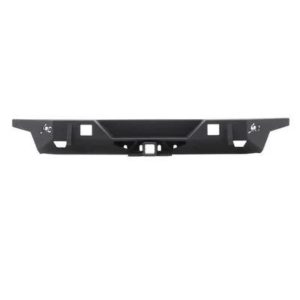
Smittybilt SRC Carbine Rear Bumper – 76745
- Fits 2007–2018 Jeep Wrangler JK 2-door and Unlimited 4-door models
- Carbine rear bumper in 3/16 inch cold rolled steel
- Receiver hitch and D-ring mounts included
- Two-stage textured matte black finish
- Part number S/B76745
SKU: S/B76745 -
Bumpers, Bumpers, Tire Carriers & Winch Mounts, Rear Bumpers
Smittybilt GEN2 XRC Rear Bumper – 77858
 Bumpers, Bumpers, Tire Carriers & Winch Mounts, Rear Bumpers
Smittybilt GEN2 XRC Rear Bumper – 77858
- Fits 2018–2022 Jeep Wrangler JL models
- Steel GEN2 XRC rear bumper with receiver hitch and D-ring mounts
- Powder coat finish
- Sensor sockets needed for some Sport and Sahara models
- Part number S/B77858
SKU: S/B77858 -
Bumpers, Bumpers, Tire Carriers & Winch Mounts, Rear Bumpers
Smittybilt GEN2 SRC Rear Bumper – 77714
 Bumpers, Bumpers, Tire Carriers & Winch Mounts, Rear Bumpers
Smittybilt GEN2 SRC Rear Bumper – 77714
- Fits 2018–2022 Jeep Wrangler JL models
- Steel GEN2 SRC rear bumper with a class III, 2-inch receiver hitch
- Two reverse lights and D-ring mounts included
- Replaceable PP+TPO slip strips add damage protection
- Part number S/B77714
SKU: S/B77714 -
Bumpers, Bumpers, Tire Carriers & Winch Mounts, Rear Bumpers
Smittybilt Classic Rock Crawler Rear Bumper and Tire Carrier with Receiver Hitch and D-ring Mounts (Black) – 76651D
 Bumpers, Bumpers, Tire Carriers & Winch Mounts, Rear Bumpers
Smittybilt Classic Rock Crawler Rear Bumper and Tire Carrier with Receiver Hitch and D-ring Mounts (Black) – 76651D
- Fits 1987–1995 Jeep Wrangler YJ, 1997–2006 TJ and 2004–2006 LJ
- Rear bumper with receiver hitch, D-ring mounts and a tire carrier
- Carrier holds tires up to 35 inch
- Zinc under-coat and dual-stage powder coat in textured black
- Part number S/B76651D
SKU: S/B76651D -
Bumpers, Bumpers, Tire Carriers & Winch Mounts, Rear Bumpers
Smittybilt Apollo Rear Bumper – 77784
- Fits 2018–2022 Jeep Wrangler JL and 2020–2021 Gladiator models
- Powder coat steel rear bumper with D-ring mounts
- Compatible with the factory tire carrier or the Smittybilt HD Pivot 7743
- No receiver hitch and no tire carrier included
- Part number S/B77784
SKU: S/B77784 -
Bumpers, Bumpers, Tire Carriers & Winch Mounts, Rear Bumpers
Smittybilt 3″ Rear Double Tube Bumper without Hitch (Stainless Steel) – JB48-RS
 Bumpers, Bumpers, Tire Carriers & Winch Mounts, Rear Bumpers
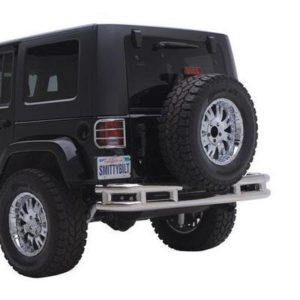
Smittybilt 3″ Rear Double Tube Bumper without Hitch (Stainless Steel) – JB48-RS
- Fits 2007–2018 Jeep Wrangler JK 2-door and Unlimited 4-door models
- Stainless steel, one-piece tubular rear bumper
- Robotically welded with pre-cut vertical uprights
- No receiver hitch and no D-ring mounts included
- Part number S/BJB48-RS
SKU: S/BJB48-RS -
Bumpers, Bumpers, Tire Carriers & Winch Mounts, Rear Bumpers

Rugged Ridge Dual Tube Rear Bumper without Hitch (Stainless Steel) – 11573.03
 Bumpers, Bumpers, Tire Carriers & Winch Mounts, Rear Bumpers
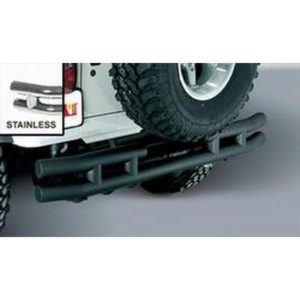
Rugged Ridge Dual Tube Rear Bumper without Hitch (Stainless Steel) – 11573.03
- Fits 1987–1995 Jeep Wrangler YJ, 1997–2006 TJ and 2004–2006 LJ models
- Stainless steel dual tube rear bumper with welded end caps
- 17-inch rear opening for tires up to 31 inch on the factory spare mount
- Optional frame-mounted receiver hitch described; title says without hitch
- Part number RUG11573.03
SKU: RUG11573.03 -
Bumpers, Bumpers, Tire Carriers & Winch Mounts, Rear Bumpers

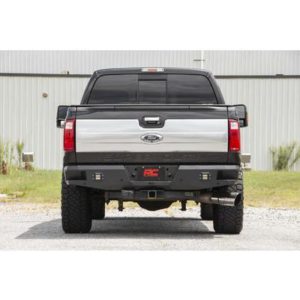
Rough Country Heavy Duty Rear LED Bumper (Black) – 10784
 Bumpers, Bumpers, Tire Carriers & Winch Mounts, Rear Bumpers
Rough Country Heavy Duty Rear LED Bumper (Black) – 10784
- Fits 1999–2016 Ford F-250 and F-350 Super Duty trucks
- All-steel rear LED bumper with two pre-installed 2-inch LED cubes
- Two integrated steps for bed access
- Keeps the factory receiver hitch; sensor relocators included
- Part number R/C10784
SKU: R/C10784 -
Bumpers, Bumpers, Tire Carriers & Winch Mounts, Rear Bumpers
Rough Country Heavy Duty Rear LED Bumper (Black) – 10773
 Bumpers, Bumpers, Tire Carriers & Winch Mounts, Rear Bumpers
Rough Country Heavy Duty Rear LED Bumper (Black) – 10773
- Fits 2007–2018 Chevrolet Silverado 1500 trucks
- All-steel rear LED bumper with two 2-inch flush-mount LED cubes
- Two integrated steps for bed access
- Keeps the factory receiver hitch; sensor relocators included
- Part number R/C10773
SKU: R/C10773


Why replace a rear bumper
Stock rear bumpers are designed for appearance and impact standards, not for recovery or trail abuse. An aftermarket rear bumper adds strength for tow and recovery points, can improve departure angle by tucking the corners, and often provides a mount for a hitch, lights, a swing-out tire carrier or a spare tire.
In this branch you will see steel bumpers with bare or powder-coated finishes, tubular stainless designs, and plate-style bumpers with shackle tabs.
Features to compare
Listings in this category use several consistent fields, which makes comparison simple:
- Receiver hitch included or not. Some bumpers have a built-in receiver, while others need a separate hitch or accept the factory one.
- D-ring or shackle mounts for recovery. Check the rated capacity of any shackle you use.
- Tire carrier included or not, and whether the carrier can swing.
- Finish such as bare steel, matte black powder coat, or stainless. Bare steel needs a coating before use to prevent rust.
- Sensor and light cutouts, which matter if your vehicle has parking sensors or a backup camera.
Material and weight
Steel is stronger and usually less costly, but heavy. Aluminum saves weight and resists rust yet is not as tough for hard recovery. Added weight on the rear hangs behind the axle, so consider your springs or shocks, especially if you add a tire carrier or tow often. Heavier bumpers can also affect payload, and you may want to inspect rear suspension after installation.
Installation and compatibility
Most rear bumpers are bolt-on, vehicle-specific kits, but a two-person install is wise because the parts are heavy. Some require trimming, relocating wiring or fuel filler components. Torque the mounting hardware to specification and recheck after the first trail outing.
Confirm fitment for your exact year, make, model and trim, including whether you have parking sensors, a trailer harness or a factory spare mount, and compare against the manufacturer's specifications. For towing, confirm the hitch rating of the receiver. Equipment rules, lights and tow ratings vary, so check local regulations.
Before you buy, measure the departure angle you need, decide whether you want a tire carrier or a spare mounted elsewhere, and think about lighting and camera needs. Photos and dimensions on each product page help you compare how far the bumper sticks out and how much it weighs.
Matching accessories and avoiding mistakes
A rear bumper rarely stands alone. Think through the rest of the back of the vehicle before you commit. A swing-out tire carrier needs a bumper rated for the extra weight and leverage, a hitch receiver must suit the trailer you tow, and lights or cameras need cutouts and wiring paths.
- Check that the bumper clears an aftermarket spare tire, exhaust tips and a rear tow hook.
- Confirm whether the factory backup sensors can be reused or whether a cutout kit is needed.
- Do not forget to account for the added weight when sizing rear springs, especially with a carrier and a full-size spare.
- Seal any bare steel edges and inspect welds and fasteners for rust after wet or salty trips.
Popular Rear Bumpers brands
- Fab Fours (19)
- Addictive Desert Designs (14)
- Smittybilt (9)
- DV8 Offroad (7)
- Body Armor 4x4 (6)
- ARB 4x4 Accessories (4)
- Poison Spyder Customs (3)
- Rough Country (2)
- Rampage (2)
- Bestop (2)
- Road Armor (1)
- Rock Slide Engineering (1)
Rear Bumpers FAQ
Do aftermarket rear bumpers include a hitch receiver?
Some do and some do not. Listings usually state whether a receiver hitch is included. Check this before you decide, and confirm the receiver class and tongue weight rating if you tow.
Can I use the D-rings for recovery?
D-ring or shackle mounts are meant for recovery use, but only with properly rated shackles and straps used in a safe, controlled way. Follow the bumper manufacturer's guidance and never use tow ball mounts for recovery.
Will a heavier bumper hurt my suspension?
It adds weight behind the axle, which can cause rear sag, especially with a tire carrier. Heavier springs or adjustable shocks may help. Check the weight in the product details.
Is a bare finish ready to use?
No. Bare steel will rust and needs a coating such as paint or powder coat before installation. Check the finish line in each listing. Prepping and coating it properly before installation protects the metal for years.