
Seat covers protect cloth or vinyl upholstery from mud, sun, spills and wear, and they refresh seats that have seen years of trail use. This listing covers front, rear and headrest covers in neoprene, vinyl and other materials from Smittybilt, Bartact, PRP Seats and Rugged Ridge. Match the cover to your model and seat layout, then compare the products below.
Seat Covers
Showing 1–12 of 67 resultsSorted by popularity
-
-
Interior Parts & Accessories, Seat Covers, Seat Covers

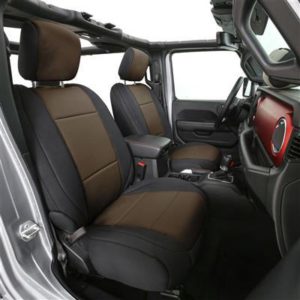
Smittybilt Neoprene Front and Rear Seat Cover Kit (Black/Tan) – 472125
 Interior Parts & Accessories, Seat Covers, Seat Covers
Smittybilt Neoprene Front and Rear Seat Cover Kit (Black/Tan) – 472125
- Neoprene front and rear seat covers in Black/Tan for 4-door Wrangler JL
- Complete set of front pair and rear seat covers
- Padded, pleated center section for comfort
- Rear map pocket on the front covers
- Slip-on installation; machine washable in gentle cold
SKU: S/B472125 -
Interior Parts & Accessories, Seat Covers, Seat Covers
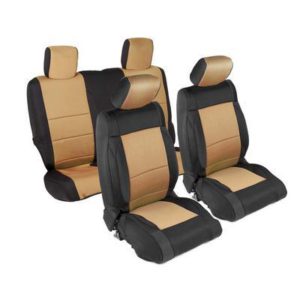
Smittybilt Neoprene Front and Rear Seat Cover Kit (Black/Tan) – 471525
 Interior Parts & Accessories, Seat Covers, Seat Covers
Smittybilt Neoprene Front and Rear Seat Cover Kit (Black/Tan) – 471525
- Neoprene front and rear seat covers in Tan/Black for 2-door Wrangler JK
- Complete set of front and rear covers
- Padded, pleated center section for comfort
- Slip-on installation, no tools required
- Machine washable in gentle cold
SKU: S/B471525 -
Interior Parts & Accessories, Seat Covers, Seat Covers
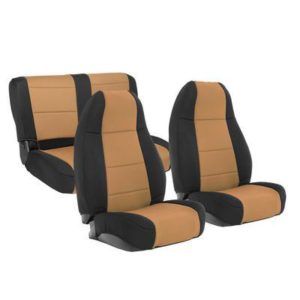
Smittybilt Neoprene Front and Rear Seat Cover Kit (Black/Tan) – 471025
 Interior Parts & Accessories, Seat Covers, Seat Covers
Smittybilt Neoprene Front and Rear Seat Cover Kit (Black/Tan) – 471025
- Neoprene front and rear seat covers in Black/Tan for early CJ and YJ Jeeps
- Fits early CJ5, CJ7, Scrambler and 1987 to 1990 YJ models
- Kit includes front and rear covers
- Slip-on installation with no tools required
- Rear covers may fit loose on 1976 to 1980 models
SKU: S/B471025 -
Interior Parts & Accessories, Seat Covers, Seat Covers
Smittybilt Neoprene Front and Rear Seat Cover Kit (Black/Red) – 472130
 Interior Parts & Accessories, Seat Covers, Seat Covers
Smittybilt Neoprene Front and Rear Seat Cover Kit (Black/Red) – 472130
- Neoprene front and rear seat covers in Black/Red for 4-door Jeep Wrangler JL
- Each kit includes a front pair and rear seat covers
- Padded, pleated center section and double stitched seams
- Slip-on installation with no tools required
- Machine washable in gentle cold
SKU: S/B472130 -
Interior Parts & Accessories, Seat Covers, Seat Covers
Smittybilt Neoprene Front and Rear Seat Cover Kit (Black/Red) – 471430
 Interior Parts & Accessories, Seat Covers, Seat Covers
Smittybilt Neoprene Front and Rear Seat Cover Kit (Black/Red) – 471430
- Neoprene front and rear seat covers in Black/Red for 2-door Jeep Wrangler JK and JL
- Kit includes front and rear covers
- Center section padded and pleated for comfort
- Slip-on installation with no tools required
- Compatible with the front seat air bags
SKU: S/B471430 -
Interior Parts & Accessories, Seat Covers, Seat Covers
Smittybilt Neoprene Front and Rear Seat Cover Kit (Black/Gray) – 472122
 Interior Parts & Accessories, Seat Covers, Seat Covers
Smittybilt Neoprene Front and Rear Seat Cover Kit (Black/Gray) – 472122
- Fits 2018-2026 Jeep Wrangler Unlimited (JL) 4-door models, non-Rubicon
- Neoprene seat cover kit for front and rear seats in Black/Charcoal Gray
- Padded, pleated center section; front covers have a rear map pocket
- Machine washable; installs with no tools required
SKU: S/B472122 -
Seat Covers, Interior Parts & Accessories, Seat Covers
Smittybilt Neoprene Front and Rear Seat Cover Kit (Black) – 472101
 Seat Covers, Interior Parts & Accessories, Seat Covers
Smittybilt Neoprene Front and Rear Seat Cover Kit (Black) – 472101
- Neoprene front and rear seat covers in Black/Black for 4-door Wrangler JL
- Sold as a complete set of front pair and rear covers
- Padded, pleated center section for comfort
- Rear map pocket on the front covers
- No tools required; machine washable in gentle cold
SKU: S/B472101 -
Interior Parts & Accessories, Seat Covers, Seat Covers
Smittybilt GEN2 Neoprene Front and Rear Seat Cover Kit (Red/Black) – 578130
 Interior Parts & Accessories, Seat Covers, Seat Covers
Smittybilt GEN2 Neoprene Front and Rear Seat Cover Kit (Red/Black) – 578130
- Nine-piece neoprene kit in Red/Black for the 2020 to 2026 Jeep Gladiator
- Only fits vehicles with rear armrests
- Front covers cut for the recliner and side air bags
- Five headrest covers and a middle headrest cover
- Heavy-duty zippers; water and sweat resistant
SKU: S/B578130 -
Interior Parts & Accessories, Seat Covers, Seat Covers
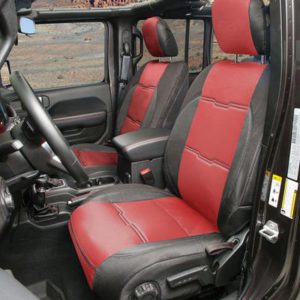
Smittybilt GEN2 Neoprene Front and Rear Seat Cover Kit (Red/Black) – 576230
 Interior Parts & Accessories, Seat Covers, Seat Covers
Smittybilt GEN2 Neoprene Front and Rear Seat Cover Kit (Red/Black) – 576230
- Neoprene front and rear seat covers in Red/Black for 2-door Wrangler JL
- Includes front and rear covers with a front zipper pocket
- Net pouch on the back of the front headrests and seats
- Padded, pleated center section for comfort
- Removable rear panel; protection for cup holder and armrest
SKU: S/B576230 -
Interior Parts & Accessories, Seat Covers, Seat Covers
Smittybilt GEN2 Neoprene Front and Rear Seat Cover Kit (Charcoal/Black) – 578122
 Interior Parts & Accessories, Seat Covers, Seat Covers
Smittybilt GEN2 Neoprene Front and Rear Seat Cover Kit (Charcoal/Black) – 578122
- Nine-piece neoprene kit in Charcoal/Black for Gladiator and Wrangler
- Works only with vehicles that have rear armrests
- Front covers with recliner cut-outs and side air bag provisions
- Rear map pockets and a middle headrest cover
- Water and sweat resistant; no tools for install
SKU: S/B578122 -
Interior Parts & Accessories, Seat Covers, Seat Covers
Smittybilt GEN2 Neoprene Front and Rear Seat Cover Kit (Charcoal/Black) – 576222
 Interior Parts & Accessories, Seat Covers, Seat Covers
Smittybilt GEN2 Neoprene Front and Rear Seat Cover Kit (Charcoal/Black) – 576222
- Neoprene front and rear seat cover kit in Charcoal/Black for 2-door Wrangler JL
- Includes front and rear covers with a front zipper pocket
- Net pouches on the front headrests and seats
- Protection for an optional cup holder and armrest; child seat anchor access
- Water resistant and breathable material
SKU: S/B576222

Choosing a material
Material is the biggest decision. Neoprene resists water and spills and feels softer, which suits wet gear and beach or river trips. Vinyl wipes clean easily and handles abrasion. Heavy fabric such as coated polyester or canvas-style weaves holds up to rubbing and sun. Look for stated water resistance or waterproofing, UV-resistant fabric and reinforced stitching on high-wear edges. Dark colors hide dirt, but also hold more heat in direct sun.
Fit and coverage
- Front, rear or both: Many products are sold for front seats, rear benches or headrests separately, so confirm what the listing includes.
- Vehicle-specific patterns: A direct-fit cover follows the seat's shape and cutouts, which matters for side airbags, seat adjusters and fold-down backs.
- Two-door or four-door: Seat structure differs, so the model body style matters.
- Model years: Seat designs change across generations, so year ranges are important.
Safety and airbags
Many modern vehicles have airbags built into the seat sides. Covers that are not designed for them can interfere with deployment. Use only covers described as compatible with your seat design and follow the manufacturer's directions. Heated seats and seat sensors can also be affected by thick covers, so check compatibility.
Installation and care
Installation usually involves loosening headrests, threading straps and clips under the seat and pulling the cover snug. Warm material is easier to stretch, so a sunny day or a warm garage helps. Remove debris from the seat first, because grit under a cover wears it from the inside. Clean neoprene and vinyl with mild soap and water, and check the care label for fabric. Always confirm fitment for your exact year, make and model and read the manufacturer's specifications.
Sizing details are easy to overlook. Compare the cover's listed seat type, such as bucket, bench or fold-flat rear, and whether the vehicle has a rear split seat or integrated armrests. Wash covers according to the care label, and let them dry completely before reinstalling, so mildew does not develop beneath them.
Finally, inspect covers periodically for loose stitching, worn edges and stretched straps. Catching small problems early keeps a cover looking neat and prevents the fabric from shifting or bunching, which can wear the upholstery underneath faster than no cover at all.
Materials, stitching and construction
Construction quality shows in the seams and attachment system. Look for double or triple stitching on stress points, UV-resistant thread, and elastic or hook-and-loop straps that hold the cover without gaps. A backing layer of foam gives padding and helps the cover resist bunching, while a thin scrim backing keeps the material from stretching. Neoprene usually comes in thickness values, and a thicker layer insulates better from heat and cold but fits more snugly.
If you take the vehicle on wet trails, dry the covers and seats afterward, as trapped moisture can encourage mildew. In very hot climates, vinyl and dark colors get hot to the touch, so a lighter shade or a breathable fabric may be more comfortable. Measure carefully for cut-outs such as seat belt buckles, armrests and storage pockets, and make sure none of them are covered in a way that blocks access.
Popular Seat Covers brands
- Smittybilt (21)
- Bartact (18)
- PRP Seats (7)
- Rugged Ridge (5)
- Coverking (3)
- Rough Country (3)
- Corbeau (2)
- Bestop (2)
- Aries Offroad (2)
- Covercraft (1)
- INSYNC Business Solutions (1)
- MasterCraft Safety (1)
Seat Covers FAQ
Are neoprene seat covers waterproof?
Neoprene is highly water resistant, but whether a specific cover is fully waterproof depends on construction, seams and backing. Read the product details for the manufacturer's water resistance claims.
Will seat covers interfere with side airbags?
They can if they are not designed for airbag seats. Use covers described as compatible with your seat design, and follow the manufacturer's instructions. If you are unsure, ask a qualified installer.
Do seat covers fit both two-door and four-door models?
Not always. Seat shapes, folding mechanisms and cutouts differ between body styles and model years. Check the listing and confirm fitment for your exact year, make and model.
How do I keep seat covers from sliding?
Pull them snug, fasten every strap and clip under the seat, and make sure headrest openings line up. A properly sized direct-fit cover stays put much better than a loose universal one.