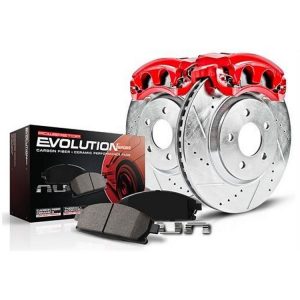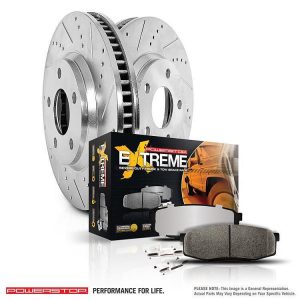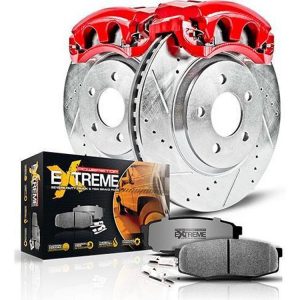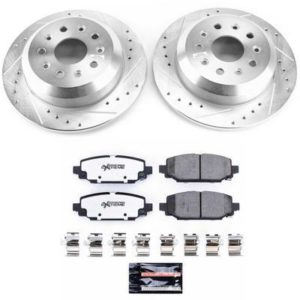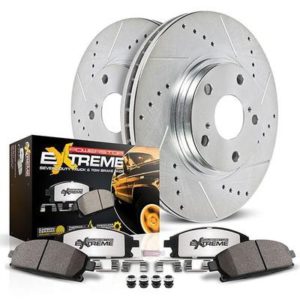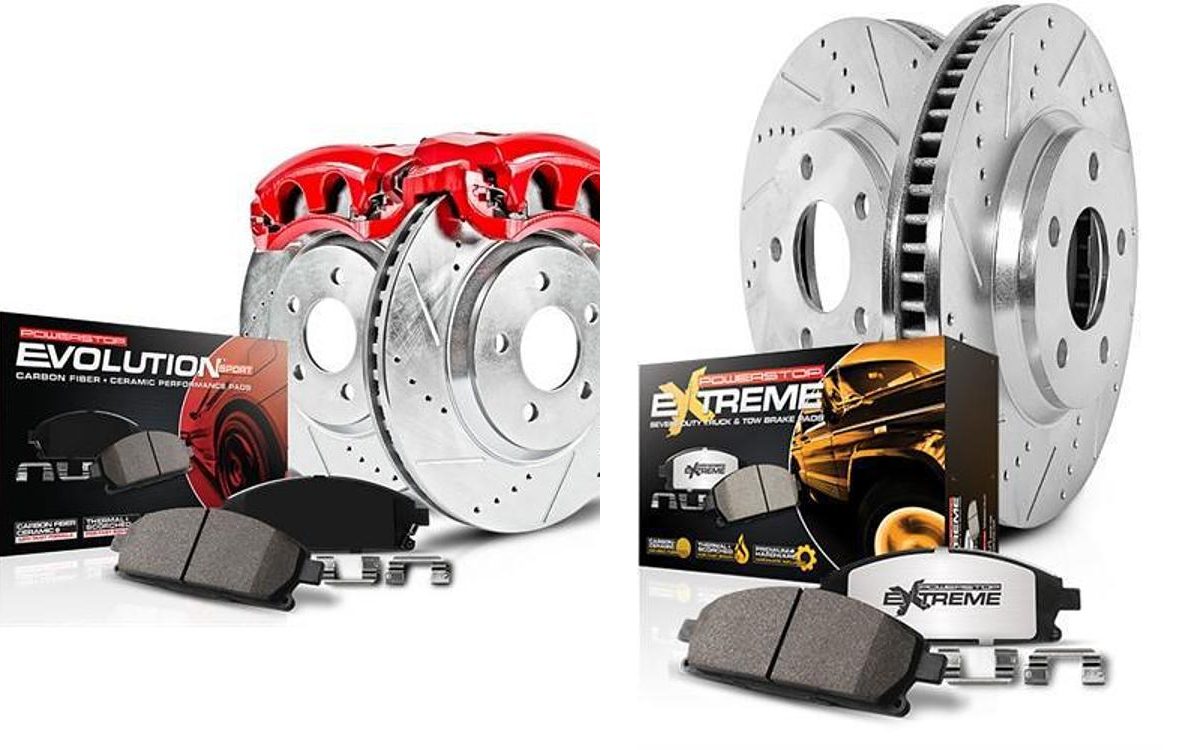
Power Stop Z23 vs Z36 is the question behind most brake-kit searches for a pickup or Jeep, and the answer is simpler than the part numbers make it look. Both kits put drilled, slotted and zinc-plated rotors on your truck with a carbon-fiber ceramic pad, premium hardware and a packet of hi-temp lubricant in the same box. The difference is the pad compound and what Power Stop built it to survive: the Z23 Evolution Sport is the daily-driver upgrade, the Z36 Truck & Tow is the kit for towing, hauling, mountain grades and lifted trucks on bigger tires, and the Z26 Street Warrior sits off to the side for high-horsepower street cars. Below: what each line is, what is in the box, which Power Stop kits fit which trucks, and how to bed them in.
Key takeaways
- Same rotor, different pad: Z23 and Z36 kits both ship drilled, slotted, zinc-plated rotors; the Z36 pad is a carbon-fiber ceramic compound strengthened to handle heavier loads, and it rides on stainless-steel shims instead of the Z23’s rubberized shims.
- Pick by load, not by badge: a stock-height truck that commutes gets the Z23; anything that tows, hauls, runs 33-inch or larger tires or lives on mountain roads gets the Z36.
- Same warranty: Z23, Z36 and Z26 kits all carry Power Stop’s 36-month, 36,000-mile warranty, rotor cracking included; the Z26 is a street-car kit, so for a truck the real decision is Z23 or Z36.
- Read the part number: a plain K number is a Z23 rotor-and-pad kit, a -36 suffix is Z36, -26 is Z26, KC adds powder-coated calipers and KOE is the Z17 stock replacement.
- Bed them in: Power Stop’s procedure is 5 stops from 40 to 10 mph, then 5 from 35 to 5 mph, no cooling between stops and no sitting on the pedal.
The Power Stop lineup in plain terms
Power Stop sells its kits by a Z number that names the pad compound, and the kit is built around that pad. Four lines come as complete kits, and a fifth is sold as pads.
- Z17 Stock Replacement (Autospecialty): an OE-style refresh. It comes with Z17 ceramic pads with a thermal-scorched surface, dual-layer rubberized shims, non-coated rotors that are 100% mill balanced, stainless hardware and lubricant, under a 24-month or 24,000-mile warranty. It is for daily driving and commuting when all you want is the stopping feel the truck had from the factory.
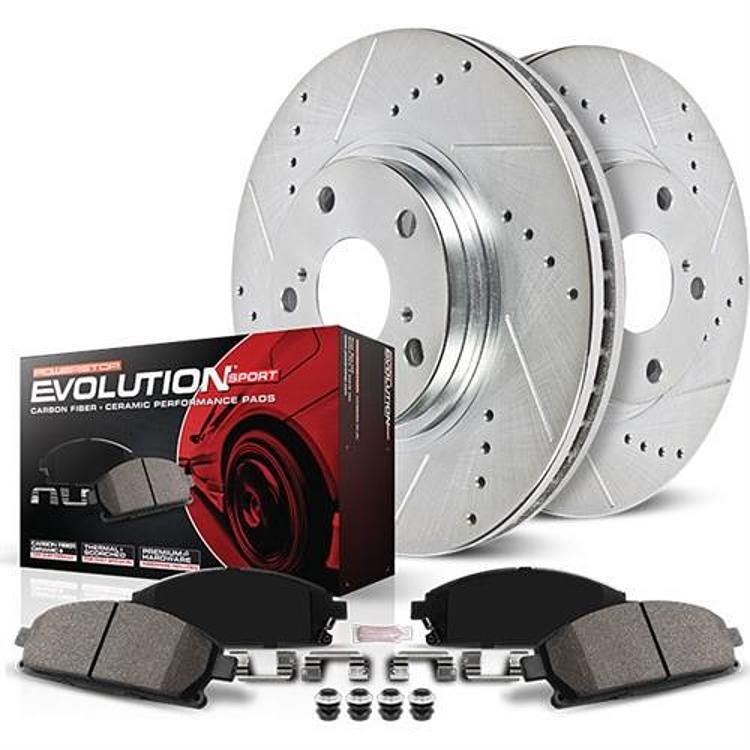
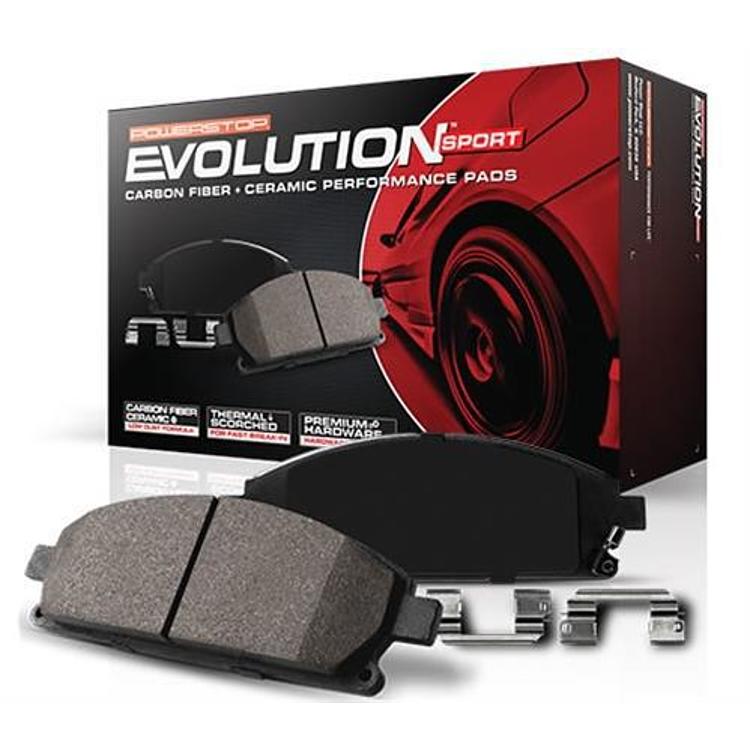
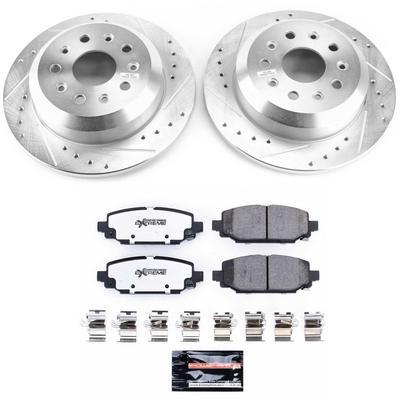
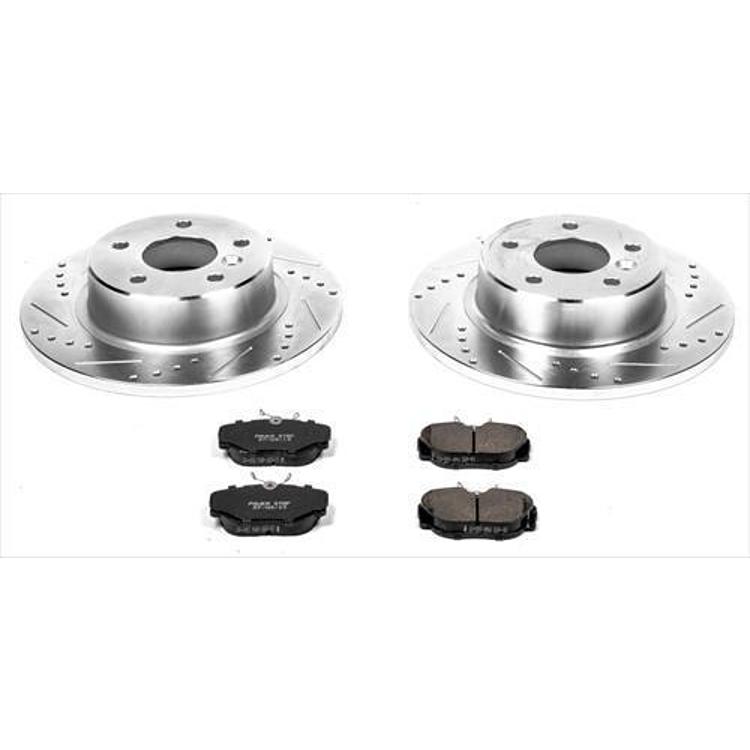
- Z23 Evolution Sport: the “Daily-Driver Upgrade” in Power Stop’s own words, recommended for daily driving and commuting in cars, trucks and SUVs. Carbon-fiber ceramic pads, dual-layer rubberized shims, drilled, slotted and zinc-plated rotors, stainless hardware and hi-temp lubricant.
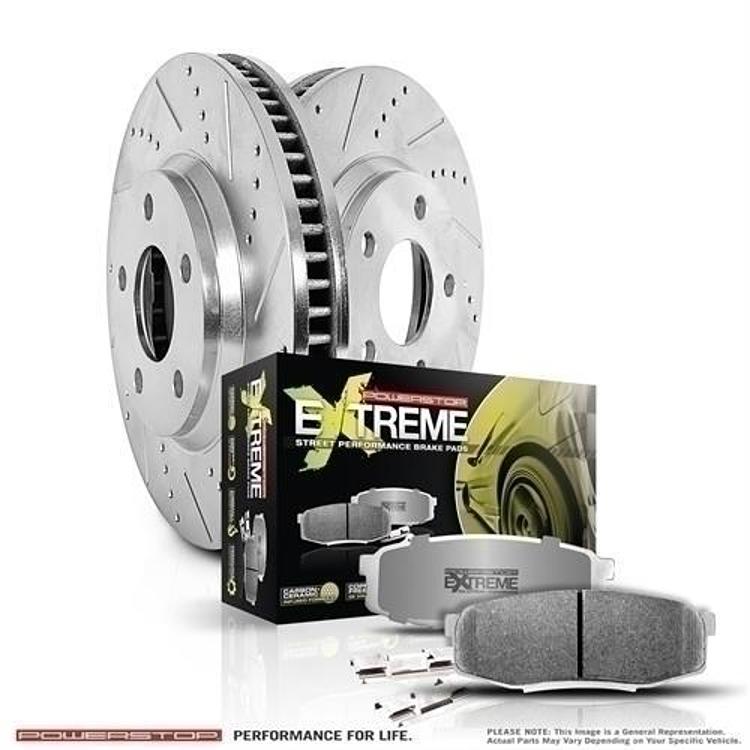
- Z26 Street Warrior: the performance street kit, recommended for high-horsepower muscle cars, modified vehicles and cars on bigger wheels. Carbon-fiber ceramic pads that shed heat better than a typical ceramic pad, stainless-steel shims, the same drilled, slotted and zinc-plated rotors.
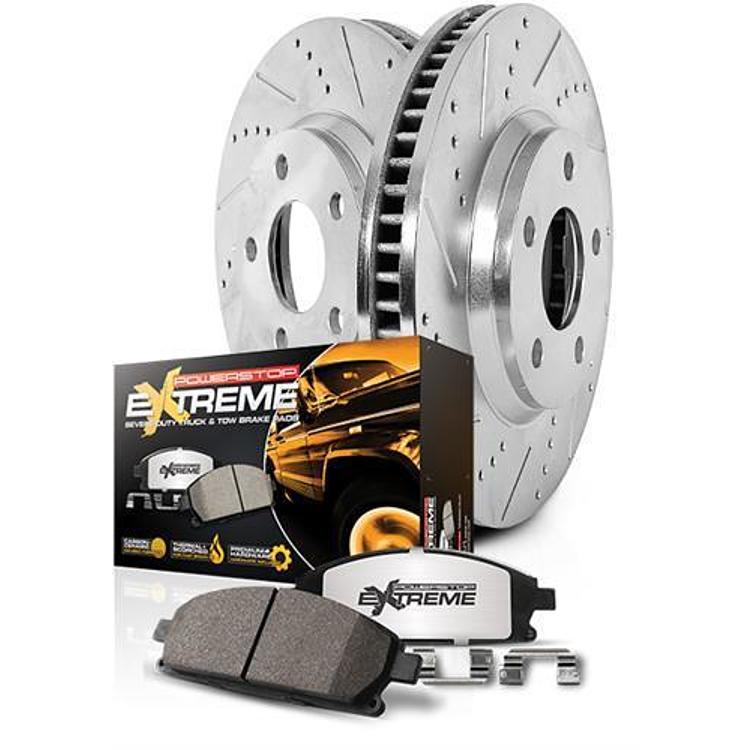
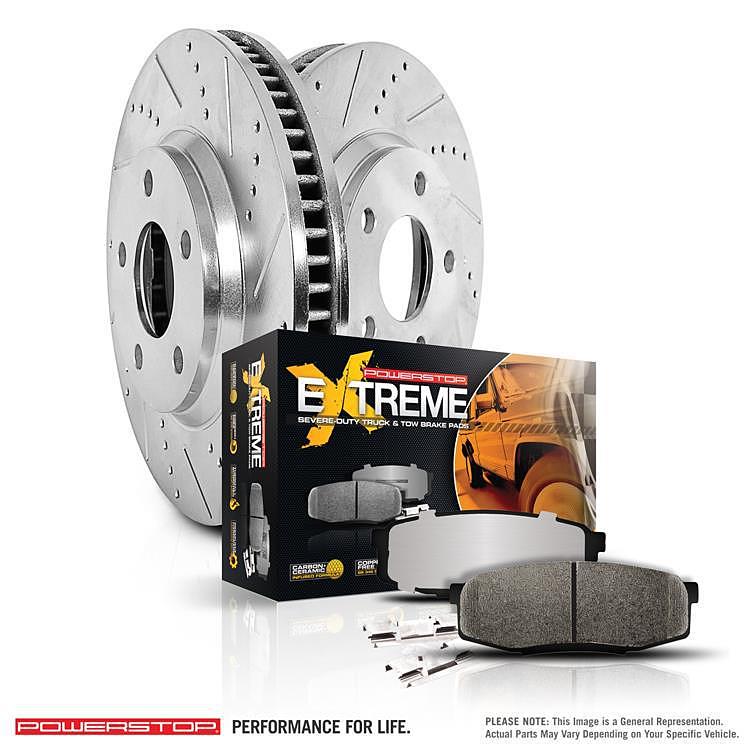
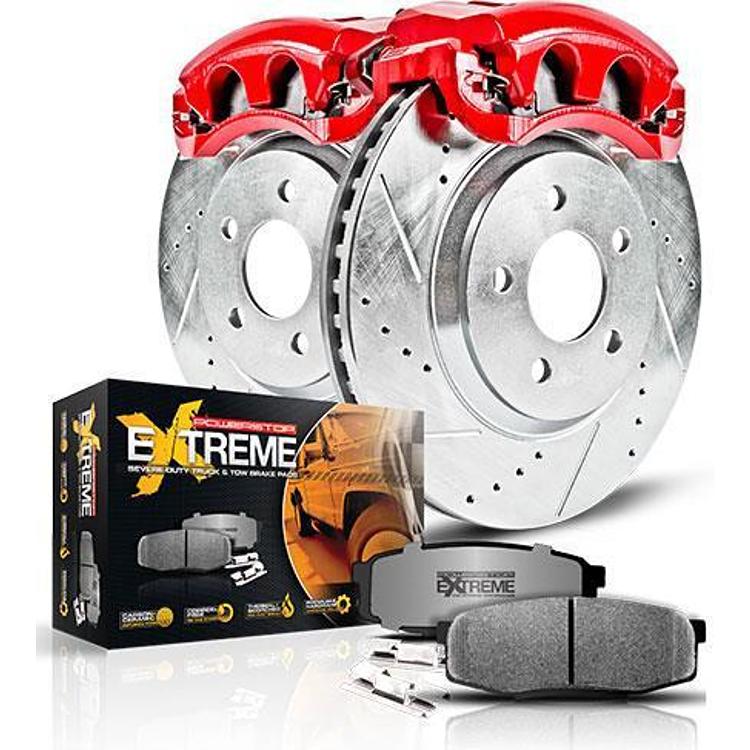
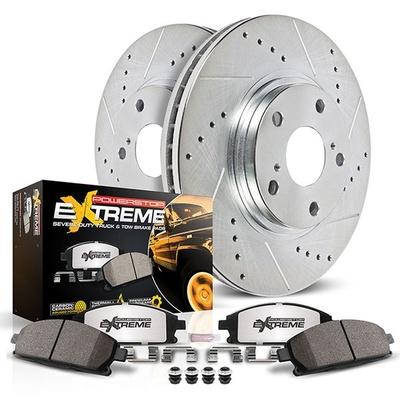
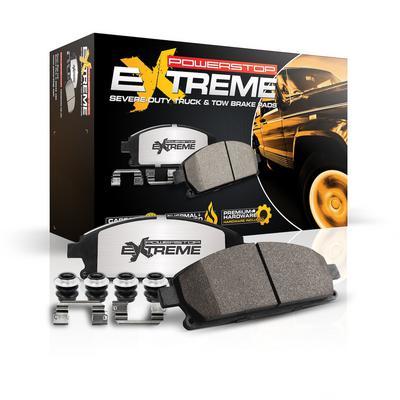
- Z36 Truck & Tow: “Severe-Duty stopping power designed for trucks & 4X4s” on Power Stop’s page, recommended for towing, hauling, big tire upgrades, mountain driving and off-road use. Carbon-fiber ceramic pads strengthened for heavier loads, stainless-steel shims, drilled, slotted and zinc-plated rotors, stainless hardware with a new pin bushing kit where applicable, and hi-temp lubricant.
- Z16 Evolution: a low-dust ceramic pad sold on its own, and the pad in a few older 1-Click drilled-and-slotted kits.
The Z23, Z26 and Z36 kits share one more thing: Power Stop backs each of them for 36 months or 36,000 miles, and the warranty text on all three pages says it includes rotor cracking while excluding normal wear and failures caused by disc thickness variation, the uneven wear that shows up as pedal pulsation. All three pages also describe a one-time 60-day exchange that depends on the break-in procedure having been followed, which is one more reason to do it properly.
What is in the box
Every Power Stop kit page carries the line “Everything You Need Is In The Box”: matched rotors and pads with the clips, springs and grease a bare pad set leaves you hunting for. Here is what comes in them.
- Rotors: drilled and slotted, cast iron, with a silver zinc plating for long-lasting rust and corrosion protection. The drill holes are beveled and the slots are rounded. Z26 rotors are named Evolution Tru-Cast and described as reverse engineered from OE samples, and the plating note adds “except hub and rotor assemblies,” which means a rotor that bolts in with its own hub comes unplated.
- Pads: a carbon-fiber reinforced ceramic formula in all three upgrade lines, with a thermal-scorched surface for faster break-in. The Z23 formula significantly enhances braking performance versus traditional ceramic brake pads; the Z36 compound is strengthened to handle heavier loads; the Z26 compound improves heat dissipation. The pads are chamfered and slotted like OE pads, and Z26 pads add powder-coated backing plates.
- Shims: dual-layer rubberized shims on the Z23 and Z17, premium stainless-steel shims on the Z36 and Z26. Rubber shims are the quieter choice at commuting temperatures; stainless shims are there to survive the heat a loaded truck puts into the caliper.
- Hardware: premium stainless-steel hardware in every kit, plus a new pin bushing kit “where applicable” on the Z36 and Z26. Many Z23 kits also include a pin bushing, so check the contents of the kit for your truck.
- Lubricant: a packet of hi-temp brake lubricant for the slide pins and pad contact points. Some Z23 kits label it ceramic brake lubricant.
- Not in the box: calipers (unless the part number starts with KC) and brake lines. Plan on reusing your brake lines or buying them separately.
Current Z36 pads are carbon-fiber ceramic. A few older Z36 kits, including the K6258-36 for the 2012–2018 GM HD trucks, ship with a Z36 high-friction metallic pad. If the compound matters to you, check the pad box when the kit arrives.
How to read a Power Stop part number
Power Stop’s part numbers follow a pattern that saves a lot of squinting at titles:
- K1234: a rotor-and-pad kit without calipers. A plain K number with no suffix is normally a Z23 Evolution Sport kit, but a few older 1-Click kits with plain K numbers carry Z16 pads, so check which pad the kit names.
- K1234-36: the same kind of kit with Z36 Truck & Tow pads. Titles vary (“Severe-Duty,” “Extreme Performance,” “Heavy Duty Truck and Tow”), but the -36 is what tells you the pad.
- K1234-26: Z26 Street Warrior pads.
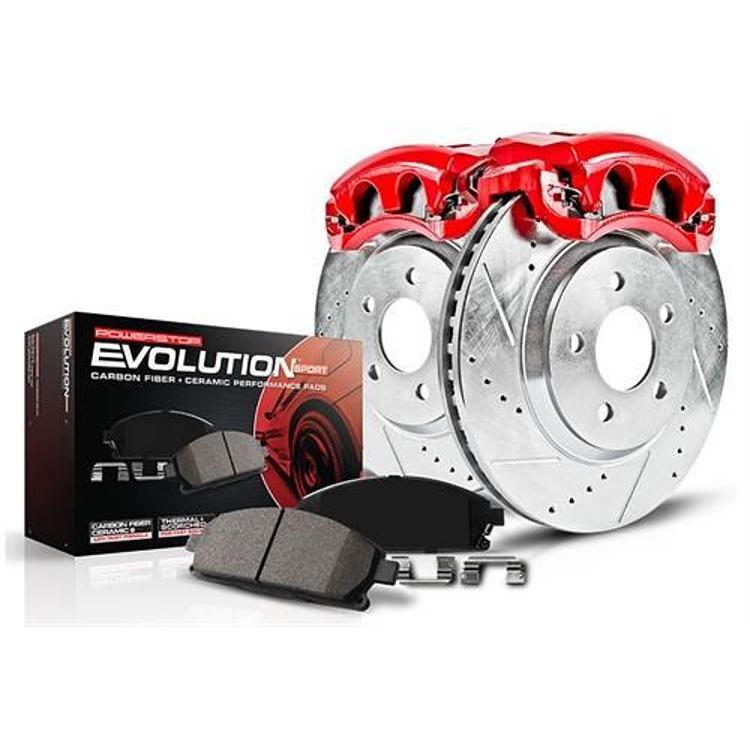
- KC1234 or KC1234-36: the kit plus powder-coated calipers (red on most kits). The “1-Click” in many titles is Power Stop’s name for these one-box kits.
- KOE1234: a Z17 stock replacement kit with non-coated rotors.
- Z23-1234 or Z36-1234: a pad set on its own, same number across both lines when the pad shape is shared. The F-150’s 2010–2018 front pad, for instance, is sold as both Z23-1414 and Z36-1414.
Z23 Evolution Sport: the daily-driver kit
The Z23 is the kit for a truck or SUV that is driven the way it left the dealer: commuting, errands, the occasional loaded weekend. Power Stop’s pitch for it is not stopping distance but manners. The page claims the carbon-fiber ceramic formula runs quieter and cleaner than traditional ceramic pads, with the low-dust claim “verified through 3rd party on-vehicle testing,” and gives no stopping-distance numbers.
What you get over a stock brake job is the rotor. Slots clean and de-glaze the pad face and give gas, water and dust somewhere to go; the drilled holes cut rotor weight and improve wet-weather bite. On a stock-height half-ton or a Wrangler on stock tires, that rotor paired with a quiet ceramic pad is a noticeable upgrade without changing how the pedal feels when cold.
Z23 kits lean toward cars and crossovers (Edge, Highlander, Cayenne, Q7), and for trucks and Jeeps the Z23 comes mostly as pad sets rather than full kits. The exception is the Wrangler JK: the KC3090 and KC3097 Z23 kits with calipers fit every 2007–2018 JK. For a JK on stock or 31-inch tires that does not tow, that is the right line.
Z36 Truck & Tow: for towing, hauling and bigger tires
Power Stop explains the reasoning in one sentence: adding weight by hauling a load, towing a trailer or fitting a larger wheel and tire combination changes the conditions your stock brakes work under, and those conditions may exceed what the stock parts can handle. The kit is “engineered to handle the added stress of towing, hauling, mountainous driving and lifted trucks.” The drilled rotor is there to keep temperatures down on long descents, and the Z36 pad is there to add the brake torque a heavier, taller-geared truck needs.
That tire point is the one most buyers miss. A lift kit and 35-inch tires raise the rolling radius, which gives the tire more leverage against the same rotor and caliper, and the extra unsprung weight has to be slowed on every stop. Nothing about the truck’s rating changed, but the brakes now work harder at every speed. The Z36 pad and the stainless shims are the parts of the kit aimed at that heat; a Z23 on the same truck will stop it, but it will run hotter than it was designed to and wear faster. If you are shopping shocks for the same lifted truck, the Bilstein 5100 vs Fox 2.0 comparison covers the other half of that build.
In practice the Z36 pads run warmer, so expect them to feel firm rather than grabby when cold, and bed them in before the first loaded trip.
Z26 Street Warrior: where it fits
The Z26 is the odd one out for a truck site. It is built for high performance, high horsepower muscle and modified cars: muscle cars, modified vehicles, performance vehicles, increased horsepower and bigger wheels. The Z26 kits for trucks and SUVs are few: one is for the 2008–2017 INFINITI EX and QX50, the other, K1482-26, is a front kit for the 1982–1995 S10, S10 Blazer, El Camino, S15 Jimmy and Sonoma.
The Z26 pad is built like a performance pad: a carbon fiber and ceramic hybrid with a higher coefficient of friction than OE, powder-coated backing plates, stainless shims, and fade resistance to 1,500 degrees “per Power Stop.” That heat tolerance is about repeated hard stops from speed, which is a different job from holding a trailer back on a grade. For a towing truck the Z36’s load-strengthened compound is the better match; for a sports sedan on 20-inch wheels the Z26 is.
Z23 vs Z36 vs Z26 compared
| Feature | Z23 Evolution Sport | Z36 Truck & Tow | Z26 Street Warrior |
|---|---|---|---|
| Power Stop’s label | Daily-Driver Upgrade | Severe-Duty, for trucks and 4X4s | Extreme Street Performance |
| Recommended for | Daily driving, commuting; cars, trucks, SUVs | Towing, hauling, big tire upgrades, mountain driving, off-road | Muscle cars, modified and performance vehicles, bigger wheels |
| Pad compound | Carbon-fiber ceramic | Carbon-fiber ceramic, strengthened for heavier loads | Carbon-fiber ceramic, tuned for heat dissipation |
| Shims | Dual-layer rubberized | Premium stainless steel | Premium stainless steel |
| Rotors | Drilled, slotted, zinc plated | Drilled, slotted, zinc plated | Drilled, slotted, zinc plated (Evolution Tru-Cast) |
| Hardware | Stainless hardware, hi-temp lubricant | Stainless hardware, pin bushing kit where applicable, hi-temp lubricant | Stainless hardware, pin bushing kit where applicable, hi-temp lubricant |
| Part number | K####, KC#### with calipers | K####-36, KC####-36 with calipers | K####-26, KC####-26 with calipers |
| Warranty (Power Stop) | 36 months / 36,000 miles | 36 months / 36,000 miles | 36 months / 36,000 miles |
The table makes the pattern obvious: the rotor, the hardware and the warranty are constant across the three upgrade kits, and the pad and shim are the whole decision. The Z17 sits below all three with non-coated rotors, rubberized shims and a 24-month, 24,000-mile warranty, which is why it is the stock-replacement option rather than an upgrade.
Front, rear or both axles
Power Stop sells each line as a front kit, a rear kit and, on many applications, a front-and-rear kit, also called a 4-wheel set. The front axle does most of the stopping on a light truck, so front kits outnumber rear kits and front pads wear first. Three rules keep the job balanced:
- Front-only is fine when the rears are healthy. Check rear pad thickness and the rotor face before ordering a front kit; a fresh front axle on a worn rear one shifts the balance under hard braking.
- Rear kits matter more on a tow rig. The rear axle carries more of the stop when a trailer or a loaded bed is pushing on it. Power Stop makes Z36 rear kits for exactly that reason: the K7943-36 rear kit for the 2018–2021 Wrangler JL, the K1890-36 rear kit for the 1999–2004 F-250 and F-350 Super Duty, and the K2197-36 rear kit for the 2003–2006 Wrangler TJ and LJ.
- Do not mix lines on one axle. The rotors and pads in a kit are matched, so install them together. Running a Z36 pad against a worn stock rotor, or a new rotor against half-worn pads, wastes the bed-in and often brings judder.
Which kit fits your truck
These kits and pads fit these trucks. Confirm your exact year, model and brake size with Power Stop’s fitment lookup before ordering, because one model year often has two rotor diameters.
- Jeep Wrangler JK (2007–2018): the Z23 kits with calipers KC3090 and KC3097 cover every JK year. Pads: Z23-1273 and Z23-1274, and Z36-1274 for a JK on 35s.
- Jeep Wrangler JL (2018 on): the Z36 rear kit K7943-36 for 2018–2021, and the Z36-6005 rear pads with hardware listed through 2026. There is no Z23 or Z36 front kit for the JL.
- Jeep Wrangler TJ and LJ: the Z36 rear kit K2197-36 for 2003–2006, a Z36 kit with calipers for the 1999–2006 TJ, and Z23-477 or Z36-477 pads back to the 1997 TJ and the 1990–1995 YJ.
- Jeep Gladiator: There is no Z23, Z36, Z26 or Z17 part for the Gladiator.
- Toyota Tacoma: pads only, no kits. Z23-976 for 2005–2018 and Z23-389 or Z23-436 for 1995–2004; the only Z36 pad listed is Z36-436 for the 1995–2004 truck. There is no Z36 pad for the 2005 and later Tacoma.
- Toyota Tundra: pads only. Z23-1303 and Z23-1304 or Z36-1303 and Z36-1304 for 2007–2018, and Z23-976 for 2000–2006.
- Toyota 4Runner: the Z36 front-and-rear kit K15095DK-36 for 1995–2000; Z23-606 and Z23-976 pads for 2003–2018; Z36-436 pads for 1995–2002. No Z36 pad for the 2003 and later 4Runner is listed.
- Ford F-150: Z36 kits with calipers KC1939A-36 and KC1943A-36 for 2005–2008, the Z36 front-and-rear K15089DK-36 for 1990–1993, and the Z17 front kit KOE3167 for 2010–2020. Pads: Z23-1414 or Z36-1414 (2010–2018), Z23-1602 or Z36-1602 (2012–2018), Z23-1012 or Z36-1012 (2004–2011) and Z36-1790 rear pads (2015–2020).
- Ford F-250 and F-350 Super Duty: Z36 kits K6403-36 (2013–2018 F-250, 2013–2017 F-350), K5575-36 (2010–2011), K1781-36 front (2005–2008 F-250, 2005–2011 F-350) and K1890-36 rear (1999–2004). Pads: Z36-1680 and Z36-1691 for 2012–2018, Z36-1333 for 2008–2012, Z36-1067 through Z36-1069 for 2005–2011, and matching Z23 numbers for most of those years.
- Chevrolet Silverado and GMC Sierra 1500 (2007–2018): the Z36 kit with calipers KC2069-36, which also lists the Tahoe, Yukon, Suburban, Avalanche and Escalade of those years. Pads: Z23-1363 or Z36-1363 for 2007–2018, Z23-1707 for 2014–2018.
- Silverado and Sierra 2500 HD and 3500 HD: the Z36 front kit K6258-36 for 2012–2018 and the KC2071-36 kit with calipers for 2001–2010.
- Ram 1500: the Z36 kit with calipers KC2172-36 for the 2002–2010 Dodge Ram 1500 and the 2011–2018 Ram 1500. Pads: Z23-898 or Z36-898 (2002–2018) and Z23-1084 or Z36-1084 (2006–2018).
- Ram 2500 and 3500: pads only for 2011–2018 (Z23-1399, Z23-1400, Z36-1399, Z36-1400) plus the Z17 kit KOE5490 for the 2003–2008 Dodge Ram 2500 and 3500.
Two things stand out. For most trucks the Z36 is the line with the kit and the Z23 comes as pads, which is Power Stop reading its market: the full-kit buyer for a pickup is usually the one who tows. And the newest trucks are thin or absent here, so a current-generation owner should start from Power Stop’s own lookup. The Wrangler, Bronco and 4Runner comparison covers the rest of what those platforms need.
Break-in: Power Stop’s procedure
New pads and new rotors need a transfer layer of pad material on the rotor face before they work as designed, and Power Stop makes the procedure a condition of its 60-day exchange. Its support page, “What is the Break-In Procedure?”, opens with the warning that proper pad bedding can prevent performance issues, and gives these steps for new pads on drilled and slotted rotors, which is what every Z23, Z36 and Z26 kit is:
- Five moderate to aggressive stops from 40 mph down to 10 mph in rapid succession, without letting the brakes cool and without coming to a complete stop.
- Five moderate stops from 35 mph down to 5 mph, again in rapid succession without cooling. Expect to smell resin as the brakes heat up.
- Cool down: drive for about 5 minutes at moderate speed without heating the brakes and without coming to a complete stop, so the heated resin in the pads cools and cures.
- Normal use once the brakes are back to standard operating temperature.
The warning in the middle of that page is the part people skip: if you are forced to stop during the procedure, shift into neutral or leave room so the truck can roll slightly, because holding the pedal down with hot pads lets the pad imprint the rotor and that imprint becomes judder. Coated-rotor and track kits have their own procedures, so the instruction sheet in your box governs if it differs from the steps above.
Do the procedure unloaded, on an empty road, before the trailer goes on: bed in a Z36 kit before the first tow. A few other habits make the kit last:
- Clean the hub face before the rotor goes on. Rust scale between hub and rotor hat causes runout, and runout on a new rotor shows up as pulsation within a few thousand miles, which the warranty excludes as disc thickness variation.
- Service the calipers. The kits reuse your calipers unless you bought a KC kit, so clean and lubricate the slide pins with the supplied grease and check the piston boots. A sticking caliper drags one pad, overheats a new rotor and wears the set unevenly.
- Flush old fluid. Moisture lowers its boiling point, and a long grade with a trailer is where you find that out. Power Stop’s warranty text excludes damage from DOT 5 silicone fluid, so stay with what your truck specifies.
- Re-torque the wheels after the first short drive, and look for hairline cracks from the drill holes at every pad change.
Which one for you
- Stock-height daily driver, no trailer, tires within an inch of factory: Z23 Evolution Sport. You get the drilled and slotted rotor, the quiet low-dust pad and the hardware, and the rubberized shims keep it the quietest of the three. If your truck has no Z23 kit listed, Z23 pads on your existing good rotors are the next best thing, or a Z17 kit if the rotors are done.
- Anything that tows or hauls, or any lifted truck on 33s or bigger: Z36 Truck & Tow, and do both axles if the rears are tired, because the rear carries more of the stop with a trailer. This is the kit for the Super Duty, the HD GM trucks, the Ram 1500 that pulls a camper and the JK or JL on 35s.
- High-horsepower street car or a hot-rodded S10: Z26 Street Warrior, which is built for repeated hard stops from speed rather than sustained load.
- Not sure, and the truck does both jobs: Z36. The penalty for a Z36 on a truck that rarely tows is a firmer cold pedal; the penalty for a Z23 on a truck that does tow is heat and wear, and that is the worse mistake.
Frequently asked questions
Is the Z36 overkill on a truck that never tows?
Not if the truck is lifted or on larger tires. Power Stop names big tire upgrades and mountain driving alongside towing and hauling as what the Z36 is for, and a 35-inch tire works the brakes harder on every stop whether or not there is a trailer behind it. On a stock truck that commutes, the Z23 is the better match: its rubberized shims and daily-driver pad run quieter, and the Z36’s firmer cold pedal buys you nothing you will use.
Can I run Z36 pads with Z23 rotors, or Z36 pads on my stock rotors?
The rotors in the Z23 and Z36 kits are the same design, drilled, slotted and zinc plated, and Power Stop sells the pads separately under their own numbers, so pairing Z36 pads with a Power Stop drilled and slotted rotor is how most owners of trucks without a Z36 kit get there. Putting any new pad on a worn stock rotor is the combination to avoid: the kits are sold as matched sets, rotors and pads are meant to be installed together, and a new pad bedded onto a grooved or lipped rotor never builds an even transfer layer.
Do drilled rotors crack?
Drill holes are where a hard-used rotor shows cracks first, so look for hairline cracks radiating from the holes at every pad change. Power Stop’s beveled holes are meant to reduce that, and its 36-month or 36,000-mile warranty on the Z23, Z36 and Z26 kits explicitly includes rotor cracking, so a cracked rotor within that window is a warranty claim. Normal wear and pulsation from disc thickness variation are excluded, which is why a clean hub face and a proper bed-in matter.
What is the difference between a “Severe-Duty,” “Extreme” and “Heavy Duty Truck and Tow” kit?
Nothing in the pad: all three titles sit on part numbers ending in -36, and all three use the Z36 Truck & Tow pad. The titles come from different years of Power Stop packaging. What does change is the suffix and prefix: a K kit is rotors and pads, a KC kit adds powder-coated calipers, and a kit titled front, rear or front-and-rear covers that axle only.
Does Power Stop make a Z36 kit for the Jeep Gladiator or the 2005-and-up Tacoma?
No. There is no Power Stop Z23, Z36, Z26 or Z17 part for the Gladiator, and the only Z36 part for the Tacoma is the Z36-436 pad for the 1995–2004 truck; the 2005–2018 Tacoma takes Z23-976 pads. Check Power Stop’s fitment lookup for newer parts.
Pick the line by the load the truck carries, match the part number to the axle, and bed the kit in before the first trailer. The full range is in the disc brake pad and rotor kits category, with the standalone drilled and slotted rotors and brake pads for trucks that take only a pad; the broader disc brake kits and components landing page covers calipers, caliper brackets and the other brake brands if Power Stop makes no part for your year.
Sources
- Power Stop, Z23 Evolution Sport Brake Upgrade Kit: kit contents, intended use, warranty and return terms.
- Power Stop, Z36 Truck & Tow Brake Upgrade Kit: kit contents, “Great For” list, pad description, warranty.
- Power Stop, Z26 Street Warrior Brake Upgrade Kit: kit contents, intended use, warranty.
- Power Stop, Z17 Stock Replacement Brake Kit: non-coated rotors, Z17 pads, 24-month warranty.
- Power Stop, What is the Break-In Procedure?: the bedding steps quoted above.
- Power Stop, Z36 Truck & Tow Carbon-Fiber Ceramic Brake Pads: the Z36 pad sold on its own.